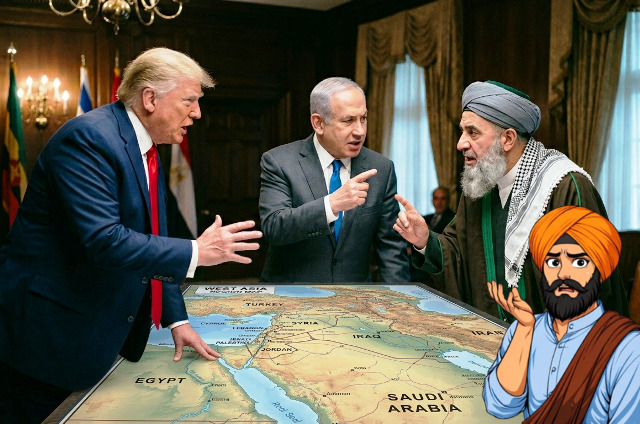
Will The ‘Real God Shady’ Stand Up Please

Every time I watch the news on the Iran-US-Israel war, the song Real Slim Shady comes to my mind, however much I try to block it and search for serious reasons for this war. Consequences, yes but reasons, I am struggling so much.

There is the Israel Zionist movement with its prophecy of end of days. For some of them the whole project of Israel is based on a promise of some real estate by God during times when there were no estate agents, stamp duty or municipal tax let alone mortgages! I have researched endlessly in all the search engines and I can’t find God and God Property Dealers Unlimited, your friendly real estate agent. Or even God and Son or God and daughter! (Even God may have thought ahead of being PC in the age of feminism).

So when was the land made available for a bid and when did the sale take place without exchange of money, isn’t recorded. At least no documents exist on Wikiancient. Apparently, the only condition was that the Jews accept God as the only god and no one else. During those days there was a lot of competition and a great number of an ancient form of spam mail or ID hacking by wannabe gods. Many entities claimed to be messiahs with direct line to God the Big one even through Trump wasn’t even born then.

Israel is on a mission to get that land back in order for the messiah to come down and then the bad world ends giving way to better times! It seems Netanyahu is speeding to bring the date of ‘end of times’ forward stacking up a lot of deaths on the way to have his name etched in history.

But there is another group who have a claim on God’s time or a sort of promise that God allegedly made to mankind (not sure to woman kind and gender assignment kind). This group is the ‘real Christians’ as they call themselves. They now mostly live in the Yuunited Staetus of Ammerikaa. They believe the end of days is nigh, when a rupture will occur in time and space and all the good Christians (the pious ones who have been encouraging death and destruction of unbelievers) will get through. They just need someone to push red nuclear button to bring end of world. They keep on voting red neck American billionaires only to be disappointed. They tried hard during the Iraq war with the help of some mad hat neocons, but the Bush family wasn’t quite ready to travel through this rapture. Besides, there weren’t enough space Ubers at that time. In fact, there were probably none, especially not the self-driven ones.

You don’t want a non-Christian Uber driver (immigrant to US) taking the ‘pious’ through the US Rapture Highway 1 only to be returned at the toll booths or Heaven’s immigration, because the driver is not one of the pious. “Go find a pious driver, or don’t come back!” God’s Heavenland Security immigration officer might thunder! Goddo’s HS Department officers can be even more intimidating than Amerikan immigration officers and worse than Amerikan Homeland Security bods. Believe me, that is possible. Some of the leaders of the hopeful rapturists have been laying hands on Trump’s head and forehead to cajole him to get on with the war. But perhaps because of the Orange wig, the hands are not getting the divine message through. Some want nuclear holocaust and hallelujah, time and space will open up for them.

And there is a third group. Also pious and sure that they are the privileged ones favoured by God. These are the Muslims who also think the Mahdi is coming around this time who will get rid of the infidels make the land sacred again and then curtains open, God will show up. The dead will rise and the good ones will cross over to heaven to enjoy a permanent package holiday which never ends. They were promised this by none other than, yes God Himself!. They too have to bring about the circumstances for the Mahdi and for this great event to happen. Heathens, Kaffirs or infidels like me will be too late to convert and will end up in that permanent hell holiday where hotels are booked but not built, cars continue to have punctures, road have potholes  and the food causes food poisoning with no toilets around due to waiting too long for the delivery boy. Many among the branch of Shia are waiting for the Mahdi. Some Sunni groups are trying to outrace them.

So we have three communities with a lot of ‘death inducing kit’ like missiles and bomber planes and minds with hate, each promised by God the shady, who has never shown his face since Eve came on the scene. According to all three, Adam used to have regular fire side conversations with God. Then Adam asked for a companion. And God created Eve from the spare rib that he had put in man for occasional repairs, just like a spare tyre. Adam instead traded the spare rib for Eve (good bargain bad bargain, only a married man can say). But as soon as Eve showed up, God went into hiding!

Ever since that day, God the He, has given all these promises or insurance policies to mature around this time. It was supposed to be 2000 AD but all prophecy purveyors forgot that the promises were based on the lunar calendar and not the Gregorian one.

This war might end if the real God the shady stands up and tells the world, which promise He really made and whether He did really make a promise. Until then we have three suicidal people dragging all the rest of us into this story. I at least don’t trust driverless Ubers and want to enjoy my pension before end times.

Yet it doesn’t end there. There is an entire Hindu theory about the four juugs. Some Rishi with his Chela is supposed to end this Kaliyuug with something quite powerful. Could be Trump and Putin with all the nuclear arsenal. The big puzzle with all above is, what will happen to the unborn man who leads a large State. Of God it is said, ‘He is neither born nor can He die’. Does it also apply to small h, ‘he is neither born, therefore cannot die’. Except through voter cards maybe!.

A Lantern in Stark Daylight

“Have you ever heard of the madman who on a bright morning lighted a lantern and ran to the market-place calling out unceasingly: “I seek God! I seek God!” …”Where is God gone?” he called out. “I mean to tell you! We have killed him,—you and I! We are all his murderers!
Friedrich Wilhelm Nietzsche, The Gay Science 

Is the war over?

Can wars ever be over?

Will they ever stop killing children and mothers?

With a terrible economic crisis stalking the world, and the gulf economy in shambles, is this mindless war Donald Trump was trapped into by Israel and his ‘crusading aides’ – finally over? 

Like the fake ceasefire and bombings in Gaza, will it go on and on, with Iran refusing to bend or crawl?

With a beleaguered Trump shifting ground on the war, first he said it will be only for four to five weeks, then, five/10 days of no attacks on power plants, after Iran said it will do a tit for tat in its already devastated neighbourhood of stooge regimes.

Then, “we have won the war” – game over. And, finally, the White House spokesperson, Karoline Leavitt, said in a kind of Hegelian dialectic turned upside down, that Iran should realise that they have lost the war. 

According to a Reuters report, she said, President Trump does not bluff and he is prepared to unleash hell. “Iran should not miscalculate again,” Leavitt told reporters in a press briefing. “If Iran fails ⁠to accept the reality of the current moment, if they fail to understand that they have been defeated militarily, and will continue to be, President Trump will ensure they are hit harder than they have ever been hit before,” she said.

The report stated: Iran is still reviewing a US ⁠proposal ⁠to end the war, despite an initial response that was negative, a senior Iranian official told Reuters, indicating that Tehran had so far stopped short of rejecting it outright. Talks with Iran were still under way, Leavitt said. “Talks continue. They are productive, as the president said on Monday, and they continue to be,” she added.

Talks were on before the war as well, with Oman as moderator, with Iran agreeing to the most difficult demands: no nuclear enrichment, inspection by IAEA, while US sanctions should end. Every impartial observer in the American establishment has categorically stated that there was “no imminent threat” from Iran, including Joe Kent, who recently quit as the head of the US National Counterterrorism Centre. “I cannot in good conscience support the on-going war in Iran. Iran posed no imminent threat to our nation, and it is clear that we started this war due to pressure from Israel and its powerful American lobby,” he announced in a social media media.

The latest flip-flop is Trump is saying he is ready to end the war, and it does not matter if the Strait of Hormuz is open or shut.

Trump said in a Tweet, and he has been repeating this: The Iranian Air Force is gone. The Navy is gone. Many ships SUNK. Total OBLITERATION.

So, pray, how come US stealth aircrafts, worth billions (one shot in Saudi Arabia, experts say, will cost $700 million now), its war carriers, its military bases in the Gulf, have been destroyed? How come all airports are shut and millions stranded, including Ben Gurion airport in Tel Aviv? So how many oil tankers and other installations of the Gulf nations have been blown up?

How is Tel Aviv so ravaged, and also Haifa, with its nuclear installations apparently hit, and scores of its generals eliminated? One report said that the Israel army chief has said that his force is totally demoralised and weakened – that it’s just not possible to carry on. Besides, when the US is sending troops on the ground (“to die for Israel”, as is the folklore in America), why is Israel refusing to put their own troops on the ground?

Surely, with troops on the ground, the US should remember Vietnam – the two-decade war they waged against a small, poor country, so far away. The mighty US lost.

Thousands of marines, having murdered ordinary folks without impunity, as in the My Lai massacre, were trapped forever in a post-traumatic stress disorder. For an elementary lesson, Trump and Pete Hegseth should watch Coppola’s Apocalpse Now, orOliver Stone’s Platoon.

Now, if the US has won the war and if that is so, the war has indeed seen its gory end, and Iran has been decimated. Is it so?

In the last and recent 12-day war, with, again, the Israelis as the sinister plotter, Trump claimed to have bombed the hell out of the Iran nuclear reactors, after an uprising which the MOSSAD tried to manipulate. It got exposed, and eliminated thereby, while this authentic restless movement against economic hardships was compelled to fizzle out.

Come to think of it, it’s a strategy they have applied umpteen times and exactly what they are trying out in Cuba now, with no success. Sometimes they succeed, at other times they fail miserably – and it’s funny that their crusaders do not even choose to change this squeezed- out strategy.

First, prolonged, endless, terrible sanctions for decades, crippling the economy, creating mass suffering and social unrest, propelling thereby civil society protests; then arrange the diabolical entry of MOSSAD and CIA, entrenched in ‘enemy’ countries.

Soon after, starts an orchestrated media campaign — of how democracy is being restored. In Iraq it was the mythical WMDs, and in Iran it is pro-democracy ‘regime change’.

The women’s freedom card failed, with the war starting with a trademark Israeli signal: 170 school children murdered by a Tomahawk missile fired from a naval destroyer.

(The two navy officers who did it have been identified, like the IDF officers who pumped 355 bullets into six-year-old Hind Rijab’s body, trapped in a car with dead relatives in Gaza.)

Besides, if they had bombed the hell out of all the nuclear reactors in the 12-day war, what was the ‘imminent threat’ this time?

Epstein Files?

The everyday sleazy revelations of a grotesque Paedophile Establishment? With Epstein operating as a confirmed Mossad agent!

Or, was it because after getting away with yet another genocide in occupied Palestine, the “war criminal” in Tel Aviv, an international pariah, and his fanatic extreme-right cabinet, now aimed to go for its most favourite civilizational project: Greater Israel, with a ‘regime change’ in the only country in the Middle East which has refused to succumb. All they wanted is another stooge regime in Tehran.

Hence, Trump was trapped, with his Zionist son-in-law, a real estate businessman, playing the negotiator/strategist, and another Zionist white supremacist, with a crusader’s cross tattooed on his chest (Trump’s secretary of war) — pumping for war.

As if war is a mindless video game.

The fact is as long as the ‘Axis of Evil’ is around, forcible occupation, full-scale banditry, mass murders of innocents, targeted killing of school children, military or ‘peaceful coups’, assassinations of elected leaders, among other total violations of international law will continue.

The latest is the abduction of a president and his wife, in the middle of the night, from their bedroom. For this evil Axis, this has been done ad infinitum, this was normal before, and this is post-normal now, like ‘Truth Social’ — Trump’s aptly named Twitter handle.

However, the truth is that with 8 million people marching against him across America last week and his approval ratings abysmally low, a trapped Trump wants to desperately wriggle out of this war in which he and Bibi have been decisively decimated.

If anything, it has shown the world, yet again, what an Iranian propaganda video is now showing, going viral: From Vietnam to Iran and Cuba, from Nelson Mandela to Hind Rijab, from Hitler to Mussolini – when your time is up, you don’t have to hold a lantern in bright daylight to see it.

Like Neitzsche’s mad man — with a lantern in the middle of a market place, in stark daylight.

‘Iran Has Forced The Global Hegemon US To Eat Humble Pie’

Dr Yasir Ali Mirza,a Visiting Research Fellow at IPSA, New Delhi, says Iran’s retaliation against the US has exposed the vulnerabilities of American military might. His views:

Iran is facing the most dangerous existential threat since the Islamic Revolution in 1979. The on-going US-Israeli invasion has significantly escalated the situation in the Islamic Republic. It is facing maximum pressure, yet, is successfully intact after days of military onslaught. Latest media reports suggest that Tehran has forced the US to eat humble pie in this battle of nerves and firepower.

Iran survived the initial shock of the targeted killings of their Supreme Leader Ayatollah Ali Hosseini Khamenei and other top leaders and military commanders; it responded swiftly. The second whammy came when the Secretary General of the Supreme National Security Council, Ali Larijani, was killed in unprecedented strikes as it sparked the concern about its future. Iran, historically, has been capable in dealing with these extreme scenarios with grit and resilience.

Iran is at a critical juncture, and is pushed against the wall. Iran has survived the initial shock, but the coming days will determine how it can weather this storm, or, if the accumulated pressure of war, geopolitical posturing, economic hardship and internal disturbances will ultimately prove insurmountable. The present scenario suggests that these factors are creating uncertainty and a protracted conflict scenario in the Middle East.

Since the beginning of the Cold War, the US has acted as a self-appointed global hegemon, dominating international security and economic spheres through approximately 800 military bases worldwide, facilitated by its notorious Military Industrial Complex (MIC). Washington’s singular objective has been the security of the Zionist entity — Israel. Iran remains the only obstacle to Israel’s territorial ambition to dominate the region and extend its influence beyond its present geographical boundaries. In turn, Israel provides the US with a strategic foothold in the region.

Netanyahu has been demanding military intervention since the early phase of the Islamic Revolution. He is the main lynchpin behind Trump’s mindless war. This serves two interests: Israel’s expansionist policies and regional geopolitical ambitions, with the US maintaining its strategic and energy interests in the region. Decimating Iran’s capabilities, or achieving regime change, followed by the decline of the ‘Axis of Resistance’, would permanently shift the balance of power in their favour.

The pre-emptive attack, justified on the pretext of an imminent Iranian nuclear threat amid diplomatic negotiations, is merely an excuse to legitimise the invasion. This war is absolutely illegal, lacking any basis under international law or sanction from any global forum. Trump now finds himself strategically isolated, facing a prolonged conflict with no clear exit, while NATO and EU allies are unwilling to help.

Iran’s effective retaliation against the US military bases and other installations has exposed the vulnerabilities of the so-called US military might. The security guarantees it once extended to its allies in the Gulf Sheikhdoms now seem hollow, leaving them exposed and abandoned, and forced to choose between an isolated US and a retaliatory Iran. Multiple strikes on Gulf energy infrastructure has expanded the war into a regional theatre, advancing a strategy of attrition aimed at undermining the economic viability of sustained US presence.

The MAGA support base is likely to crumble. The dynamics of regional geopolitics have already changed by Iran’s defiance. It has challenged the limits of uni-polarity.  Trump’s military adventure may well prove to be the Waterloo of the American Empire. In its wake, a new world order is likely to emerge, one defined by multi-polarity that has long been on the horizon.

Despite damage inflicted by Iran, Israel’s strategic posture is likely to remain assertive. The Paradoxically, the on-going instability can consolidate its illegal occupation of Palestine. It remains engaged against Hezbollah to deter resistance from the Lebanese Shia Movement along its northern border. In the West Bank, sustained military operations and continued settlement activity reflect long-term security concerns.

In Syria, following the removal of Bashar al-Assad, actors such as Hayat Tahrir al-Sham (HTS) and its leader Abu Mohammad al-Joulani, who has past links to al-Qaeda, have reshaped the landscape in ways Israel continues to monitor closely. Israel would expand its occupation by annexing maximum territories and advancing its sinister project of ‘Greater Israel’ — rooted in biblical claims. This phenomenon will persist as long as the powerful pro-Israel Jewish lobbies continue to influence the contours of US foreign policy.

(The narrator He has widely travelled to Iran and Iraq and completed his Ph.D. on Role of Iran in Post-Saddam Iraq: Political and Ideological Dimensions.)

As told to Amit Sengupta

‘Diplomacy Isn’t About Moral High Ground, It’s About Guarding Your Interests’

Ayiat Dar, a multimedia journalist and communications professional, says In a world dividing into camps, India’s Strength Lies in not rushing into one. Her views:

As headlines grow louder about rising tensions between the United States–Israel and Iran, the same question keeps popping up everywhere—from TV debates to tea stalls and family dinner tables: “Who should India support?” Some people believe India must take a strong moral stand and openly back one side. But Indian diplomacy has never really been about picking favourites. At its core, it has always been about protecting the everyday interests of its own people.

Choosing a side may sound bold and principled, but in reality, it’s a risky move with consequences that could directly affect millions of Indians. Foreign policy isn’t just about ideals and statements; it quietly shapes the cost of petrol, the strength of the economy, and the safety of Indians working abroad.

For the average Indian household, the “moral high ground” doesn’t make groceries cheaper or keep the lights on. If India leans too far toward the US-Israel alliance, it could strain relationships with important energy partners in the region. Much of the oil that fuels our cars, buses, and homes comes from West Asia. Any disruption there could quickly translate into higher fuel prices and rising living costs back home.

But leaning too far the other way isn’t simple either. If India were to tilt strongly toward Iran, it could risk its growing partnerships with Western countries—relationships that bring investments, technology, defense cooperation, and jobs. These partnerships help strengthen India’s economy and security, and they matter for the country’s future.

Then there is another reality that rarely gets enough attention: Indians working in the Gulf. More than nine million Indians live and work across that region. They are teachers, engineers, nurses, drivers, and construction workers—people who send money home to support families and build better lives. For them, a conflict in West Asia is not just a headline. It could suddenly become a question of safety.

This is why India’s approach often looks like neutrality. But it isn’t about sitting quietly on the fence. In many ways, India is holding the fence steady while the world pulls it apart. By maintaining relations with all sides, India keeps communication open when others stop talking. That ability is valuable in a world where diplomacy is often replaced by confrontation.

Staying balanced allows India to secure energy supplies, protect its diaspora, and continue working with different global partners without getting pulled into someone else’s conflict. It also allows India to act as a voice of calm when tensions rise.

Some critics call this “self-interest.” But for a country of over a billion people, looking after its own citizens is not selfish—it is responsible leadership.

At the end of the day, the goal of foreign policy should not be to win moral arguments on global stages. It should be to protect livelihoods, keep the economy stable, and ensure the safety of its people.

In a world that is constantly dividing itself into camps, India’s strength may lie in refusing to rush into one. Because when the world asks whose side India is on, the answer should remain simple: the side of its own people.

As told to Deepti Sharma

‘India’s Strategic Neutrality Safeguards Our Interests In War Situations’

Abhay Singh, an ICSSR Doctoral Fellow in Banaras Hindu University, says India’s multi-alignment foreign policy insulates it from global crises. His views:

In recent years, India has emphasized strengthening its relations with countries around the world and multilateral engagement. Furthermore, India has demonstrated its strategic neutrality in various conflicts between other countries, neither openly supporting nor openly condemning any side. This is the reason that through its foreign policy, even in various conflicts in the world, India has ensured the safe evacuation of its citizens and protected its national interests by fulfilling the needs of civil security and energy without any pressure.

In the current geopolitical landscape—particularly amidst the on-going conflict involving Iran, Israel, and the United States in West Asia and the Gulf region—India has steadfastly maintained its strategic neutrality, prioritizing its national interests above all else. India has adopted a balanced and cautious diplomatic stance regarding this conflict. India has refrained from openly supporting any specific side; instead, it has emphasized dialogue, restraint, and diplomatic resolution. This approach reflects the core tenet of India’s foreign policy: Strategic Autonomy.

Currently, India has placed particular emphasis on safeguarding the security of Indians residing in West Asia—specifically in the Gulf nations—as well as on securing the country’s energy requirements.

Throughout this conflict, India has accorded top priority to the safety of the large Indian population residing in countries such as Saudi Arabia, the UAE, Qatar, Kuwait, Bahrain, and Oman—a demography consisting predominantly of migrant workers.

It was for this very reason that, following the retaliatory bombardment of these nations by Iran in response to US attacks, Prime Minister Narendra Modi himself personally engaged with the heads of state of all these Gulf countries to ensure, first and foremost, the safety of the Indians living there. India initiated dialogue with Iran on other levels only after ensuring the safety of Indians residing in these countries and the safe repatriation of those returning from there.

India sources a significant portion of its energy requirements from various countries in West Asia. A major share of global oil trade passes through the Strait of Hormuz, making it of paramount importance to India. In addition to crude oil, India imports 60 per cent of its LPG requirements—90 per cent of which traverses this very Strait of Hormuz.

Consequently, the security of energy supplies and maritime trade routes constitutes a key priority for India. This is precisely why India has maintained engagement with Iran at various levels; even amidst the on-going conflict—during which numerous incidents have unfolded in the Strait of Hormuz—India has successfully leveraged its diplomatic channels to ensure the safety of vessels transporting energy supplies to the country.

This conflict constitutes a major test for India’s diplomacy—a realm in which India has historically managed its relations with Iran, Israel, and the Arab nations distinctively, operating on multiple levels simultaneously. In this critically important region, India positions itself as a responsible power committed to fostering regional stability and peace.

It is for this reason that, in the context of the Iran–US–Israel conflict, India has adopted a balanced and pragmatic approach; while scrupulously avoiding complete alignment with any single party, it has prioritized dialogue and diplomatic solutions.

Consequently, at a time when other nations across the globe appear to be grappling with the various global repercussions stemming from this conflict, India is proving successful in its diplomatic endeavours by steadfastly safeguarding its national interests—a success exemplified by the safe evacuation of Indian vessels from Iran and the continued safety of Indian nationals residing in the Gulf nations.

(The narrator is pursuing his research on ‘Narratives of Strategic Autonomy – A qualitative study of India’s foreign policy Discourse towards United States’)

As told to Rajat Rai

Will Iran Survive the War?

Feeling confident after Venezuela, President Donald Trump set eyes on Iran, goaded by Netanyahu. The USA appears to have expected that decapitation of the leadership (Ayatollah Khamenei) and others in the government, and with some help from a mass rising, would convince the rest to embrace American terms. That hasn’t happened.

It also appears that the late Ayatollah Khamenei prepared for martyrdom through an expected assassination. Being in poor health, rather than die a normal death, he chose not to hide but go in Shia history as a martyr a great honour in Shia Islam. What Ayatollah Khamenei may not have planned for is an attack when his family was there who were wiped out as well except his son, Mojtaba Khamenei, who has now become the new Supreme Leader.

An Angry Trump has promised to pound Iran even more with mutterings from others in the administration that the new Supreme Leader’s days are numbered. America expected a Venezuelan type capitulation.

Iran on the other hand has not shown any sign of wanting to waive the white flag. Is it being delusional, foolish or does it really have a plan to survive the most powerful country in the world?

It would be an error to characterise Iran as a country run by hardline Mullahs with little understanding of the modern world, science or global politics. It will be equally simplistic to think of the Iranian Shia Mullahs as priests in other religions, putting trust in God or Allah and thinking all will be well, until it goes unwell and then run for cover.

It was at a Biodiversity conference in Teheran that I first came to understand the Shia clerics of Iran. In a session on cloning, the keynote speaker was a Shia Cleric. His opening statement was that it is ‘haram, that is blasphemous’ and against the teachings of the Qur’an to say that man can create. Resigned to hearing a long lecture, as one would from a religious cleric, that cloning is a sin, an act against God and will never succeed, I was completely shocked by his follow up statement. “Cloning isn’t creation; it’s simply replication of what God has already created. But mankind isn’t ready for this yet!”

I spent a long coffee with another young cleric at a Coffee bar. He told me about the training of an Iranian cleric. It is three years of studying the Qur’an. Then a year of western philosophy, followed by a year of eastern philosophy including Hinduism, then a year of science and lastly a year of deconstruction of all ideas relative to Islam. It takes seven years to become a modest cleric in Iran! His grasp of both western and eastern philosophy was remarkable.

What struck me was that the clerics interpret the Qur’an in a way that it does not hinder scientific or economic progress. In most countries, clerics support the crown or regime but in Iran they were supporting progress and science. They were not preaching long sermons about wrath of God. The clerics were enabling scientific and modern life except modern liberal social developments such as freedom of expression etc.

The University medical school where the conference was held, had 60% female students. There were four women chancellors from various Universities at the conferences. I saw many taxis and buses being driven by Iranian women, albeit in a Hijab. This was another surprise. I also saw young couples canoodling in coffee bars.

On coming back, I told a UK think tank conference that I didn’t think a rebellion would succeed in Iran simply so that women can wear mini-skirts or some people can make political statements against the regime. They are neither holding back science nor economic progress.

In the 46 years since Ayatollah Khomeini ousted the Shah in 1979 and took over, the clerics have built a very resilient system of continuing leadership, institutions, educational establishment and training. The system isn’t dependent on one person or a small group of hardline dictators. It is diffuse, built on consensus and very difficult to crack. It isn’t like the Indian Maharajahs, including the Sikh Maharajah, whose Kingdoms collapsed within a few years after death of a tough Maharajah. They never built institutions to survive.

Iran’s majority population is Shia. The Shia, like the Jews, have spent most of their history in a state of persecution. They believe that the Caliph or Imam after Prophet Muhammad should be from his family while the Sunnis took a different view. After the killing of the third Shia Caliph Husayn Bin Ali at the Battle of Karbala in 680, the Shia have spent long periods as persecuted group within the larger Muslim world, dominated by Sunnis. They have been in power from time to time, and have held on to it in Iran (Persia) since 18th century when Sunni Persians were converted to Shia. Over the centuries they have developed sophisticated approaches to survival as dispersed groups, as insurgents and set up resilient institutions.

The Jews also have a long history of being persecuted and living intermittent centuries of exile since the 8th century BCE when the Neo Assyrian Empire took over their lands. Subsequently Romans took over Jewish lands and put many into slavery. This was followed by Christian crusaders. Jews were forced to disperse in various parts of Europe, facing marginalisation and persecution and even further exiles from adopted lands such as the one from England in 1290 and from Spain in 1492 . The most recent and inhuman was the Holocaust by Germans. The Jewish word for this form of exiled existence is Galut, a sense of negative existence always seeking the homeland from where they were dispersed.

Hence, Jewish civilisation and culture have a number of days of remembrance and a long memory that influences sensitivity to possible exile and persecution again. This is particularly evident in Jews whose historical roots have been of living in ‘galut’ in Europe. There are Jewish communities in India (Cochin Jews and Paradesi Jews) from ancient times of exodus who have never faced persecution, whose outlook is different and are quite well integrated.

It is a sad and ironic fate of history that the two communities who have faced so much persecution in history from others are now at each other’s throats, fighting each other for what both think is survival. Rather than respect each other’s history they see each other as the greatest threat.

Both communities have survived history by leveraging other powers. Currently the Jewish community has enjoined the patronage of United States while Iran’s Shias have drawn Russia and China closer to them. Whereas China avoids theatres of proxy wars, Russia and America are long players of that war game.

Where this ends is anyone’s guess. As a highly intelligent community with deeply entrenched institutional structures, Iran has developed strategies of dispersal defence guided by Ayatollah Khomeini. They have what is called the ‘four’ leadership structure. Expecting decapitations, destruction of their infrastructure and first line of defence, they have set up a multi-tier leadership line with at least four trained to take over in succession when one dies. This is in every field and organisation. So killing the head of Army or the Supreme Leader makes little difference as the successors have already been trained to take over.

Similarly they also have a decentralised defence structure with commanders of different units having autonomy to continue when others fall. It is not dependent on a CENTCOM. They have factored in bombing of their military headquarters or blasting off all their military gear, air force etc. They have satellite forces such as Houthis and Hezbollah. Their tactic is to make war very expensive for the enemy, so it hurts financially rather than just in human terms. They have been masters of asymmetrical warfare for centuries. The Assassins creed were Shia. And as the Iranian commander said, they have studied American warfare and prepared for it for 20 years.

In Indian history, this was the form of warfare practiced by Sikh misls against the Mughals. They had a semi spiritual leader at Harmandir Sahib, but the misls were autonomous war groups who bled the Mughals to final defeat. The Sikhs unfortunately did not prepare for victory and left no enduring institutions to resist occupation.

Iran is going for desalination plants in the Gulf States who are dependent on this as source for nearly 90% of their water supply They are choking oil supplies and making the Gulf states unattractive for investments. They have gone for the new AI centres in the Middle East in which Gulf investments have been significant. They are hoping that the economic fallout will affect United States and Europe, thus forcing America to withdraw from this conflict.

The USA does not really have a civilisational gravitas to have a sense of self contentment. Since early settlers it has been a country of political or economic migrants from all over the world. It is a nation defined by a combination of power, opportunity and victimhood usually seeking comfort in being ‘great’. It was not surprising that Trump’s call for Make America Great Again resonated with voters, who sought being ‘great’ after the humiliations in Afghanistan and Iraq. But it is also pragmatic with ‘Project Great’ and takes a step back when it becomes too costly in human and economic terms.

James Baldwin, a Black civil rights activist in USA famously said that American history and identity are built on destruction of others. He was talking of destruction of Black people but in the new America where Blacks also hold significant parity, it is now destruction of a weaker country in the world. ‘No more foreign wars’ doesn’t really work for the USA. Besides its military-industrial complex survives on them. Winning is an option, not a necessity. Iran is the victim now.

The question whether Iran’s Shia regime will survive war against the most powerful army in the world will most likely depend on if Iran continues with the strategy of asymmetrical warfare, bleeding the American driven economic architecture of the world and exhausting America’s commitment to a conflict that has no real ideological or strategic purpose for it other than expression of power and perhaps access to resources.

On the larger tapestry of Middle East, the region could be a lot more peaceful and stable if the Jewish State of Israel and the Shia State of Iran could find a common bond to survive as both have suffered long histories of persecution. Their enemies were also common, Christian Europe and Sunni Islam for Jews, and Sunni Muslims and now Christian West for Shias. A shared history in different temporal spaces – surely something to bond over at a coffee table.

Iran War, Hubris or Rise of Pax America

As United States and Israel bombard Iran mercilessly, assassinating some of its top leadership, hoping a compliant regime change that will give up nuclear technology, there could be a few outcomes, some unexpected and some hoped for. For the United States this could be an opportunity to resurrect Pax America, often being relegated to history books after 9/11 and the Middle East wars. For Israel, this could offer the scope to negotiate with its neighbours from a position of considerable strength. And for Iran, the future could be better economic stability, a less oppressive leadership and better integration in the modern world.

But it could also go the other way with United States facing further hubris, rebellions in the Gulf monarchies and equivalent of the worst period of Iraq magnified all over Middle East. What happens in Iran could also determine the future trajectory of China and Russia.

The United States has faced formidable challengers in the last two decades that have grown bigger.. It was distracted after 9/11 with wars that it lost. That gave opportunity for other powers to rise. Both China and Russia are almost equals of USA now wither in might or economically. They have been expanding their network of ‘friendly’ countries around the world, especially those that don’t seem to get on with the United States or are dictatorships themselves and have found company in the China-Russia axis.  

Since taking power, Trump’s America appears however to be weakening China and Russia by prizing away its ‘friendly’ circle of friends and draw them into the US orbit. Syria was almost gifted to Trump during the twilight period of American political change between winning election in November and taking over power in January. Assad of Syria was indebted to Russia and was solidly in its camp. But the rebellion he was trying to put down overthrew him with the help of Saudis and USA. Then Israel hammered Hammas and Hezbollah, weakening Iran. Iran has been a solid pillar in the China Russia camp.

The USA bombarded Islamic groups in Nigeria, obliging the Nigerian government to become partners. It also attacked Islamic State operatives in Somalia drawing the Somali government closer into its influence. Between March and May 2025, it attacked the Houthis of Yemen. The bombing wasn’t all that successful but it was clear that Saudi Arabia was in further debt to USA.

The most spectacular military operation was the clinical extraction of Venezuela’s dictator Maduro and his wife from their ‘palace’. Without a large scale attack on the Venezuelan dictatorship Trump secured Venezuela with this decapitation. Venezuela’s oil is now at the disposal of USA instead of China which was importing around 5% of its crude oil from Venezuela. China has shifted supply chains

Iran’s supply of oil to China is more significant. China imports about 12% its crude oil from Iran. This is a significant amount for a country dependent on oil imports for its otherwise export driven economy that need energy for manufacturing.

Gradually, the USA appears to be strangling China’s economic bloodline. It appears not only to be shrinking the China-Russia axis but exposing both countries as impotent partners when one of their medium sized friends faces threats from the USA.

Countries around the world will think carefully before jumping into the China-Russia camp now. Iran along with North Korea, have perhaps been the most lanyard wearing members of this axis. So was Syria. Syria’s president Assad got sanctuary in Russia but little more. Neither China nor Russia seems to have assisted Iran much in facing the inevitable show down with USA.

Iran supplied Russia with drones for its war against Ukraine. There are Russians working in Iran’s nuclear program. But there is no evidence of any powerful Russian missiles or defence systems capable of outsmarting American missiles yet evident on Iran’s soil.  

China too appears to be sitting on the sidelines, perhaps resigned to lose another international partner. This will affect its relationships with quite a few countries as they see China’s unwillingness to get involved. The United States has made threatening noises at South Africa and is not too happy with Lula of Brazil either. Both countries are in the BRICS camp.

America’s next target is likely to be Cuba, thus truncating one of Russia’s longest asset in South America and that gets up America’s nose. Cuba has survived sanctions and the notorious standoff between Soviet’s Khruschev and America’s Kennedy, an episode that tested nuclear brinkmanship to the last minute before the Soviet backed off. Soon after the Soviet also collapsed but more due to the disastrous war in Afghanistan than this single episode. However the episode did bring a truth home to many countries, that in a ‘who blinks first’, America is the winner.

If Iran capitulates within the next couple of weeks, the USA will be back on course to regain this century, or at least the next few decades as Pax America. It has pushed away Europe and Europe’s obsession with Russia. It does not rely on Britain being its junior partner. Robin to Batman now is Israel. Israel has few scruples as has been evident in the war against Hammas and mass scale killings of Palestinians. The United States under Trump is now weary of the very foundations of world order that the United States created after World War II. It has been the architect of rules based order and human rights principles formed an ideological framework to keep order. The creator is now destroying its creation as it doesn’t  suit its ambition to remain top dog.

Politics however is not an exact science and predictions are usually risqué. Tables could turn. Both America and the Iranian clerics are driven forces. They are driven by ambitious ideologies for which they are willing to take immense risks and destruction.

The Iranians must have game planned many scenarios of attacks by the US-Israel coalition.  It may have planned for wipeout and then come back as the Taliban did. Ideology is a strong motivator. Maduro’s Venezuela and the Iran of Shia Clerics are worlds apart. The Venezuelan regime was simply hungry for power and the high life. The Iranians are in power to do God’s work as they understand it.

Iran is also one of the most intelligent and advanced countries embracing modern science in the Islamic world. It has creatively interpreted Islam to justify scientific progress. Its image problems are due to human rights violations.

By attacking the Gulf monarchies, Iran is deliberately or unwittingly opening the doors to organisations like Al Qaeda to achieve their ambition of removing American bases or ‘infidels’ from the holy land as they see it. For Al Qaeda and ISIS this is a poisoned chalice. They depend on patronage from the powerful in these countries. They hate the Shia, calling them worse evil than America and they are now being helped in their mission by that same ‘devil’. If they start moving towards weakened monarchies, all hell could break loose in the Middle East. That more than Iran surviving the American onslaught is the greatest danger to world economy and stability now. If it happens, Pax America will certainly find refuge in history books while China’s patience will pay off.

There are many unexpected turns in wars, once started. Iraq was a classic case in our times. The resilience of the Pushtun dominated Taliban has been another one that has defied odds. It is too soon to make predictions about outcomes from Iran. The best the world can hope is that President Trump will throw an olive branch to the Iranian regime, accept some nuclear programme and begin talks to ease sanctions. This will guarantee peace for some time, keep the Gulf states intact and avoid a worst nightmare than what followed Bush’s ‘victory’ over Iraq.

‘India’s Neutrality Safeguards Its Global Position In War Times’

Dr. Jitendra Kumar, Assistant Professor of Political Science in Lucknow University, says that India has never been a complete supporter or a complete opponent of any country. His views:

The uneasy truce between Iran and Israel, which was escalated by the use of military power by America, is a matter of concern for West Asia as well as the entire world. The situation can trigger again at any point of time. Since India’s stance has always been neutral with most of the third world and western countries and it has always been in favour of solving problems through peace and dialogue, it would always advocate that the horrors of war should not be destructive and the relations between different countries along with international trade should not turn bitter.

With a new and more committed leadership since the past decade, India aspires to become a leading global power, it is prioritizing its strategic autonomy and non-alignment. India is also avoiding getting embroiled in any conflict that does not serve its direct national interests thus further strengthening its neutral stance.

Any global conflict presents India with tough choices — balancing energy security, economic stability and its delicate diplomacy between Israel and Iran (in the recent case). Though India is moving towards a diversified energy portfolio, including renewables, oil and gas also has significant importance for our country and economy. Thus, maintaining friendly relations with Iran and other Gulf countries ensures long-term access to energy sources; hence destabilization of West Asia can never be in our interest.

Our neutral stance also establishes India as a reliable ally or leader that is able to engage with all parties that also have diversified interests and ambitions. It also enhances its potential role as a mediator in regional conflicts and empowers it in multilateral forums such as the United Nations Security Council.

Our continued neutrality not only ensures a stable defense relationship with Israel, allowing access to cutting-edge military and cybersecurity technology, it also leaves the door open for future defense or trade cooperation with Iran if international dynamics change. Chabahar port, which is a strategically important project between India and Iran, is the best example of our renewed global stance in the recent past.

India also avoids alienating major powers such as the US, Russia and the EU, which are deeply divided over Middle East politics. Neutrality safeguards India’s global position as well as advances its vision of a multipolar, balanced world order. Ultimately, India would like to see the crisis between Iran and Israel dissipate soon and it is also in continuous dialogues with both these countries along with the other giants like USA, Russia and China.

Strategic autonomy has been prioritized by India as opinions are divided over Iranian nuclear activities in the Middle East itself. India will not want to be drawn into bloc-based confrontations thus, it works on a bilateral basis with its Middle East partners to develop trust and enhance its interests.

As told to Rajat Rai 

Iran-Israel – What Just Happened

Iran-Israel – What Just Happened

Iran’s drone and missile retaliation for Israel bombing its Embassy in Lebanon has pushed Israel into a political maze with no clear exit in sight. That is the ingenious strategy of the Iranian Mullahs if they can pull it off. Israel’s position appears to be weakened. If it retaliates, many of its ‘friends’ or partners in the international community will be extremely unhappy; some will turn against it. Moreover, Iran will probably escalate it to a full war, which the world wants to avoid. If it does not retaliate, Israel will look weak and the regional challengers to it will become more confident.

Militarily, Israel is the superior of the two countries. Its arms technology is highly advanced and its famous Iron Dome defence systems have won the admiration of the most advanced military powers. It also has the added advantage of having a nuclear capability that may have been a powerful deterrence to any ambitious powers in the neighbourhood. It prides in a highly efficient army. Most importantly its second deterrence has been its willingness to strike back harder and mercilessly.

Israel has laid waste to Gaza and killed over 33,000 Palestinians in response to the October 7 attacks by Hamas. The ferocity has shocked not only the Palestinians but rest of the world too. Israel has a history of ‘taking out’ military commanders and scientists of its adversaries, particularly Iran, Hezbollah and Hamas. Under its current foreign policy and defence policies, it cannot simply sit back and let the Iranian attack unanswered. Its prestige, its deterrence factor and its own concept of security are at stake. It is caught between a reckless reaction or limited reaction to appease its own population.

How did it come to this? The Iranian leadership, it has to be said, is capable of extraordinary intrigue and strategy. In the second Iraq war, Iran was a major instigator behind the scenes to push the United States to attack Iraq and hence rid Iran of its arch enemy, the Saddam regime. Iran did not achieve that by any direct or indirect diplomacy with US.

Iran had nurtured four secret agents and put them close to the Saddam regime. These people probably didn’t know each other. Each of them then defected to different agencies of the USA. Each of them had a similar base story but a different ending. They told the FBI, CIA, and State Department that Saddam was indeed developing nuclear and chemical weapons. They even identified underground locations where this was allegedly happening. Each of them had a different ‘intelligence’ to give on the stage of the development of the weapons of mass destruction.

United States agencies were very competitive at that time and didn’t like to disclose their ‘source’ to the other agency. So each agency was pushing the narrative that they had absolute confirmation that Saddam was developing nuclear weapons but neither would disclose their ‘source’. The narrative appeared convincing as each defector gave incremental time span for final development of the nuclear bomb.

The US under Bush was looking for any excuse to attack Iraq after 9/11. Justifying it by the WMD story, it attacked Iraq and got rid of Saddam for Iran without realising what it was doing, until quite late when it tried to instal Chalabi as Vice President and discovered that he was in fact a suspected Iranian agent!

Now too, Iran has woven a spider’s web and choreographed the event and responses. It engaged in loudspeaker strategy of its intentions. It alerted Israel and all its partners about what it was about to do and what weapons it will use.

The first principle of any attack is meant to be the ‘surprise’ to catch the enemy asleep. Here Iran was declaring everything so that the ‘enemy’ and its partners had enough time to put up appropriate defence. And so they did. According to Israel, UK and USA, 99% of the drones and missiles were brought down before they reached their target. The coalition declared that Iran’s 301 drones and missiles had failed!

However, some missiles did reach targets despite the Iron Dome, advanced American and British counter drone-missile technology and an almost week’s warning to prepare.

ALSO READ: Terror Attack in Iran Augurs Bad Omen for W Asia

Iran, it seemed, was reckoning on all its drones and missiles being neutralised. It did not want any civilian casualties. And it was not really declaring war. It was a much announced megaphone warning to Israel and its partners that it will retaliate and that it has more advanced technology in wait if it comes to war.

That a few of the missiles hit targets has shown that if Iran were to mount 500 or more drones and missiles of the same calibre, it could hit a few targets with devastating damage. Secondly, it has also indicated that it has even more advanced technology to overcome the defensive systems of its ‘enemies’.

The most important outcome of the Iranian action is that it has politically incapacitated Israel and punctured its ‘invincibility’ factor in the Middle East. Again it has used its ‘enemy’ to supress its other ‘enemy’, Israel.

Iran has told USA that it will attack American targets if USA gets involved further. Its proxy, the Houthis, have already cornered British capabilities. The Americans know that Iran could damage many of its oil interests in the Middle East, which will send oil prices rocketing and the economy downhill.

Both USA and UK have leant on Israel to back off from further action. Israel is also fearful that it may not be able to rely on American and European support. It cannot be sure whether it can damage Iran without causing considerable damage to itself in destruction and human life. Israelis won’t forgive their government for this. Israel may triumph in the beginning, but in the long term it will be a shell of its current self.

The invincibility factor is disappearing. All that is left is a regime high on inflamed octane wanting to reassert its fierce factor in the region without knowing what to do. If Israel does something, it will backfire. If it doesn’t do anything, the Netanyahu regime’s bubble will be burst. The Nuclear deterrent won’t work for the simple reason that the whole world will turn against it. Iran may even pull in Russian or North Koreans nuclear arsenal in the conflict. A nuclear strike on Israel will decimate it considerably. America didn’t use a single nuclear weapon in any of the wars it was losing since Second World War.

Biden did try to explain to Netanyahu to learn from the American experience in Iraq and Afghanistan which significantly deflated American power and allowed its competitors to rise in the world of power. Netanyahu didn’t listen, but chose to bombard Gaza relentlessly.

Iran, it needs to be understood, is an ancient power with long history of strategic abilities. Just because regimes change, doesn’t mean wisdoms and experience are lost. The training of an Iranian Mullah is not just the Quran. They spend three years in the study of the Quran, a year in western philosophy, a year in other philosophies such as Hinduism, Confucian etc. A year studying basic science and international relations and a year in critical thinking. It’s a seven-year course to match any PhD in the world. They are not simple priests that one encounters in many developing world.

The future for the current Israel regime is uncertain. Perhaps the best way forward is for Israel to come to terms with its limitations, change its leadership and seek coexistence within Middle East rather than surviving on the‘fearful factor’. Through this very difficult crisis, it needs a change of direction, just as the USA did after humiliations in Iraq and Afghanistan. Ironically, Iran can be a key to its conflict with Hamas and the door to a peaceful future. Israel needs a leadership that can engage through diplomacy and chart a different future for it.

For more details visit us: https://lokmarg.com/
