A Please-All-Please-None Festival
The international film festival movement began as an artistic showcase in Venice in 1932 and in Berlin in 1934, and soon became an event for political debate against Fascism and Nazism. Hollywood stars attended the Berlin fest. A “counter-festival” was staged at Cannes. The festivals’ political nature has often caused friction between organisers, participants, and states.
Last week’s International Film Festival of Delhi (IFFD) witnessed no such friction. It was Delhi state’s own show while three of the major filmmaking centres, West Bengal, Tamil Nadu and Kerala, having their own film events, besides Assam, a cinema pioneer, are preoccupied with perform-or-perish state assembly elections.
Delhi got a political walkover of sorts after a standoff with the International Film Festival of Kerala (IFFK), 2025. The Union Ministry denied sensor exemptions for several films, including those from Palestine. The Kerala government framed this as a defence of artistic freedom against a “shadow ban”.
While IFFD’s programming favoured broad inclusiveness over strict “cinephile” curation, the strategy seemed aimed at building a new, urban and hopefully, apolitical audience.
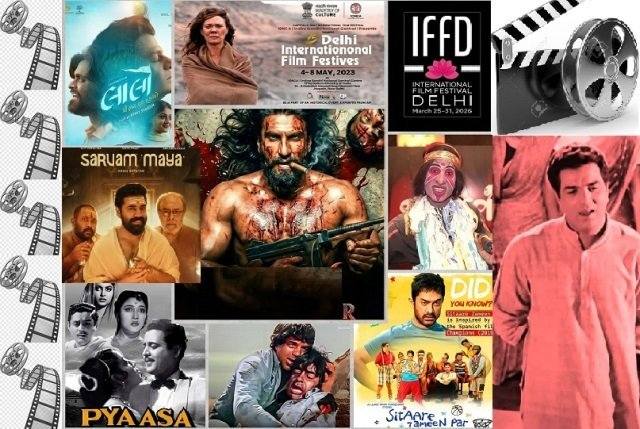
The IFFD saw a clever combination of populism with a heavy dose of piety and politics. The ceremony began with a tribute — forget the controversy — marking 150 years of Vande Mataram, setting a cultural tone for the evening. It ended with the screening of Laalo – Krishna Sada Sahaayate, a story of redemption, faith and divine intervention and the first Gujarati film to cross ₹100 crore at the box office.
Popular cinema was the flavour. As can be expected, the current Bollywood biggie, Dhurandhar 2 – The Revenge, which has crossed ₹1,000 crore, got many top awards and was screened. And Sholay (1975) catered to the older audience, grandmothers included. Its maker, Ramesh Sippy, received a “lifetime achievement” award to mark 50 years of the film.
A defining feature was its inclusive “free entry” model, which required only online registration, and encouraged high participation from students as well as general film buffs. Beyond screenings, the festival hosted the CineXchange Film Market and ‘masterclasses’ by experts like cinematographer K K Senthil Kumar and actor Piyush Mishra.
The ‘Night of Honours’ closing ceremony recognised several industry veterans and contemporary successes: Lifetime Achievement Awards were presented to Sharmila Tagore, Nandamuri Balakrishna (celebrating 50 years in cinema), and posthumously to Dharmendra.
Women were in focus, right from the opening ceremony. Significant emphasis was placed on ‘Women in Cinema’, with panels featuring the award-winning Guneet Monga and the launch of the ‘Her Lens’ program to amplify female narratives. So were children. ‘Most Inspiring Film of the Year’ was Aamir Khan’s Sitaare Zameen Par, directed by R S Prasanna. ‘Delhi on Reel’ featured directors Imtiaz Ali and Rakesh Omprakash Mehra. Actor Boman Irani conducted a masterclass in script-writing.
For unknown reasons, the festival remained under-reported. Regular critics shied away after the opening, and day-to-day reporting of the events was restricted and ‘magazine-ish’, and largely on social media. Optics matter, more so for a media event.
The first IFFD was overdue, considering the national capital’s growing dominance at the national level, its rising global profile and its status as the world’s largest film producer.
It was also in keeping with Delhi’s role in cinema, despite never becoming a filmmaking centre, and despite several unsuccessful efforts in the past. It has been a favourite film location, though.
But Delhi is where film policy is laid and enforced. From here, political ‘inspiration’ flows and policy directions are set, although the Central Board of Film Certification, where the buck stops in any dispute, is located in Mumbai, with multiple regional offices.
‘Babu’, the officer class, has enforced the cinema’s working, and that has included the film festivals.
The first edition of the International Film Festival of India was held in Bombay in 1952, organised by the Films Division, under the I&B Ministry, with the patronage of the then Prime Minister Jawaharlal Nehru. He was unable to make it to the inaugural ceremony, and Minister R R Diwakar opened it.
New Delhi became the festival hub for the next four decades thereafter. It hosted 24 international film festivals, called IFFI, and later, Filmotsav. Its logo reflected the sublime vision ‘Vasudhaiva Kudumbakam’ (The world is one family), inspired by the Maha Upanishad.
From the 3rd edition (1965) onwards, the festival introduced a competition section. Satyajit Ray chaired it. The major landmark of the third edition was that the FIAPF (International Federation of Film Producers Association), the Paris-based International body to control film festivals across the world, recognised IFFI with an ‘A’ Grade, bringing it at par with the major festivals of the world, Cannes, Berlin, Venice, Karlovy Vary and Moscow.
But filmmaking centres clamoured to host it. Filmostavs were held in Kolkata (1975), Mumbai (1976), Chennai (1978), Bangalore (1980), Kolkata (1982), Mumbai (1984), Hyderabad (1986) and Thiruvananthapuram (1988). From the 12th edition onwards, the title ‘Filmostav’ was abandoned and the name IFFI was retained for all festivals irrespective of the venue being in New Delhi or elsewhere. A new chronology for the festival was charted in 1993, re-scheduling it as the 24th edition, accounting for all the previous festivals.
Held in January, IFFIs had to deal with problems getting the best films and filmmakers, so soon after the Christmas holiday. The Indian filmmakers and enthusiasts from the South braved Delhi’s chill. Several cinemas showed the festival films, and in that pre-Internet era, they incited curiosity about the ‘uncensored’ content.
To its credit, India received films, even if not the best that were reserved for the more prestigious festivals elsewhere, from both sides of the ‘blocs’ in the Cold War era. Some of the best cinema from Eastern Europe, for one, and filmmakers like Carlos Saura (Spain), Márta Mészáros (Hungary), to name just two, were on the International Jury. The “East-West” politics were always there, but India managed them.
Perhaps, the most ‘apolitical’ IFFI was in 1977, organised during the Emergency, one of India’s darkest periods. Indira Gandhi made it a ‘prestige’ event, getting the best films and filmmakers from the West, which was, anyway, critical of her in that Cold War era.
Seated together were some of the world’s best: Italy’s Michelangelo Antonioni, Greek-American Elia Kazan, Japan’s Akira Kurosawa and India’s Satyajit Ray. Gandhi hobnobbed with Gina Lollobrigida, both photographing each other. And the very next day, Gandhi declared elections that she eventually lost.