A Prime Time Story
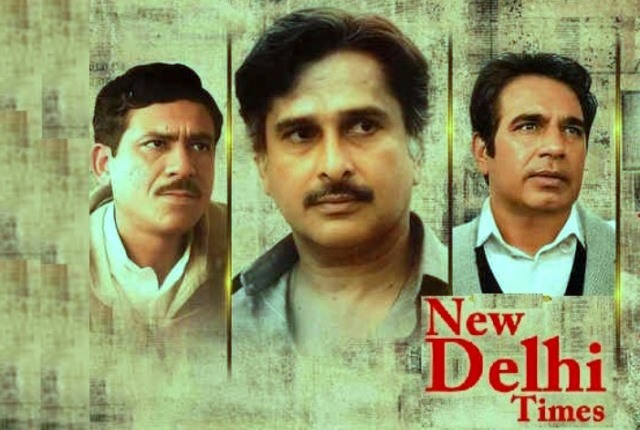
This is the story of New Delhi Times, a low-budget film made four decades ago. A surprise success at home, winning three National Awards and critical acclaim abroad, it earned quiet official disapproval. Now restored, it is self-censored by its owners.
But it is talked about. A clip in The Indian Express ‘40 Years Ago’ (March 2, 2026) recalls how its telecast on Doordarshan under the “outstanding cinema” category was scuttled and replaced with a typical Bollywood entertainer.
Key officers in the then-government were uneasy about the politician-crime-media nexus theme. Perhaps, the reason, though unstated, was the political disquiet over the unlocking of the Ram Temple’s doors in Ayodhya under a court verdict.
There was only Doordarshan then, and the print medium was all-powerful, unlike today with multiple sources of information and entertainment. But the politician-criminal nexus exists and is even more virulent.
The media is the unwitting victim and, at times, a participant. With the advent of technology that requires big money and political clout, the media cannot help but become a pawn in the game.
New Delhi Times bears comparison with the ongoing tussle between much of the corporately-owned mainstream platforms, dubbed ‘godi media’, and those critical of the government who call themselves independent, with social media influencing all.
New Delhi Times would seem dated today, with its typewriters and teleprinters running perforated tapes in the newspaper office. But the theme is upsetting enough to cause problems even today with the censors and distributors and beyond them, with various interested groups, not the least the political class.
The Press has seldom been portrayed with any degree of authenticity in Bollywood. That makes New Delhi Times a happy exception. It remains one of the few Bollywood films to tackle the issue of corruption in media, joining Kundan Shah’s Jaane Bhi Do Yaaro (1983), Main Azaad Hoon (1989) and Rann (2010).
Debutante director Ramesh Sharma depicted an idealist journalist/editor who pursues news with sweet-talking politicians at large and their criminal proxies on the streets.
Sharma says: “I myself am surprised by how a low-budget film made so many years ago is still remembered by those who have seen it. Probably because the core theme—the politician-criminal-media nexus—is disturbingly unchanged, only more sophisticated today.
“In the 1980s, the film showed how politicians plant stories, how owners cave in to pressure, and how journalists risk everything for the ‘real news’ that someone, somewhere, desperately wants hidden. Today we see the same dynamics amplified: paid news, self-censorship by media houses, selective outrage, and the blurring of journalism with entertainment.”
Sharma gathered together a plethora of the finest talent on offer—Gulzar as the scriptwriter, the legendary Subrata Mitra as the cinematographer, Louis Banks as the composer, Renu Saluja as the editor and Nitish Roy as the art director.
Shashi Kapoor plays Vikas Pande, the pipe-smoking executive editor, with Sharmila Tagore as his lawyer-wife. That won Shashi his National Award. At a meeting last year, Sharmila made a poignant mention of her role and wanted to see the film again.
Gulzar’s dialogues like “The real truth is what someone wants hidden… everything else is advertisement” or the exchange about journalists “stripping others naked to entertain the world” feel prophetic in the age of TRP-driven coverage and algorithmic echo chambers. The fact that people are still debating these issues shows how raw and relevant the message remains, Sharma reminisces.
Vikas is not a hero. Realising that his pursuit of truth led to information being planted on him and that he has been used, he muses: “Yaqeen nahin aata yeh wohi desh hai jahaan 50 saal pehle, leader aur awaam ek saath azaadi ki ladai lad rahe the (It’s difficult to believe that this is the same country where, 50 years ago, leaders and the public fought for freedom together).”
The film won an award at the Karlovy Vary and Tashkent international festivals. A special screening had to be cancelled because a lawyer filed a petition objecting to a dialogue that “all lawyers are liars”. By the time it was dismissed, it was too late to fly the film’s copy. Such obstacles, Sharma says, are more frequent in the present times.
Sharma says: “At a time when most Bollywood was busy with action masala, I dared to make a film to show the Press as neither an all-powerful saviour nor a helpless victim—just human beings caught in a dirty system. It goes to underscore the truth that we were so timid that my slightly courageous film is grouped with the few honest films on Indian media.
How would he approach the subject today?
“If I were to make this film again, nothing much would change other than the technology, social media, the disinformation battle, cyber hacking, etc. But the core theme of the politician-criminal-media nexus will remain the same. And I would still end it with the closing monologue about a country that once fought for freedom together. Because, it still hits hard in 2026. It’s not just a 1986 film; it’s a warning that keeps proving itself right again and again.”
The film is precious to Gulzar. In Two Tales of My Times (2008), he ranks New Delhi Times alongside his other great, Maachis (1996).
The film won Sharma the National Award for Best Debut, along with Subrata Mitra for cinematography. For Shashi, it was the first of the three National Awards.
But for all this labour and the rewards and awards, Sharma found his film going into a limbo. Although he continued to make films, mostly documentaries, he did not repeat his success.
Sharma’s woes with the film’s distribution were recounted in a review in The New York Times (October 9, 2007): “This hard-hitting political drama was hit equally hard by Indian distributors and television, who declined to run the film.”
Restored, the film is also ‘revised’ in that some scenes and dialogues that the present-day dispensation may not approve have been deleted or altered.
Calling it “self-censorship,” film analyst Deepanjana Pal, writing in Newslaundry (August 9, 2025), laments: “The changes made to New Delhi Times make it weaker at a narrative level, removing details of characterisation and motivation. The cuts reduce New Delhi Times to a damaged version of itself.”
If exercising freedom is the benchmark, the ‘Times’, it seems, have a long way to go to reach ‘New Delhi’.