A Teardrop on The Face of Buddha
Conflict, in any age, anywhere, needs chroniclers, like Sanjaya, narrator of the 18-day battle’s proceedings in the Mahabharata. That task is performed by journalists, who do it, objectively if not always neutrally, even as they risk their lives.
Veteran journalist P. Jayaram spent considerable time as Colombo-based correspondent of the United News of India (UNI), covering the ethnic conflict between the majority Sinhalese and the Tamils on the island of Sri Lanka.
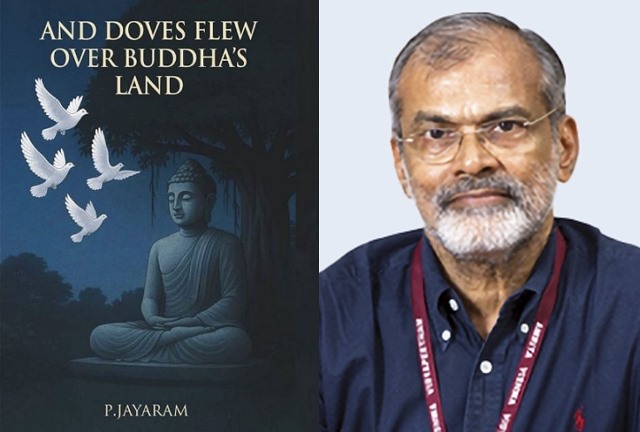
As old scars are unlikely to be erased anytime soon, he tells his story, And Doves Flew Over Buddha’s Island, in the form of a novel, so as not to scratch them.
It was, and shall remain, a conflict between the majority Buddhist and the Hindu minority – of people and faiths, both emanating from India – of differing language and culture, of people enduring a part-ancient and part-colonial legacy, of the international power-play.
Managing these civilizational links in modern times is not easy for India as well. Caught in a complex web, it seeks to play the larger neighbour. It must also guard its geopolitical interests on an island next door, located bang in the middle of the Indian Ocean Region.
The 26-year conflict saw India entering a ‘Chakravyuha’ by committing its military to a peace-keeping role on an alien land. None of the stakeholders honestly sustained it, and the Lankans even reneged. India came out bleeding profusely.
For Jayaram and other Colombo-assigned Indian journalists, reporting amidst raging anti-India sentiment could not have been comfortable. Like other smaller neighbours, it pays to be anti-India. This writer can empathise, having missed the Colombo assignment, but later visiting Jaffna, Trincomalee and Batticaloa to see IPKF operations.
Jayaram tells of love and hope amidst hatred and violence. The political class nurtures it to polarise society and win sectional support. He records the concerns, confusion and contradictions in a society.
Symbolising the hopeless grimness, yet deeply in love, are Suresh, a Hindu Lankan Tamil and Darshini, his Sinhala/Buddhist soulmate and course-mate at the engineering college. Their University professor, Thurairajah, whose wife is dying, and his family, rendered homeless like thousands of other Tamils, swears that he “will not raise his children among barbarians who claim recorded civilisation of 3,000 years.”
Minister Lasintha Weerekoona echoes rumours of the Indian Army ‘invading’ the island to ‘protect’ the Tamils and threatens: “Sri Lanka’s Tamils will be wiped out within 24 hours.”
Jayaram records: “But other than expressions of concern over the continuing ethnic violence, there was no tangible action on the part of Delhi.”
Complicating the ethnic conflict were the Marxist/ Maoist Sinhala radicals of the Janatha Vimukthi Peramuna (JVP), fighting to overthrow the existing structure of “class enemies.” The State eliminated them, but the Sinhala-Tamil differences remain.
It began with independent Lanka’s first prime minister’s “son-of-the-soil” policy. The story is similar to other former colonies that became free, across Africa and Asia. Through the 1980s, right up to 2009, “students killed students and prisoners killed prisoners.” Jayaram, who scouted for ‘hard’ news, displays a newsman’s penchant for unvarnished details. A good novel about people must rest on hard facts to sound credible, and not only on mushy, pulpy, sweet/sour/bitter nothings.
Save the two lovers, perhaps, his characters bear real names known in their times. There is irony in abundance as many of them died violent deaths. Jayaram’s novel serves to remind us of their edgy existence and their exits, timely or not, justified or not. They are masters of their situations, and before long, are victims. The conflict is unforgiving.
Jayaram’s narrative is straight. He uses words like ‘thugs’ for those who engage in or mastermind violence. His sympathies are with all victims of violence. He does not pass judgment on their actions and intentions. Nor, for that matter, does he mourn their deaths. He is simply Sanjaya, the narrator of the Mahabharata.
The novel underscores the sad reality that violence is the principal weapon in any conflict. The targeting of unarmed innocents, even children, school and women at marketplaces, like in the north and northeast of Lanka where the Tamils predominantly reside, is akin to what mankind has engaged in down the ages, be it erstwhile Yugoslavia, East Pakistan, Afghanistan…. The list is long and certainly unending. Humankind continues to kill, and will do till eternity.
That violence begets violence is a given. Jayaram writes: “The brutality of attacks by Indian forces against Tamilians matched, if not exceeded, those of the Sri Lankan forces.”
He puts it in cold words — of mayhem by “Sinhala Thugs” meant to put the Tamils on the island “in their place”, as “a signal to their patrons in Delhi”. This only prompts the Tamil militants of the LTTE and other outfits to arm themselves with resolve, and with guns and explosives, to counter bullet-for-bullet.
Delhi was, of course, the most favourite villain. When the first contingent with plans for sending 3,000 was announced in July 1987, I had said this was going to be “India’s Vietnam.” None belurved it. The IPKF at one stage swelled to a lakh. A few thousand guerrillas defeated the world’s fourth-largest army.
Colombo didn’t want the IPKF, and the Lankan Tamils, not just the Eelam and Sinhala boys, were all happy to see it withdraw.
Back in Tamil Nadu, Chief Minister M. Karunanidhi refused to participate in a ceremony to welcome them back. The Indian military has faced defeats, small and big, but such ignominy was unprecedented.
Five years after the IPKF was forced to leave, “those who cheered its exit desperately wanted the Indians back, if needed, invoke the same 1987 Accord that had been rejected.” Once bitten, badly, by the Lankans’ rank opportunism and lack of grace, India merely expressed concern when the LTTE started using surface-to-air missiles, and wisely refused to return to that quagmire.
Just every stakeholder had blood on hand. But it was Rajiv Gandhi, who signed the Accord with President J R Jayawardene and sent the IPKF, who paid the highest price. Many analysts say that this stopped his track to lead India again.
Jayaram’s narrative has the teenage Dhanu carrying out a blast at Fort Railway Station in Colombo. That earned her LTTE supremo Prabhakaran’s attention and later, the key role in Rajiv Gandhi’s assassination.
Having killed a President, several ministers, most of the Tamil rivals and a former Indian premier, emboldened LTTE chief Prabhakaran. Very late, he realised that his biggest mistake was to kill Rajiv. Too drunk with power and strength, he did not know when to accept a ceasefire and end the conflict.
It all ended on May 18, 2009, when the Sri Lankan Army closed in on him. India kept away this time. An estimated 50,000 Tamils perished. The government later admitted that 20,000 had disappeared. In all, 100,000 perished in the conflict.
As peace – of the graveyard – prevailed, doves flew back to the Land of Buddha. While Lanka is relatively at peace today, the Tamils’ aspirations remain largely unfulfilled.
Today, a mellowed and matured former JVP activist, Anura Kumara Dissanayake, is President of Sri Lanka.