Delhi is Merely Part of a Regional Air Quality Crisis
When the Delhi ministers went overboard on initiatives to fight air pollution in the Capital city, one of them, Urban Development Minister Ashish Sood, made a point in the passing that Delhi air was not affected by its internal factors only. During the same time span, one was travelling by mist-clad roads across the Gangetic plains and decided to make a check on the Minister’s claim.
There was some truth in what the Minister said, the AQI data for 17–21 December 2025 clearly shows that poor air quality was not confined to Delhi alone but spread across the entire Gangetic plain, with most cities remaining in the “unhealthy” category and several—most notably, Ghazipur—slipping into the “very poor” to “severe” range. This pattern undercuts the popular tendency to view Delhi’s winter smog as a problem generated solely within the National Capital Territory or driven predominantly by its vehicular population.
Instead, it points to a regional atmospheric phenomenon, where Delhi is only one—albeit the most visible—node in a much larger pollution continuum. The Indo-Gangetic plain functions like a vast, shallow airshed. During winter, meteorological conditions across this belt—from Punjab and Haryana through western and eastern Uttar Pradesh to Bihar—become strikingly similar.
Temperatures drop sharply at night, surface winds weaken, and temperature inversion layers form, trapping pollutants close to the ground. This inversion does not respect state boundaries or municipal limits. Once established, it allows emissions from multiple towns, cities, industries, farms, and transport corridors to accumulate and persist for days.
The data reflects this reality. While Delhi recorded AQI values in the mid-to-high 300s, towns such as Ghazipur hovering around 300 and crossing that mark by the fourth day reveal that severe pollution is not exclusive to megacities. Ghazipur does not have Delhi’s vehicular density, industrial scale, or construction footprint. Yet it experienced air quality levels comparable to or worse than many Delhi monitoring stations.
This alone challenges the narrative that automobile emissions within Delhi are the singular or dominant cause of extreme winter pollution. Several structural factors explain how a semi-urban or suburban district like Ghazipur can record AQI values in the severe category:
In smaller towns and peri-urban areas across eastern Uttar Pradesh and Bihar, households continue to rely heavily on firewood, dried cow dung cakes, coal, and agricultural residue for cooking and heating. Winter intensifies this usage. While each source may appear small in isolation, their cumulative impact across thousands of households becomes substantial, especially when atmospheric dispersion is minimal.
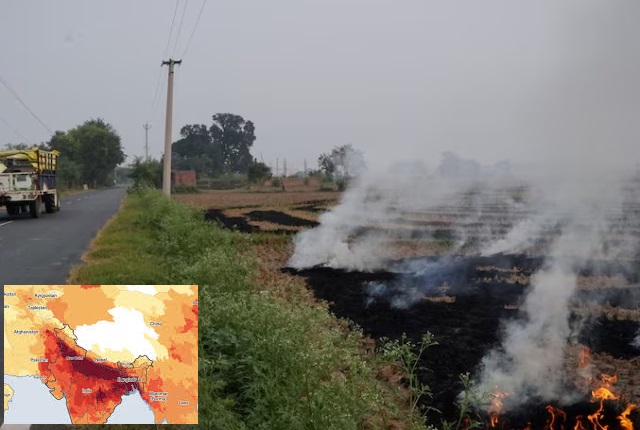
Policy and media attention often concentrates on stubble burning in Punjab and Haryana, but crop-residue burning occurs across the Gangetic belt, including eastern UP and Bihar. Though smaller in scale per incident, the sheer spatial spread ensures that background PM₂.₅ levels remain elevated throughout winter.
The Gangetic plain hosts thousands of brick kilns, many operating with outdated technology and low-grade fuels. These kilns are often located on the outskirts of towns like Ghazipur, Azamgarh, and Buxar. Their emissions are continuous through winter, releasing fine particulates that linger under inversion conditions.
National and state highways passing through smaller towns carry heavy diesel traffic, including long-haul freight vehicles. Unlike Delhi, where entry restrictions, fuel norms, and vehicle-age caps exist (even if imperfectly enforced), smaller towns lack comparable regulatory intensity. Emissions here disperse poorly in winter and directly feed into local AQI spikes.
Even without large construction projects, unpaved roads, riverbanks, and agricultural land contribute dust. In winter, gaseous pollutants like SO₂ and NOx—emitted from vehicles, kilns, and generators—undergo chemical transformation into secondary particulate matter, raising PM₂.₅ levels independent of visible smoke sources.
Delhi’s AQI remains worse than its eastern counterparts for understandable reasons: higher vehicle density, constant construction activity, greater energy demand, and a dense concentration of population. However, Delhi’s pollution is amplified by the polluted air mass it receives from surrounding regions, not generated solely within its borders. When the background air entering the city is already “unhealthy” or “very poor,” even moderate local emissions push AQI into the severe category.
This explains why control measures focused narrowly on Delhi—odd-even schemes, construction bans, or restrictions on private vehicles—often deliver limited and short-lived relief. They attempt to treat a regional disease with a municipal prescription. As long as Ghazipur, Lucknow, Buxar, Patna, and dozens of smaller towns remain pollution hotspots during winter, Delhi will continue to inhale their emissions, just as they inhale Delhi’s.
Blaming automobiles alone is politically convenient but scientifically inadequate. Vehicles are undeniably a major source of NOx and PM₂.₅ in Delhi, yet they cannot explain severe AQI levels in towns with far fewer vehicles. The Ghazipur data makes this evident. A realistic assessment must recognise that winter air pollution over the Gangetic plain is driven by a complex emissions mix interacting with hostile meteorology, not by any single sector.
The phenomenon highlighted by the 17–21 December data demands a Gangetic plain–wide strategy, not city-specific firefighting. This includes coordinated crop-residue management across states, rapid transition of brick kilns to cleaner technologies, accelerated household energy transition, regulation of freight corridors, and—most critically—dense, credible air-quality monitoring in smaller towns to inform policy.
In short, Delhi’s smog is the most visible symptom of a much larger malaise. Ghazipur’s severe AQI levels during the same period confirm that air pollution in north India is a shared atmospheric crisis, unfolding over an entire region. Treating Delhi in isolation will continue to produce political theatre—but not breathable air.
(Sidharth Mishra is an author, academician and president of the Centre for Reforms, Development & Justice)