Govt Won’t Take Action Against IndiGo, Despite Unprecedented Chaos
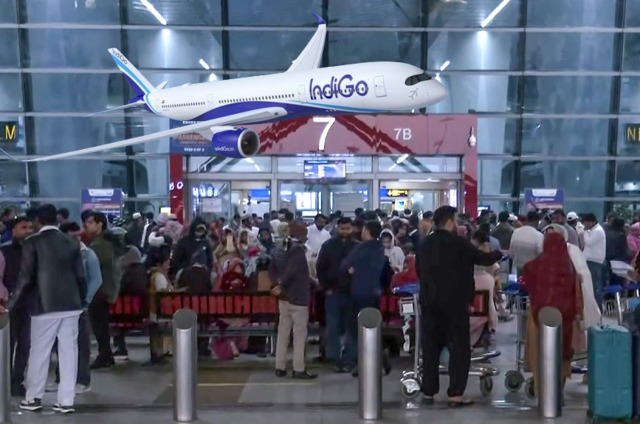
The Narendra Modi government, for all its public muscle-flexing, appears poised to let the country’s largest airline, IndiGo, escape without stringent consequences for the unprecedented chaos it unleashed in the skies last week. The misery caused to lakhs of passengers, many stranded at airports for hours, some even for days, sparked outrage across the country.
Yet, the signals emerging from the Ministry of Civil Aviation suggest that the government may ultimately choose a conciliatory approach rather than hold the airline firmly accountable. The clearest indication of this came through an interview published in a national daily, where Union Civil Aviation Minister Ram Mohan Naidu responded to pointed questions on punitive action against IndiGo. His remarks, measured to the point of being deferential, revealed more than what was said directly.
To a specific question on whether the government would initiate action against IndiGo for prolonged flight delays, mass cancellations, and inadequate passenger communication, Naidu said, “The reply to the show cause notice will determine if there is a need to take an interim action. However, we will wait for the four-member committee constituted by the DGCA to submit its report.”
This wait-and-watch approach contrasts sharply with the seriousness of the crisis. At its peak, IndiGo had grounded a significant portion of its fleet, citing crew shortages and cascading operational disruptions. Airport terminals, particularly in Delhi, Mumbai, Bengaluru, and Hyderabad, saw overflowing crowds, fraught tempers, and families sleeping on floors.
Social media was flooded with horror stories of passengers boarding flights only to be deboarded hours later and those missing weddings, funerals, and international connections due to lack of information. Yet, instead of taking a firm position on accountability, the Minister appeared keen to reassure rather than reprimand.
Defending IndiGo’s broader performance, Naidu emphasised, albeit indirectly, that the airline’s scale and efficiency make it an unlikely villain. “IndiGo is an efficient airline with over 60% market share,” he said, suggesting that the current crisis could be viewed as an aberration rather than systemic negligence.
This line of reasoning raises troubling questions. Does size grant immunity? Should dominance in the market translate into leniency in regulation? And most importantly, does the government view IndiGo as too big to be held strictly accountable?
Though Naidu acknowledged that IndiGo had clearly faltered in crisis management, even this criticism was delivered with visible restraint. “Why did it take two days for them to ensure that flights’ status are informed to the passengers well in advance so that they don’t get stuck at the airports, is something that we are looking at,” he said.
The fact that it took two full days for IndiGo, a company that prides itself on operational excellence, to stabilise its information flow and proactively reach out to stranded customers is not a minor lapse. It is a fundamental failure of passenger service obligations. Under DGCA norms, airlines are mandated to inform flyers of delays and cancellations in a timely manner. The chaos of last week shows these rules were not just overlooked but abandoned altogether.
Despite this, the tone of the Minister’s interview suggests that the government’s priority may be to manage perception rather than enforce accountability. Instead of announcing provisional penalties or signalling stricter oversight to restore public confidence, the government’s messaging has been curiously soft.
This is particularly surprising given the Modi government’s reputation for acting swiftly and decisively in the face of public crises. In industries ranging from pharmaceuticals to online gaming to food safety, regulatory agencies have cracked down hard when public interest was seen to be at stake. Yet, when lakhs of passengers were left stranded, elderly people were made to stand for hours without assistance, and families with infants had no clarity on their flights, the response from the Centre was muted.
Observers suggest several possible reasons. IndiGo’s overwhelming market share makes it central to India’s aviation ecosystem. Any harsh punitive action, such as grounding aircraft, imposing heavy fines, or restricting schedules, could lead to further disruptions, worsening the very crisis the government seeks to contain. Moreover, at a time when the government is actively promoting air travel as part of its infrastructure growth narrative, acknowledging massive aviation mismanagement may not fit the political script.
Nevertheless, the responsibility of the Civil Aviation Ministry and DGCA is not merely to maintain operational continuity, but to ensure passenger rights, safety, and fair conduct. Going soft on IndiGo sets a dangerous precedent. It signals that airlines may get away with lapses as long as they are big enough, efficient enough, or important enough.
As the crisis slowly subsides, thousands of passengers are still awaiting refunds, reimbursements, and explanations. The government must decide whether it stands with the travelling public or with a dominant private operator.
The Minister’s mild interview in the midst of a massive aviation breakdown may offer an early answer, and not one that inspires confidence.
(Sidharth Mishra is an author, academician and president of the Centre for Reforms, Development & Justice)