Purity on My Plate: Politics of Bihar’s Meat Shop Order
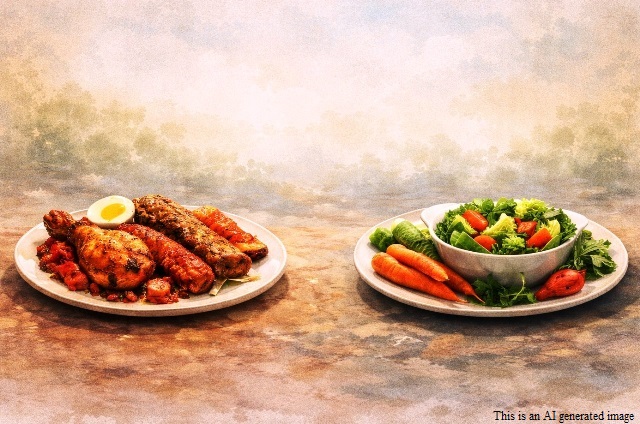
The Bihar government’s recent order banning the open sale of meat near religious places and schools has triggered a debate that goes well beyond questions of hygiene or urban regulation. Deputy Chief Minister Vijay Kumar Sinha’s remarks—that visible meat sale hurts the “purity of our sentiments” and may foster “violent tendencies” among children—have added a moral and psychological dimension to what might otherwise have been viewed as a civic order. While the government insists it is not interfering with anyone’s right to eat what they choose, critics argue that the framing risks turning a personal dietary preference into a matter of moral suspicion.
At one level, the order can be defended as an attempt to regulate public spaces. Governments routinely issue guidelines concerning food vending near schools and religious sites, often citing concerns of sanitation, crowd management, and sensitivity to local sentiment. In a diverse society like India’s, where certain spaces carry deep religious significance, authorities sometimes try to prevent friction by discouraging activities that may be perceived as offensive. If the Bihar order is implemented neutrally—without targeting any particular community—and strictly on grounds of public hygiene and order, it may fall within the ambit of administrative discretion.
However, the controversy stems less from the regulation itself and more from the language used to justify it. When meat consumption is linked to “violent tendencies,” it moves from the realm of civic management into moral judgment. There is no established scientific consensus suggesting that dietary preference for meat correlates with aggression or criminality. Human behaviour is shaped by complex social, psychological and economic factors. To imply that exposure to meat sales could predispose children to violence risks simplifying a deeply complex issue and reinforcing stereotypes.
The political context also cannot be ignored. In Bihar and beyond, food habits have increasingly become electoral talking points. Leaders such as Lalu Prasad, Tejashwi Yadav, and Rahul Gandhi have found their dietary choices amplified during campaigns. The timing of Sinha’s remarks—just before Holi and ahead of elections in states like West Bengal—has led opposition parties to question whether the order is partly symbolic. In a climate where cultural signals often carry political weight, even administrative decisions can be read through a partisan lens.
Moreover, the idea that vegetarianism represents a singular Hindu norm is historically contestable. Hindu traditions are not monolithic. Shakta practices, several regional Brahmin communities—such as Kashmiri, Bengali, Maithili and Odia Brahmins—and numerous other groups have long included meat in their diets. The National Family Health Survey (2019–21) indicates that a large majority of Indians consume meat at least occasionally. Thus, framing meat consumption as culturally alien to “our sentiments” overlooks the diversity within Hindu society itself.
There is also a social dimension to the vegetarian–non-vegetarian binary. Over centuries, diet has often been used as a caste marker. Vegetarianism came to be associated with certain upper-caste groups, while meat consumption was linked—often pejoratively—to Dalits, tribal, and other marginalised communities. While many Indians today make dietary choices for reasons of health, environment, or ethics, historical hierarchies still influence perceptions. When state action appears to privilege one dietary culture over another, it can revive old anxieties about social exclusion.
Supporters of the order may argue that restricting visible meat sale near temples and schools is about respecting sensitivities rather than asserting superiority. Yet, critics counter that respect must be mutual. A plural society cannot function if one group’s discomfort consistently dictates public norms. The Constitution protects personal liberty, including food choice, subject to reasonable restrictions. Any policy that indirectly stigmatizes lawful dietary habits must therefore tread carefully to avoid crossing into moral policing.
Another concern is economic. For many low-income households, eggs, fish, and affordable meat provide vital protein. If regulatory measures gradually shrink the spaces where such food can be sold or consumed, the burden may fall disproportionately on small vendors and poorer communities. Public policy must ensure that health and nutrition are not compromised by cultural signaling.
The broader debate also touches on a philosophical question: does abstaining from meat confer moral superiority? Indian intellectual history offers varied answers. Vedic rituals included animal sacrifice; later traditions debated or symbolically reinterpreted these practices. Jain and Buddhist philosophies emphasised non-violence toward all living beings, influencing dietary habits across communities. At the same time, ethical conduct has never been reducible solely to diet. A vegetarian individual can participate in environmentally destructive or socially unjust systems; a meat-eater can live an ethically mindful life. Violence and compassion are shaped by actions, not merely ingredients.
Indeed, modern India presents striking contradictions. The country is among the world’s largest exporters of beef, even as domestic debates over meat grow sharper. Large businesses involved in such exports are sometimes owned by families who identify as vegetarian. This economic irony highlights the gap between symbolic politics and structural realities.
Ultimately, the challenge before the Bihar government is to clarify intent and ensure proportionality. If the goal is to maintain cleanliness and prevent public nuisance near sensitive locations, the order should be framed and implemented strictly within that limited scope. The rhetoric should avoid equating dietary practice with moral threat. Public communication matters in a society where identity politics can easily inflame tensions.
Social harmony in India has historically depended on negotiated coexistence rather than enforced uniformity. A confident society does not fear diversity in food, language, or custom. It regulates public order without ranking lifestyles as pure or impure. The state’s role is to uphold law, hygiene, and equality—not to adjudicate virtue.
The Bihar episode, therefore, is less about meat per se and more about the boundaries between governance and moral commentary. It invites reflection on how language, policy, and politics intersect in shaping everyday freedoms. In navigating this terrain, governments would do well to remember that pluralism is not merely a constitutional promise; it is a lived reality that must be respected in both letter and tone.
(Sidharth Mishra is an author, academician and president of the Centre for Reforms, Development & Justice)