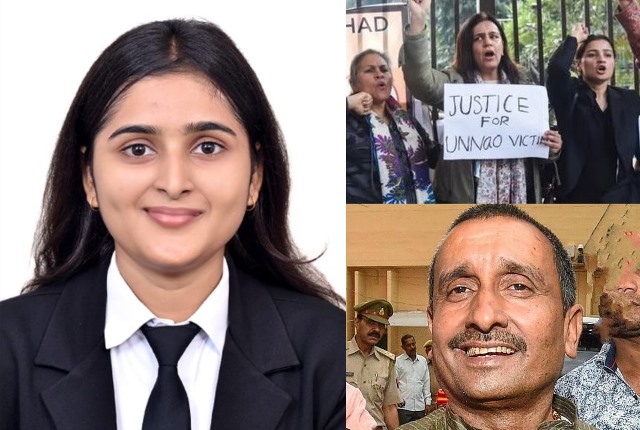
‘SC Judiciously Tackled Outrage Over Bail To Sengar In Unnao Rape Case’
Muskan Gupta, a Law Intern at Lucknow Bench of Allahabad High Court, is relieved at Supreme Court’s intervention in the Unnao rape case. Her views:
There was an understandable public outrage over the Delhi High Court’s decision to grant bail to former MLA Kuldeep Singh Sengar in the 2017 Unnao rape case. At the same time, it was heartening to see the apex court stepping in good time to correct the High Court’s assumption that an MLA did not qualify as a “public servant” under the Protection of Children from Sexual Offences (POCSO) Act.
The decision of the High Court came as a shocker – both for the public and the legal fraternity. Personally speaking, this was an ‘out of the syllabus’ observation by the High Court for most of us. In contrast, the apex court’s observation, that it was concerning that a police constable might be a public servant under the same Act, but an MLA would be exempted from the stricter provisions for aggravated sexual assault, came as a welcome relieve.
Earlier this month, the High Court’s decision had triggered extensive protests and public anger, with activists and opposition parties criticizing the move and the potential danger it posed to the survivor. It is also noteworthy that what the Delhi Court observed – while suspending Sengar’s life sentence, the court observed that he had already served more than the maximum punishment prescribed under the POSCO Act.
ALSO READ: ‘Justice Eludes Rape Victims From Marginalised Sections’
Though, in what was given as a ‘precautionary relief’ to the survivor, was that some conditions were imposed on his release from the jail including a restriction preventing him from entering a five-km radius around the survivor. How at all this was a relief, I have not been able to figure out thus far.
The earlier decision of the court was problematic and legally flawed for the manner in which it ignored and trivialized the gravity of the offence, while following a textual interpretation of the word ‘public servant’. In essence, the Court noted that a sitting MLA does not qualify as a “public servant” within the meaning of Section 21 of the Indian Penal Code.
On this reasoning, it concluded that Section 5(c) of the POSCO Act, which treats penetrative sexual assault by a public servant as an aggravated offence, is inapplicable. Even accepting the Court’s view regarding the application of Section 5(c), the grant of suspension appeared difficult to reconcile with well-settled principles governing suspension of sentence in cases involving life imprisonment for grave sexual offences. The order also reflected a hyper-technical approach that sidelines the seriousness of the offence and its impact on the survivor.
The Supreme Court’s decision was met with significant relief and praise from the victim’s family and the public, contrasting sharply with the widespread outrage that followed the Delhi High Court’s initial bail order. The intervention is welcomed and comes as a necessary correction, highlighting the gravity of the case which involved a minor victim, abuse of power, and a pattern of intimidation.
As told to Rajat Rai
‘Dhurandhar 2 is a Compelling Joyride; Those Who Call It Propaganda Miss the Point’
‘Part of the Blame for a Weakened Federal Structure Lies With Greedy Regional Parties Too’
‘Iran Has Forced The Global Hegemon US To Eat Humble Pie’