Will Iran Survive the War?
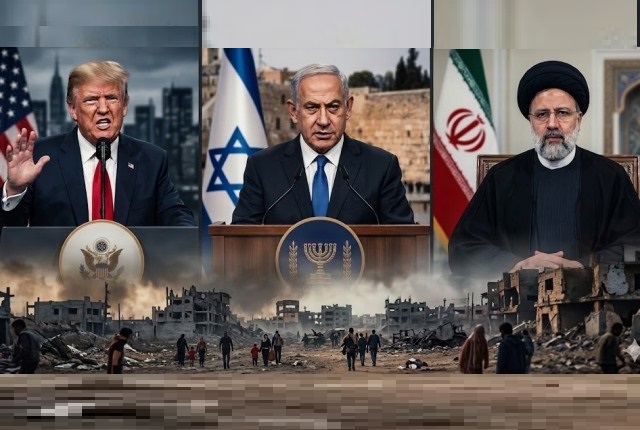
Feeling confident after Venezuela, President Donald Trump set eyes on Iran, goaded by Netanyahu. The USA appears to have expected that decapitation of the leadership (Ayatollah Khamenei) and others in the government, and with some help from a mass rising, would convince the rest to embrace American terms. That hasn’t happened.
It also appears that the late Ayatollah Khamenei prepared for martyrdom through an expected assassination. Being in poor health, rather than die a normal death, he chose not to hide but go in Shia history as a martyr a great honour in Shia Islam. What Ayatollah Khamenei may not have planned for is an attack when his family was there who were wiped out as well except his son, Mojtaba Khamenei, who has now become the new Supreme Leader.
An Angry Trump has promised to pound Iran even more with mutterings from others in the administration that the new Supreme Leader’s days are numbered. America expected a Venezuelan type capitulation.
Iran on the other hand has not shown any sign of wanting to waive the white flag. Is it being delusional, foolish or does it really have a plan to survive the most powerful country in the world?
It would be an error to characterise Iran as a country run by hardline Mullahs with little understanding of the modern world, science or global politics. It will be equally simplistic to think of the Iranian Shia Mullahs as priests in other religions, putting trust in God or Allah and thinking all will be well, until it goes unwell and then run for cover.
It was at a Biodiversity conference in Teheran that I first came to understand the Shia clerics of Iran. In a session on cloning, the keynote speaker was a Shia Cleric. His opening statement was that it is ‘haram, that is blasphemous’ and against the teachings of the Qur’an to say that man can create. Resigned to hearing a long lecture, as one would from a religious cleric, that cloning is a sin, an act against God and will never succeed, I was completely shocked by his follow up statement. “Cloning isn’t creation; it’s simply replication of what God has already created. But mankind isn’t ready for this yet!”
I spent a long coffee with another young cleric at a Coffee bar. He told me about the training of an Iranian cleric. It is three years of studying the Qur’an. Then a year of western philosophy, followed by a year of eastern philosophy including Hinduism, then a year of science and lastly a year of deconstruction of all ideas relative to Islam. It takes seven years to become a modest cleric in Iran! His grasp of both western and eastern philosophy was remarkable.
What struck me was that the clerics interpret the Qur’an in a way that it does not hinder scientific or economic progress. In most countries, clerics support the crown or regime but in Iran they were supporting progress and science. They were not preaching long sermons about wrath of God. The clerics were enabling scientific and modern life except modern liberal social developments such as freedom of expression etc.
The University medical school where the conference was held, had 60% female students. There were four women chancellors from various Universities at the conferences. I saw many taxis and buses being driven by Iranian women, albeit in a Hijab. This was another surprise. I also saw young couples canoodling in coffee bars.
On coming back, I told a UK think tank conference that I didn’t think a rebellion would succeed in Iran simply so that women can wear mini-skirts or some people can make political statements against the regime. They are neither holding back science nor economic progress.
In the 46 years since Ayatollah Khomeini ousted the Shah in 1979 and took over, the clerics have built a very resilient system of continuing leadership, institutions, educational establishment and training. The system isn’t dependent on one person or a small group of hardline dictators. It is diffuse, built on consensus and very difficult to crack. It isn’t like the Indian Maharajahs, including the Sikh Maharajah, whose Kingdoms collapsed within a few years after death of a tough Maharajah. They never built institutions to survive.
Iran’s majority population is Shia. The Shia, like the Jews, have spent most of their history in a state of persecution. They believe that the Caliph or Imam after Prophet Muhammad should be from his family while the Sunnis took a different view. After the killing of the third Shia Caliph Husayn Bin Ali at the Battle of Karbala in 680, the Shia have spent long periods as persecuted group within the larger Muslim world, dominated by Sunnis. They have been in power from time to time, and have held on to it in Iran (Persia) since 18th century when Sunni Persians were converted to Shia. Over the centuries they have developed sophisticated approaches to survival as dispersed groups, as insurgents and set up resilient institutions.
The Jews also have a long history of being persecuted and living intermittent centuries of exile since the 8th century BCE when the Neo Assyrian Empire took over their lands. Subsequently Romans took over Jewish lands and put many into slavery. This was followed by Christian crusaders. Jews were forced to disperse in various parts of Europe, facing marginalisation and persecution and even further exiles from adopted lands such as the one from England in 1290 and from Spain in 1492 . The most recent and inhuman was the Holocaust by Germans. The Jewish word for this form of exiled existence is Galut, a sense of negative existence always seeking the homeland from where they were dispersed.
Hence, Jewish civilisation and culture have a number of days of remembrance and a long memory that influences sensitivity to possible exile and persecution again. This is particularly evident in Jews whose historical roots have been of living in ‘galut’ in Europe. There are Jewish communities in India (Cochin Jews and Paradesi Jews) from ancient times of exodus who have never faced persecution, whose outlook is different and are quite well integrated.
It is a sad and ironic fate of history that the two communities who have faced so much persecution in history from others are now at each other’s throats, fighting each other for what both think is survival. Rather than respect each other’s history they see each other as the greatest threat.
Both communities have survived history by leveraging other powers. Currently the Jewish community has enjoined the patronage of United States while Iran’s Shias have drawn Russia and China closer to them. Whereas China avoids theatres of proxy wars, Russia and America are long players of that war game.
Where this ends is anyone’s guess. As a highly intelligent community with deeply entrenched institutional structures, Iran has developed strategies of dispersal defence guided by Ayatollah Khomeini. They have what is called the ‘four’ leadership structure. Expecting decapitations, destruction of their infrastructure and first line of defence, they have set up a multi-tier leadership line with at least four trained to take over in succession when one dies. This is in every field and organisation. So killing the head of Army or the Supreme Leader makes little difference as the successors have already been trained to take over.
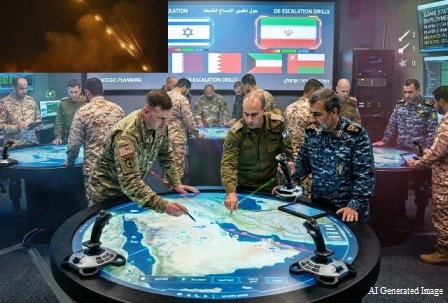
Similarly they also have a decentralised defence structure with commanders of different units having autonomy to continue when others fall. It is not dependent on a CENTCOM. They have factored in bombing of their military headquarters or blasting off all their military gear, air force etc. They have satellite forces such as Houthis and Hezbollah. Their tactic is to make war very expensive for the enemy, so it hurts financially rather than just in human terms. They have been masters of asymmetrical warfare for centuries. The Assassins creed were Shia. And as the Iranian commander said, they have studied American warfare and prepared for it for 20 years.
In Indian history, this was the form of warfare practiced by Sikh misls against the Mughals. They had a semi spiritual leader at Harmandir Sahib, but the misls were autonomous war groups who bled the Mughals to final defeat. The Sikhs unfortunately did not prepare for victory and left no enduring institutions to resist occupation.
Iran is going for desalination plants in the Gulf States who are dependent on this as source for nearly 90% of their water supply They are choking oil supplies and making the Gulf states unattractive for investments. They have gone for the new AI centres in the Middle East in which Gulf investments have been significant. They are hoping that the economic fallout will affect United States and Europe, thus forcing America to withdraw from this conflict.
The USA does not really have a civilisational gravitas to have a sense of self contentment. Since early settlers it has been a country of political or economic migrants from all over the world. It is a nation defined by a combination of power, opportunity and victimhood usually seeking comfort in being ‘great’. It was not surprising that Trump’s call for Make America Great Again resonated with voters, who sought being ‘great’ after the humiliations in Afghanistan and Iraq. But it is also pragmatic with ‘Project Great’ and takes a step back when it becomes too costly in human and economic terms.
James Baldwin, a Black civil rights activist in USA famously said that American history and identity are built on destruction of others. He was talking of destruction of Black people but in the new America where Blacks also hold significant parity, it is now destruction of a weaker country in the world. ‘No more foreign wars’ doesn’t really work for the USA. Besides its military-industrial complex survives on them. Winning is an option, not a necessity. Iran is the victim now.
The question whether Iran’s Shia regime will survive war against the most powerful army in the world will most likely depend on if Iran continues with the strategy of asymmetrical warfare, bleeding the American driven economic architecture of the world and exhausting America’s commitment to a conflict that has no real ideological or strategic purpose for it other than expression of power and perhaps access to resources.
On the larger tapestry of Middle East, the region could be a lot more peaceful and stable if the Jewish State of Israel and the Shia State of Iran could find a common bond to survive as both have suffered long histories of persecution. Their enemies were also common, Christian Europe and Sunni Islam for Jews, and Sunni Muslims and now Christian West for Shias. A shared history in different temporal spaces – surely something to bond over at a coffee table.