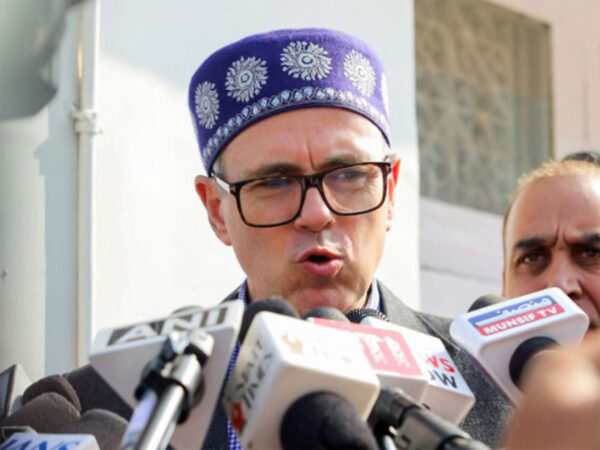
Jammu and Kashmir Chief Minister Omar Abdullah on Wednesday paid tribute to the victims of the Pahalgam terror attack, marking one year since the deadly incident that claimed 26 lives, and reaffirmed his commitment to end violence and suffering in the region.
In a post on X, Omar Abdullah said, “One year on, we remain united against terror and against violence. We remain resolute in our desire to rid Jammu and Kashmir of suffering and innocent deaths.”
He further added that efforts will continue to ensure such incidents are not repeated, stating, “We remain committed to doing everything to ensure it never happens again.”
Expressing solidarity with the bereaved families, Abdullah said, “We also remain in eternal solidarity with the families who lost their loved ones a year ago in that cowardly attack.”
The CM concluded by paying homage to the victims, saying, “May the souls of the victims of the terror attack rest in peace.”
Lieutenant Governor (LG) of Jammu and Kashmir Manoj Sinha also paid tribute to the victims of the Pahalgam terror attack, marking one year since the incident.
In a post on X, he recalled the tragedy and said, “Humble tributes to the innocent souls who lost their lives in the gruesome terror attack in Pahalgam on this day in 2025.”
He further emphasized that the loss continues to be deeply felt and remembered across the region, adding, “Their memory endures indelibly in our hearts. My thoughts and prayers are with their families,” while expressing solidarity with the bereaved families and honouring the victims of the attack.
The terror attack, carried out in Pahalgam, one of Jammu and Kashmir’s prominent tourist destinations, had shocked the nation after Pakistan-backed terrorists entered a village and killed 26 civilians. The assailants reportedly targeted victims based on their religious identity, drawing widespread condemnation and outrage across the country.
In response, India launched Operation Sindoor on May 7, 2025, targeting terror infrastructure in Pakistan and Pakistan-occupied Jammu and Kashmir (POJK). The Indian armed forces struck multiple terror launchpads linked to groups such as Lashkar-e-Taiba, Jaish-e-Mohammed, and Hizbul Mujahideen, significantly damaging their operational capabilities.
The operation triggered retaliatory actions from Pakistan, including drone attacks and cross-border shelling, leading to a brief four-day military escalation. Indian forces responded with precision strikes, reportedly targeting key radar installations in Lahore and areas near Gujranwala.
Following the escalation, both countries agreed to a ceasefire on May 10 after communication between their respective Directors General of Military Operations (DGMO).
On the eve of the anniversary, the Indian Army also recalled the operation, underlining its message of deterrence. “When boundaries of humanity are crossed, the response is decisive. Justice is served. India stands united,” the Army said. (ANI)
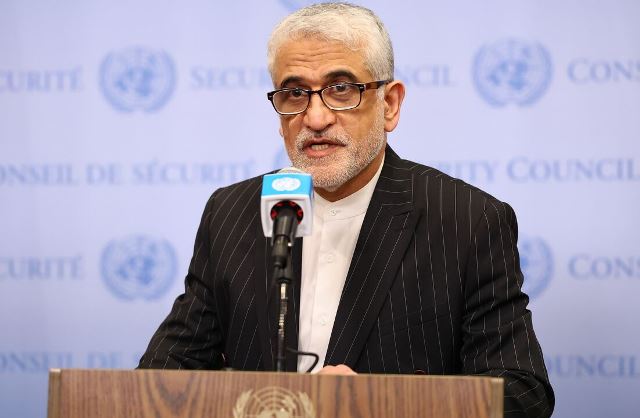
In a significant diplomatic development, Iran has established a clear precondition for the resumption of negotiations, with its UN Ambassador, Amir Saeid Iravani, stating that Tehran is prepared to engage in talks only after the United States ends its naval blockade.
Citing an interview given by Iravani to Rudlaw News Network at the UN HQ, Tasnim News Agency reported that the Iranian envoy emphasised that for any dialogue to proceed, Washington must first halt its “ceasefire violations.”
“The naval blockade of the United States, it is a violation of the ceasefire. And we told them that they should break this blockade. We have received some sign that they are ready to break it. And as soon as they break this blockade, I think that the next round of the negotiation will take place in Istanbul. Listen to them, we have not initiated the military aggression. They initiated the war against us and we are ready. If they want to sit on table and discuss and find a political solution, they will find us ready. If they want to go to the war, in this case also Iran is ready for that,” Iravani said.
The ambassador’s remarks suggest that while a channel for communication may exist, the removal of the blockade remains the primary obstacle to a formal diplomatic process.
The insistence on this precondition underscores the deep-seated mistrust between the two nations as they navigate a fragile ceasefire extension. This tension was further highlighted as the US President announced late on Wednesday that he would prolong the current ceasefire to provide a window for further diplomacy.
Earlier, US President Donald Trump claimed that Tehran is privately lobbying for the reopening of the Strait of Hormuz to curb mounting economic losses, despite its public posturing of a continued standoff.
Trump further claimed that Iran’s outward hostility regarding the waterway is a performance intended for a political audience rather than a reflection of its financial reality.
“Iran doesn’t want the Strait of Hormuz closed; they want it open so they can make USD 500 million a day (which is, therefore, what they are losing if it is closed!)” he posted, suggesting the blockade is crippling the Iranian economy.
Tensions in the Strait continue to mount. On Wedenesday the United Kingdom Maritime Trade Operations (UKMTO) reported that a container ship sustained heavy damage to its bridge after being fired upon by an Islamic Revolutionary Guard Corps (IRGC) gunboat 15 nautical miles northeast of Oman. The Master of the vessel reported that the ship was approached by one IRGC gunboat, which did not issue a VHF challenge before opening fire. UKMTO said that that while the attack caused heavy damage to the bridge, no fires or environmental impacts have been reported.
For now, the Strait of Hormuz stays at the heart of the friction. As the primary artery for global oil and liquefied natural gas, its continued closure poses a persistent threat to “international energy markets and maritime security.” (ANI)
Megastar Rajinikanth has officially wrapped up the shoot of his upcoming film ‘Jailer 2’, giving fans a major update on one of the most talked-about sequels in Tamil cinema.
Sun Pictures took to X to share pictures that appear to be from the film set. The images show the team celebrating the occasion with a cake-cutting ceremony attended by the cast and crew.
Along with the pictures, the makers added a caption that read, “Alapparai Kelappurom, Thalaivaru Nerandharam! It’s a wrap for #Jailer2.”
Take a look
Fans quickly flooded the comments section with excited reactions. One user wrote, “This is going to be huge,” while another added, “Can’t wait.”
Earlier this month, Rajinikanth had also confirmed that the shooting of ‘Jailer 2’ was complete and that the film had entered its final stage of post-production.
The superstar added that the production team will soon officially announce the release date, further heightening expectations among fans.
Speaking to the media at Chennai airport, Rajinikanth said, “The shooting of the upcoming film ‘Jailer 2’ has been completed and is currently in its final stages. The production team will soon officially announce the release date.”
The sequel follows the success of the original ‘Jailer’, which performed strongly at the box office.
Beyond ‘Jailer 2’, Rajinikanth also shared a major update on his new collaboration with fellow industry icon Kamal Haasan. The project, tentatively referred to as KH x RK, is expected to bring together two of Tamil cinema’s most influential figures on screen. According to Rajinikanth, shooting for the film is scheduled to begin in August 2026.
Meanwhile, he is also set to appear in ‘Thalaivar 173’, directed by Cibi Chakravarti and backed by Kamal Haasan. (ANI)
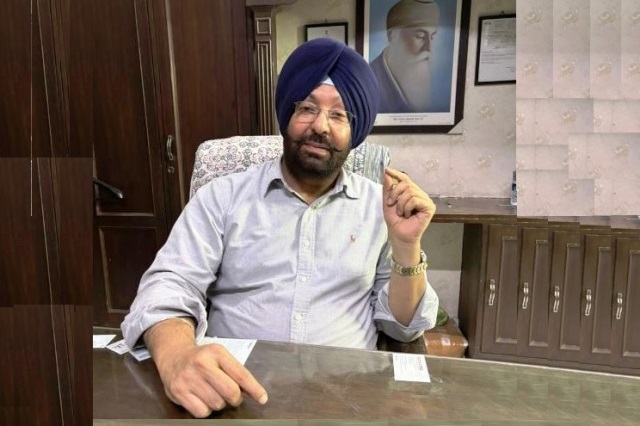
Member of the state working committee of Shiromani Akali Dal (Badal), Iqbal Singh Dhindsa, says the SAD since its inception has been committed to protecting the interests of Sikhs and the spirit of Punjabiyat. He accuses the Bharatiya Janata Party of trying to divide and decimate regional parties in several state, including Punjab. The Akali Dal has seen through their dirty tactics and is now working hard to revive its image in the state. In an interview with Mahabir Jaiswal for Lokmarg.com, Dhindsa talked about various aspects of Punjab politics, regional aspirations and federalism. Excerpts:
Q. As one of India’s oldest political parties which seeks to protect the rights of the minority Sikh community, how do you see the importance of federalism in a country as diverse as India?
The Akali Dah has been fighting for Punjab and Punjabiyat since its origin. The struggle for the rights of the Sikh community has continued and our party has made countless sacrifices towards this objective. Even today, our priority remains committed to this goal. Talking about federalism, it has been the basic Constitutional model of governance since Independence and the SAD finds it essential for the all-round development of the individual states as well as for the nation collectively.
Q. Do you believe federalism, where power is decentralised, is steadily getting weakened in India after Narendra Modi took over the Centre in 2014? If yes, please give examples to support your view.
Every party pursues its own agenda and follows its own set of rules to run a government. The BJP is running its party according to its own principles which, indirectly or directly, reflects in its governance model: that is a strong Centre. However, regional parties like the Akali Dal work on its own principles to counter such agenda. The people of Punjab had the lion’s share of the sacrifices made for India’s independence. Even before the British colonizers, our great Gurus made sacrifices to save the soul of India, to protect our culture and the underprivileged.
The situation hasn’t changed much even in Independent India; those who occupy the throne in Delhi start believing that they can run the entire country. This is not only impossible but also unviable. The centre and the state governments must work as a unit for the development of the state and indirectly the country as any conflict of interest leads to losses on both sides.
Q. The BJP is accused of cannibalizing its own regional allies, gradually weakening them and then pushing them to margins. This was seen in Maharashtra recently. You have been an alliance partner of the BJP and seen its functioning up close. Do you find any truth in such allegations?
When a regional entity joins hands with a stronger national party, some conflicts of interests are bound to happen. Our party allied with the BJP and formed a government in Punjab but unfortunately, things did not go down as per the order or the consensus. One of our aims earlier was also to unite the Sikh community and the Hindu community in Punjab to foster peace and harmony.
Instead, there were attempts to split the Akali Dal on numerous times. Thankfully, these divisive forces have been ineffective and we have remained united. Our leaders and workers are steadfast. Differences do arise due to various reasons, and our leaders and workers may temporarily go astray, but they understand that the interests of Punjab and Punjabi culture are protected by the Akali Dal and therefore, they return back to the fold in the interest of Punjab. The parties in Delhi cannot break Punjabis, because Punjab resides within us.
Q. There have been allegations that the BJP wants a strong Centre which can influence areas and power that come under States list as per the Seventh Schedule? Do you agree with this view?
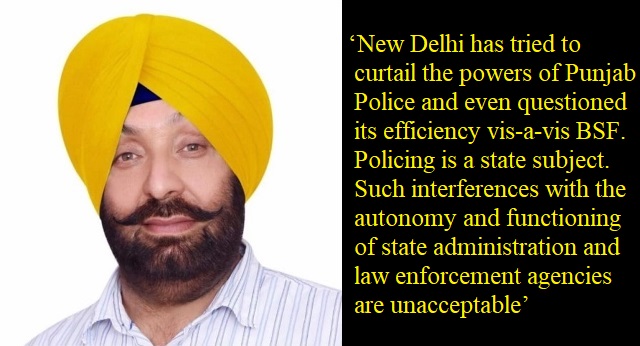
These allegations might be true to some extent and I would like to substantiate this with one example – the central government attempted to reduce the powers of the state government in Punjab by expanding the jurisdiction of the Border Security Force (BSF), allowing them to exercise its jurisdiction up to 15 km in border towns. This decision by the central government has angered the people of Punjab as it was due to the extreme efforts and commitment of our Punjab Police (PP) that terrorism was wiped out from Punjab. New Delhi has, in a way, curtailed the powers of the state police and also questioned its efficiency. Policing is a state subject. Such interferences with the autonomy and functioning of state administration and law enforcement agencies could not be termed as appropriate.
Q. Central parties have more resources and money to manipulate electorate and elections. In your view, do regional parties suffer from any handicap while posing a challenge to National political groups?
I do not believe so. Former PM late Atal Bihari Vajpayee was once the BJP’s lone MP, but now the BJP rules at the Centre as well as most of the states. Congress ruled the country for 70 years and now it remains marginalized. Ups and downs are the laws of nature and no one can stop it, no one can bind it. Since the BJP is the largest party in the country today, it has all the resources. However, regional parties have their own identity, their own vote-base, their own culture, and the ability to fight for their people. Our decisions are not driven by some big policy-maker sitting in a Delhi air-conditioned room, but by the people of Punjab on ground.
Q. Akali Dal has been reduced to just one seat in state Assembly and one in Lok Sabha. This is a monumental decline. Why do you think this happened? Has there been any inner review to find out the reasons for this decline?
One of the reasons behind our weakened state is the BJP which hatched a conspiracy and tried to take over the Gurudwara Management Committees in Punjab. BJP members spread false propaganda among the Sikh community about Akali Dal leaders. The media, social media, and some senior leaders were misled. The innocent people of Punjab were also fed lies. A campaign was launched to mislead the people of Punjab and gain votes and today, the people of Punjab are regretting it. They are cursing the BJP and the current Aam Aadmi Party government. If elections were held today, the Aam Aadmi Party and the BJP would be wiped out.
Q. How does the party leadership plan to revive its fortune in Punjab?
There is always a scope for corrections and transformation to resurrect one’s political fortunes. Things didn’t work out with National parties, so we are looking forward for possibilities with smaller and regional parties to consolidate our base. We are also connecting with the people of Punjab to carry forward our legacy of ‘Punjab and Punjabiyat’. We are also exploring other avenues to reach out to the people of Punjab and hope to come out with flying colours sooner than later.
Dreams do come true, and for Sharvari, that dream has now become reality as she has been signed as a leading lady in veteran filmmaker Sooraj Barjatya’s film ‘Yeh Prem Mol Liya’.
Backed by Rajshri Productions in association with Mahaveer Jain Films, the project stars Ayushmann Khurrana opposite Sharvari.
Expressing her excitement, Sharvari took to Instagram and wrote, “The journey of ‘Yeh Prem Mol Liya’ – a very very special film has been filled with gratitude, blessings, positivity and all things amazing”
She added, “To be directed by Sooraj sir is my biggest dream come true! And sharing this journey alongside Ayushmann makes it even more special. Can’t wait for you all to experience this on 27th November 2026, in theatres!”
The film marks Barjatya’s return to direction after his critically acclaimed ‘Uunchai,’ for which he won the National Award for Best Director.
Known for his signature family-centric storytelling, the director is set to revisit one of his most beloved cinematic elements, the character of Prem.
“With Yeh Prem Mol Liya, Rajshri’s beloved character – Prem – makes a return to the big screen after 12 years,” the makers noted.
Khurrana will step into the iconic role for the first time, bringing his interpretation to a character long associated with the Rajshri banner.
The film also reunites Barjatya with composer Himesh Reshammiya after their previous collaboration on ‘Prem Ratan Dhan Payo’. (ANI)
Vishesh Films has officially announced ‘Awarapan 2’, the long-awaited sequel to its 2007 cult classic, with a theatrical release locked for August 14, 2026, coinciding with the Independence Day weekend.
The film will see Emraan Hashmi reprise his role as Shivam.
The promotional imagery features a close-up of a hand marked with a bird tattoo, echoing the original film’s themes of freedom and redemption.
Positioned as a major Independence Day release, ‘Awarapan 2’ also stars Disha Patani in a leading role opposite Hashmi, marking her first collaboration with Vishesh Films.
Directed by Nitin Kakkar, the sequel aims to build on the emotional depth of the original while introducing a fresh cinematic approach.
Producer Vishesh Bhatt underlined the scale and emotional core of the project, stating, “Awarapan is an emotion so large that it’s meant for the big screen. It also presents exotic settings and large scale sequences but fundamentally it’s built on our core principles of layered storytelling with powerful characters and rich music. Emraan felt the angst of Shivam so deeply that he stepped into character in a heartbeat. And with Disha Patani joining us, the world of the film opened up to new possibilities,” in a press note.
The sequel continues Vishesh Films’ collaboration with Sony Music India. The original ‘Awarapan’, released nearly 19 years ago, remains widely regarded for its tragic narrative and memorable soundtrack.
The makers have confirmed that Awarapan 2 is currently in its final leg of production in Mumbai and will release in cinemas worldwide on August 14, 2026. (ANI)
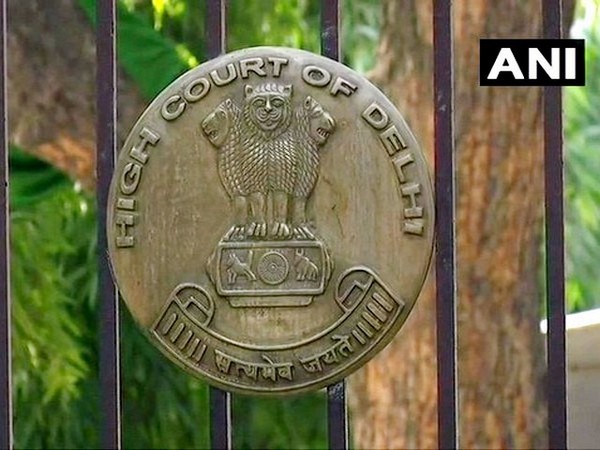
The Delhi High Court has granted an ex parte ad interim injunction in favour of actor Allu Arjun, restraining multiple entities from unauthorised use and commercial exploitation of his personality rights, including his name, image, voice, likeness and distinctive attributes, across physical and digital platforms.
Passing detailed directions, Justice Tushar Rao Gedela held that the material placed on record clearly establishes a strong prima facie case in favour of the actor.
The Court observed that the balance of convenience lies with the plaintiff and that irreparable harm would be caused if immediate protection were not granted.
Accordingly, defendants were restrained from using or misappropriating Allu Arjun’s identity or any attributes uniquely associated with him for commercial or personal gain, including through emerging technologies such as artificial intelligence, deepfakes and voice cloning.
The Court further prohibited the defendants from violating the actor’s moral rights by exploiting his performances using technological tools, and from selling or advertising any goods or services under his name or registered trademarks. This includes merchandise such as clothing, posters, mugs and digital content that leverage his persona without authorisation.
Significantly, the Court directed certain intermediaries to remove all infringing links and websites identified by the plaintiff within 72 hours, while permitting the actor to notify additional infringing content in future. Upon such intimation, intermediaries have been directed to promptly block access to such material.
The Court also granted liberty to the plaintiff to implead newly discovered infringers and seek an extension of the injunction against them.
The Court noted that the actor has demonstrated extensive goodwill and reputation built over decades, supported by documentary evidence of his career, awards, endorsements and trademark registrations. It was observed that his name, likeness, voice, gestures and other personality traits are distinctive identifiers exclusively associated with him and are entitled to legal protection.
The matter was heard on a plea filed by Allu Arjun seeking protection of his personality rights against unauthorised commercial exploitation, including AI-generated content and online merchandise. At the outset, the Court had also raised questions regarding territorial jurisdiction, noting the actor’s connection to Telangana. In response, counsel for the actor argued that the alleged violations occur across digital platforms nationwide, justifying the Court’s jurisdiction.
Senior Advocate Swathi Sukumar, appearing for the actor, highlighted the growing misuse of celebrity identities through technology, including applications enabling interaction with AI-generated versions of the actor. She termed the situation “truly frightening” and emphasised the urgent need for judicial intervention.
Meanwhile, counsel for intermediaries opposed the grant of a global injunction, pointing out that related issues are pending before a Division Bench. Taking note of the submissions, the Court confined its directions to specific infringing content while indicating that appropriate orders would follow.
The High Court has now issued summons in the suit and listed the matter before the Joint Registrar for completion of pleadings, while the case will be taken up next before the Court on September 24, 2026. (ANI)
Crude oil prices have nearly doubled amid the ongoing West Asia crisis, rising from around USD 63 per barrel in January to an average of USD 116 per barrel in April, even as domestic fuel supply remains stable, a senior government official said on Tuesday.
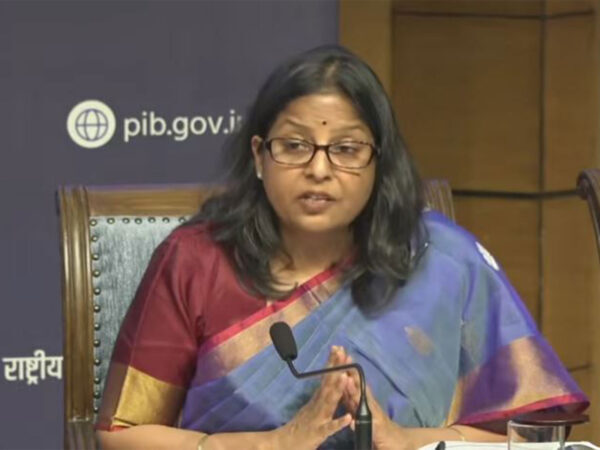
“If you see, in January, our Indian crude basket was around USD 63 per barrel. Which increased to USD 113 per barrel in March and in April, the average is around USD 116 per barrel,” said Sujata Sharma, Joint Secretary (Marketing & Oil Refinery), Ministry of Petroleum and Natural Gas, during an inter-ministerial briefing.
Despite the sharp rise in global prices and volatility, Sharma said India continues to maintain relatively lower fuel prices compared to neighbouring countries. “Our prices among our neighboring countries are one of the lowest,” she noted.
On supply, Sharma said domestic LPG availability remains unaffected. “The domestic LPG supply for the domestic kitchen is normal with respect to the bookings, and there is no dry-out reported on any LPG distributor,” she said, adding that delivery efficiency currently stands at 93 per cent.
She acknowledged some fluctuations in demand, stating, “There has been some reduction in online booking. It is in the range of 45-46 lakh per day,” while noting that commercial LPG supply has been largely restored.
Highlighting consumption trends, Sharma said that in April so far, “there has been a sale of 1,23,000 tonnes of commercial LPG… yesterday, there was a sale of 8,822 tonnes.”
The government has also expanded access to smaller cylinders for migrant populations. “The Indian government has doubled the number of 5-kilo cylinders… since April 3, there have been 7,400 awareness camps,” she said, adding that “more than 1,07,000 5-kilo cylinders have been sold so far.”
On natural gas, Sharma said supply remains stable. “Domestic PNG supply and CNG transport have been maintained 100 per cent,” she stated, adding that over “5,68,000 new consumers have been registered for PNG connections.”
She also noted a shift among consumers, with “more than 39,400 PNG consumers… surrendering their LPG connections.”
Reassuring on overall fuel availability, Sharma said, “Retail supply is also normal. No dry out of any product has been reported on any petrol pump,” while adding that “our refineries are operating at optimum capacity and crude inventory is also sufficient.”
The government has stepped up enforcement to prevent disruptions, with “more than 2200 surprise inspections and raids… carried out yesterday,” she said, adding that action has been taken wherever irregularities were found.
The briefing comes as the government continues to monitor the impact of geopolitical tensions in West Asia on energy markets and domestic supply chains. (ANI)
Legendary cricketer Sachin Tendulkar lauded the Indian players for their blistering performance in the ICC Men’s T20 World Cup 2026 final against New Zealand at the Narendra Modi Stadium in Ahmedabad on Sunday.
Superb contributions of Abhishek Sharma, Ishan Kishan and Sanju Samson helped the defending champions to post a monstrous total of 255/5 in 20 overs.
Taking to the social media platform X, Tendulkar noted that Abhishek Sharma had a challenging tournament but justified the team’s faith with a blistering half-century in the summit clash.
“Not the easiest tournament for Abhishek Sharma, but the team showed belief in his ability. He has repaid that faith with a crucial knock in the final. Well played. Ishan Kishan is bringing real momentum to the innings, and Sanju Samson is continuing his reliable run,” Tendulkar wrote on X.
Coming to the match, Majestic fifties from Sanju Samson, Ishan Kishan and a late cameo from Shivam Dube propelled India to a massive 255/6
India posted the highest total ever in the final of a T20 World Cup. Dube slammed an unbeaten 26 off just 8 balls. He smashed James Neesham for 24 runs in the final over.
New Zealand captain Mitchell Santner won the toss and elected to field against India in Ahmedabad.
India’s opening duo, Sanju Samson and Abhishek Sharma, have exposed New Zealand’s lack of big-match experience in the powerplay.
After a watchful first couple of overs, India hit top gear, clobbering 24 in the fourth over as Samson-Sharma became the first opening duo to score a 50+ stand in a T20 World Cup final.
The Black Caps’ pacers, including Matt Henry, have struggled to maintain a steady line, with Henry conceding four wides in the fifth over.
This led to New Zealand bowling eight extra deliveries in the powerplay, the most they’ve ever done in T20Is. Samson and Sharma have capitalised on this, scoring 92 runs in the power play, the highest ever in a T20 World Cup match.
Abhishek Sharma blasted an 18-ball fifty, and the duo became the first opening pair to score a 50+ stand in a T20 World Cup final.
Though Sharma wasn’t in the best of form at the start of the World Cup. Sharma rose to the occasion in the final, bringing up the fastest 50 of the tournament in just 18 balls with the help of six fours and three sixes.
Rachin Ravindra provided his team with the breakthrough as he had Sharma nicked to the wicketkeeper. However, the 98-run opening stand, with Sharma contributing 52 off 21, may have well set India up for another big score.
Even after losing the wicket, India kept up the relentless pace. Samson and Ishan Kishan have put on 93 off just 41 balls for the second wicket, taking India to 191/1 in 14 overs.
Samson continued his incredible form, scoring a half-century in the T20 World Cup final, his third consecutive in the tournament. He became the third player to achieve this feat in a semi-final and final.
New Zealand’s pace-heavy attack, featuring Lockie Ferguson and Matt Henry, struggled to contain India’s aggressive batting, with Ferguson conceding 48 runs in two overs.
Neesham gave a much needed break through over to New Zealand as he removed Samson, Kishan, and Indian skipper Suryakumar Yadav on a golden duck in the 16th over, as India slipped from 203/2 to 204/4.
Kiwi’s pulled back the scoring rate after the 16th over. Veteran seamer Henry, in his last over, opened his wicket tally after he removed Hardik Pandya for 18 runs.
India’s crisis man delivered yet again with his big hits in the final over. India finished on 255/5, six runs short of the highest T20 WC score. (ANI)
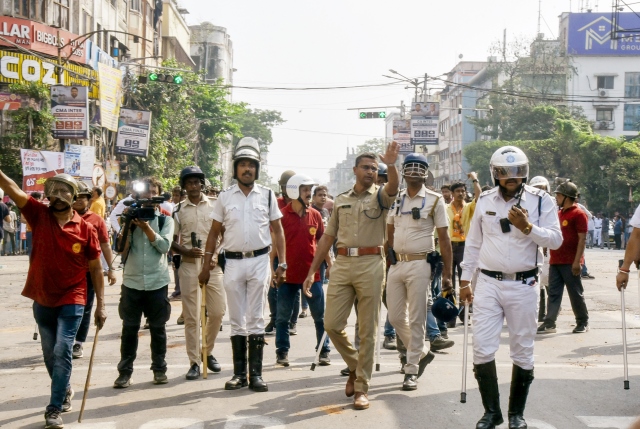
A total of nine people, including five BJP workers and four TMC workers, were arrested after tensions escalated into a clash outside Ekbalpur Police Station in Kolkata on Monday.
As per the Kolkata police, the incident unfolded on Hossain Shah Road during a campaigning programme, triggering a confrontation between supporters of the two rival parties.
According to Kolkata Police, the clash broke out when Bharatiya Janata Party (BJP) supporters gathered for a meeting led by party candidate Rakesh Singh. During the programme, sloganeering by BJP workers was met with counter-slogans from supporters of the All India Trinamool Congress (TMC), leading to a heated exchange that soon turned violent.
Police intervened to control the situation and prevent further escalation. Officials confirmed that a total of nine individuals, five from the BJP and four from the TMC, have been taken into custody. “Three FIRs have been registered against different groups in connection with the incident,” Kolkata Police said.
Further details are awaited.
The clash comes amid a charged political atmosphere in West Bengal ahead of the Assembly elections, scheduled to be held in two phases on April 23 and April 29, with counting on May 4.
Meanwhile, Chief Minister Mamata Banerjee has intensified her attack on the BJP, alleging attempts to disrupt her campaign. She recently claimed that her flight was deliberately delayed and accused the BJP of deploying “cherry-picked” officers to create hurdles for her party.
Banerjee also alleged that the BJP was trying to intimidate workers through false cases and misuse of agencies, while urging voters to remain vigilant during polling and counting.
West Bengal, which has 294 Assembly seats with a majority mark of 148, is witnessing a high-stakes contest between the ruling TMC and the BJP, with both parties ramping up their campaigns in the final stretch before voting. (ANI)
We use cookies to give you the best online experience. By agreeing you accept the use of cookies in accordance with our cookie policy.
When you visit any web site, it may store or retrieve information on your browser, mostly in the form of cookies. Control your personal Cookie Services here.
These cookies are essential in order to enable you to move around the website and use its features. Without these cookies basic services cannot be provided.
Cookie generated by applications based on the PHP language. This is a general purpose identifier used to maintain user session variables. It is normally a random generated number, how it is used can be specific to the site, but a good example is maintaining a logged-in status for a user between pages.
In order to use this website we use the following technically required cookies
wordpress_test_cookie
wordpress_logged_in_
wordpress_sec
These cookies allow the website to remember choices you make (such as your user name, language or the region you are in) and provide enhanced, more personal features. These cookies can also be used to remember changes you have made to text size, fonts and other parts of web pages that you can customize. They may also be used to provide services you have asked for such as watching a video or commenting on a blog. The information these cookies collect may be anonymized and they cannot track your browsing activity on other websites.
Cookie associated with sites using CloudFlare, used to speed up page load times. According to CloudFlare it is used to override any security restrictions based on the IP address the visitor is coming from. It does not contain any user identification information.
Cookie associated with sites using CloudFlare, used to identify trusted web traffic.
__cfruid
These cookies collect information about how visitors use a website, for instance which pages visitors go to most often, and if they get error messages from web pages. These cookies don’t collect information that identifies a visitor. All information these cookies collect is aggregated and therefore anonymous. It is only used to improve how a website works.
This cookie name is associated with Google Universal Analytics - which is a significant update to Google's more commonly used analytics service. This cookie is used to distinguish unique users by assigning a randomly generated number as a client identifier. It is included in each page request in a site and used to calculate visitor, session and campaign data for the sites analytics reports. By default it is set to expire after 2 years, although this is customisable by website owners.
This cookie name is associated with Google Universal Analytics, according to documentation it is used to throttle the request rate - limiting the collection of data on high traffic sites. It expires after 10 minutes.
This cookie is installed by Google Analytics. The cookie is used to store information of how visitors use a website and helps in creating an analytics report of how the website is doing. The data collected including the number visitors, the source where they have come from, and the pages visited in an anonymous form.
These cookies are used by Youtube, Google, Twitter, and Facebook to deliver adverts that are relevant to you and your interests. They are also used to limit the number of times you see an advertisement as well as help measure the effectiveness of the advertising campaign.
This cookie is usually associated with the ShareThis social sharing widget placed in a site to enable sharing of content across various social networks. It counts clicks and shares of a page.