Donkeys Vanishing but Donkeyism Flourishing
There is some deeply disturbing news from India that is Bharat. No, it is not inflation. No, it is not pollution. Nor is it the fact that every second person on social media has suddenly become an expert on geopolitics, economics, medicine and cricket.
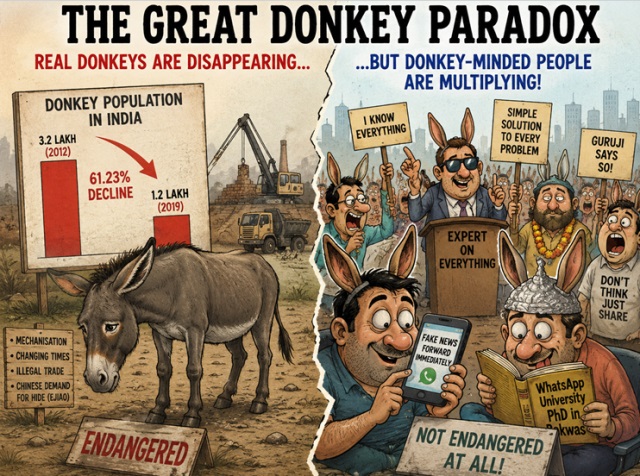
The real crisis is that donkeys are disappearing. According to livestock census data, India’s donkey population has declined by more than 61 percent between 2012 and 2019. From about 3.2 lakh, their numbers have fallen to around 1.2 lakh. Experts fear the decline has continued thereafter.
This is alarming because, at first glance, it appears to contradict everything we see around us. After all, if one were to judge by television debates, social media timelines, road traffic, election rallies and WhatsApp University classrooms, one would conclude that the country is experiencing a historic donkey boom.
Every day thousands of citizens display a remarkable ability to forward fake messages without reading them, argue passionately about subjects they know nothing about, and follow self-appointed gurus over cliffs of logic and reason. Surely, one would think, the donkey population should be flourishing.
Yet the statistics stubbornly insist otherwise. The explanation, perhaps, lies in a crucial distinction. Real donkeys and human “donkeys” are entirely different species.
The real donkey is hardworking, patient, reliable and remarkably resilient. It carries heavy loads without complaint. It serves quietly without demanding likes, shares or prime-time appearances. It does not start arguments on social media. It does not become an instant expert after watching a three-minute video. It does not insist that every problem has a simple solution.
In fact, when compared objectively, the donkey emerges as one of the more sensible creatures inhabiting the planet. This raises a troubling possibility. For centuries, humanity may have unfairly maligned the donkey.
Perhaps it is time to apologise. The actual donkey never caused a traffic jam by driving on the wrong side of the road. It never invested its life savings because an influencer promised guaranteed returns. It never believed that drinking mysterious herbal concoctions would solve all economic and health challenges.
A donkey has never been known to start a rumour that spread across an entire nation in minutes. Humans, however, continue to achieve these milestones with impressive consistency.
Experts attribute the decline in donkey numbers to mechanisation. Machines have replaced them at construction sites and brick kilns. Young people are abandoning traditional occupations involving donkey rearing. Illegal trade linked to the international demand for donkey hides has also contributed to the crisis.
In other words, society has become too modern for donkeys. Curiously, the same modernisation has not reduced the number of people willing to surrender independent thinking.
Indeed, there appears to be a reverse correlation. The more smartphones we acquire, the less we seem inclined to use the equipment already installed inside our skulls. As a result, India may soon face a peculiar situation. Future generations might visit wildlife parks where guides point towards a fenced enclosure and announce:
“Children, this is a donkey. Once upon a time, these animals carried bricks, sand and goods across villages.”
A curious child might ask, “Sir, is this the same donkey we hear about every day?”
The guide would smile gently and reply: “No, my child. Those are still available in abundance.”
The tragedy is that while the metaphorical donkey thrives, the real one is vanishing. Perhaps conservationists should launch a national campaign: ‘Save the Donkey.’ Not for sentimental reasons alone, but because the animal deserves better than being compared to us.
After all, if current trends continue, there may soon come a day when India’s last surviving donkey looks around, observes human behaviour and decides that extinction was the wiser choice.
(Sidharth Mishra is an author, academician and president of the Centre for Reforms, Development & Justice)



There seems to be an urgency of opening a serious debate on fall out of mechanisation on the cultural and ethical dimensions of society. Especially, in country like Bharat that was mainly an aggregearian society and a Sanskritik Rastra, the fall outs are very far reaching and significant.