Some Stray Thoughts To Chew On
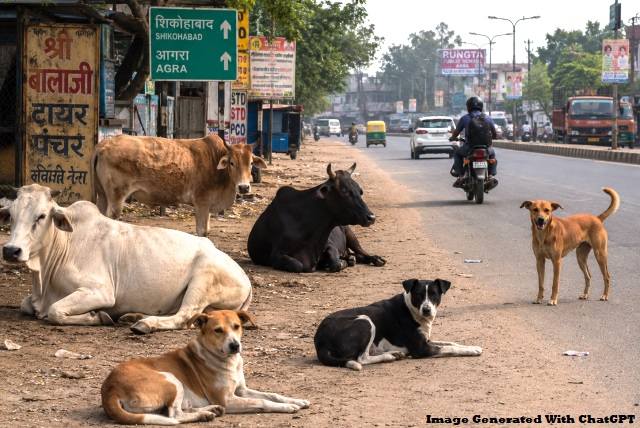
A common sight on Indian streets is a tussle between stray cows and stray dogs. While scrounging for food in garbage dumps, the dogs, in defending what they perceive as their turf, bark the bovine animal away.
One is considered sacred by the majority Hindu population, making it politically and emotionally sensitive, while the other enjoys huge middle-class and animal lovers’ empathy.
If a cow gives life-sustaining milk, a dog’s sense of loyalty is legendary. It finds mention in the Mahabharata as having attained Nirvana along with the Pandavas, its masters. And yet, it lives the proverbial dog’s life.
The two issues are interconnected. Hence, two developments of the last month must be noted: one is a Supreme Court verdict on the treatment of stray dogs. The other is a demand by Jamiat Ulama-e-Hind President Maulana Arshad Madani and prominent Muslim personalities and organisations that the government declare the cow India’s “national animal.”
Former vice president Mohammed Hamid Ansari has reportedly lent his support. Assam’s Badruddin Ajmal seeks that the Sanatan faith be respected by avoiding cow sacrifice.
The timing of this unexpected push is significant. Ostensibly, the Muslims realise that with the Bharatiya Janata Party making rapid strides across the country, and one of its core agendas being ending cow slaughter, the Muslims, estimated between 220 and 230 million, must seek to live in peace. They cannot bank on secular parties, divided and weakening as they are, for protection. Arguably though, this is the present political reality.
Ironically, starving stray cows roam the streets, even as members of a particular community, traditionally engaged in treating those that are discarded, get targeted by vigilantes who belong to another community.
The Muslims’ seemingly unified approach seeks a clear, uniform legal stance on cow’s status, moving beyond the grey areas that, experience shows, fuel vigilantism.
Lynching Crime Figures
Human Rights Watch (HRW), independent monitoring groups and human rights organisations estimate that between 44 and over 50 people have been killed in cow-protection-related violence and mob lynching across India, with hundreds of others injured. Because the National Crime Records Bureau (NCRB) does not officially maintain a separate, distinct statistical category for “cow vigilantism” deaths, precise nationwide data relies primarily on independent media trackers and human rights databases.
By making this demand, the Muslim proponents are putting the onus on the government to either resolve the conflict or explain why they won’t. It is not easy.
This potentially impacts both local beef consumption and export industries. Domestic consumption is low and uneven. It is hit further by several states in north and central India totally banning animal slaughter. But India is the Number 2 exporter globally. Legally, it strictly prohibits the export of meat derived from cows, calves and bulls. Consequently, 99 per cent of India’s “beef” exports consist of water buffalo meat, known internationally as carabeef. They earned over ₹34,000 crore in revenue, according to recent trade data.
Led by Uttar Pradesh, which accounts for 48 per cent, all carabeef-exporting states are BJP-ruled. A point of political discussion is that many of India’s top export houses are owned or co-owned by Hindu entrepreneurs, showing that economic enterprise transcends religious lines.
Perhaps this explains why the government and the BJP have not reacted so far. Only Union Minister Giriraj Singh has accused the Muslim of being guided by the opposition Congress party.
However, shorn of political and religious issues, the crisis caused by ageing domestic cattle (India has the world’s largest population) and dogs not being eliminated is alarming. It has led to a breakdown in the rural circular economy and has created a massive stray-animal crisis.
Public Health Crisis
Truth be told, a man/woman is selfish who does not want to sustain an animal once its utility is over. It becomes economically unsustainable. India is facing an escalating socio-economic and public health crisis in managing its free-roaming animal population, which includes an estimated 5 million stray cattle and 62 to 80 million stray dogs.
Managing the idle stray animals imposes a heavy financial drain on state exchequers, public health departments, and rural households. It imposes a macroeconomic burden worth billions of rupees annually, divided between medical costs from dog-mediated rabies and state expenditure on stray cattle management.
The gaushalas opened by the states cannot take in the growing cattle population that, in search of food and water, devastates standing crops and causes road and rail accidents. For stray cattle, direct deaths are less clear, but these animals frequently cause train and road accidents.
Religious sentiments have led to curbs on exports to Bangladesh, encouraging smuggling and causing human loss on both sides. Besides, it is a sore point with the neighbour that depends on Indian cattle during its religious festivals.
Although comparing a cow and a dog would be instantly disapproved of, the fact is that socio-religious protests with political goals have not ensured the cow’s safety and sustenance. These two have also eluded the dog, despite the Supreme Court ordering targeted removal of strays from high-footfall public places, transport hubs, and highways. This appears unworkable and expensive. Like the politically expedient respect for cows, lack of vision does the rest.
The courts rightly argue that while animal welfare is important, public safety and the fundamental human right to life must take priority. But the solutions they offer, as directives, have polarised society.
Stringent legal bans on cattle slaughter across most states, combined with active cow-protection groups, have crippled the traditional livestock trade. Farmers can no longer sell ageing, male, or unproductive cattle. Because keeping an unproductive cow costs around ₹7,800 per month, financially strained farmers are forced to abandon them on roads and fields.
The same happens to domestic dogs, shown love by families, even shown off with pride. Once old and sick, they are let off. This street dog crisis centres on a severe human-wildlife conflict in urban areas, creating a highly polarised domestic debate.
Animal welfare groups, including PETA India, argue that permanently locking up millions of dogs is logistically impossible, financially unviable, and inherently cruel.
Of global rabies cases, 36 per cent are in India. Experts say the disease is transmitted almost entirely by stray dog bites and disproportionately impacts children under the age of 15 from lower socio-economic backgrounds. Treating a dog bite costs between ₹1,400 and ₹2,160 per case due to hospital travel, wound care, and lost daily wages.
According to the World Health Organisation (WHO), stray dogs cause between 18,000 and 20,000 human deaths in India annually. A 2025 Lancet study, however, suggests a more conservative figure of around 5,726 deaths.
Over 3.7 million dog bite incidents were reported in India in 2025, though the actual number is likely much higher.
Sooner rather than later, India needs to resolve its dilemma of stray cows and dogs, which stems from a direct clash among deeply rooted cultural compassion, strict animal welfare laws, and critical public safety concerns.