Exit. Or, No Exit?
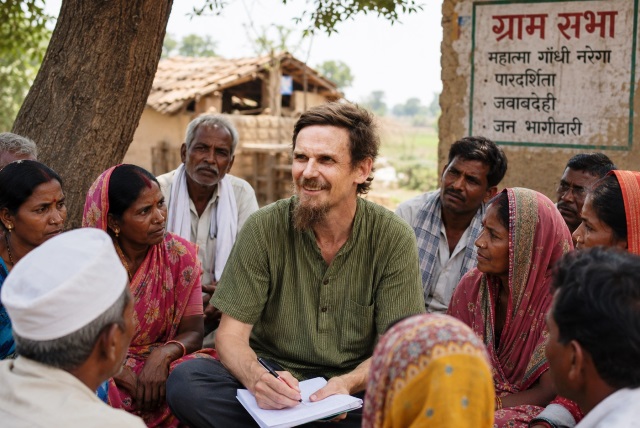
If Bengal is thinking today, what India thinks tomorrow, as the old-fashioned cliché goes, there are three clear scenarios which seem to be emerging. As a ‘probashi’ who has covered the last assembly polls on the ground, in the height of the pandemic, travelling on packed local trains, I have a million precious memories of ‘Shonar Bangla’ and its ordinary folks, especially the hardworking saree-clad women and school girls on cycles, in small towns and rural Bengal – all committed supporters of Didi.
I will share one memory, not to prove anything, only to cherish their instinctive intelligence.
After having managed a window seat in an over-crowded local from Howrah, I found a mother and her school-going daughter (without a mask) seated opposite me. She was eating an ice cream, no fancy stuff, simple, sweetened icy stuff, red in colour, which you can roll on your tongue for a long, long time.
“How much does it cost now?” I asked her.
“Five rupees,” she said, and smiled, satisfaction writ large on her dark face with big, black eyes.
“In my days, it would cost only 5 paisa,” I replied.
She laughed. “I wish it would cast the same – even now!”
I kept quiet.
“You are smiling now, I know,” she said – a naughty girl.
“How do you know? I am wearing a mask.”
“You might be wearing a mask. But your eyes are smiling,” she said.
Her happy mother agreed.
It is this sublime instinct which travels with the intelligent Bengali voter in the interiors, surrounded by paddy, coconut trees and mustard flower fields, with the cool wind blowing through the lush green landscape, the flapping banana tree leaves, and the serene waters of rippling ponds. Homeland, or no homeland, you can’t help but love its people and the place.
This is the instinctive intelligence, confident and subtle, which makes the Bengali mind, often not-so-easy-to-read, often remarkably radical, as the history of its revolutionary inheritance shows; from the freedom struggle, to the Naxalbari movement – those turbulent days of the late 1960s-early 70s, in the countryside, as much as on College Street and the prestigious Presidency College in Kolkata.
Let me tell you another story of two brave-heart schoolgirls, who remain etched in my mind. This is another forgotten story, especially in contemporary neo-Nazi times, a truly inspiring story.
In 1908, young revolutionaries (almost all our martyrs were young, the old usually are compromised) Khudiram Bose and Aurobindo Ghosh were tried in the Muzaffarpur-Maniktala bomb case. Dutt manufactured the bomb. He was sentenced to 12 years in the notorious ‘Kala Pani’ hell-holes in the Andaman jail. Suniti Choudhury, a schoolgirl, inspired by them, began to learn about shells, gunpowder and bombs. (Reference: A well-researched article by Ritesh Shukla, Bhaskar –English, November 2025).
Khudiram Bose was hanged on August 11, 1908, at the Muzaffarpur Jail. He was 18. As a kid, I grew up singing a song dedicated to him, with my sister, in our open-to-sky courtyard in Saharanpur, tears flowing from our eyes.
Ek baar bidaayi dei Ma ghure aasshi… haashi haashi chorbo phaashi… dekhbe Bharotbashi…
(Say goodbye to me finally, Mother, let me go travel… I will go to the gallows with a smile on my lips, the people of India will see…)
Rajguru, Sukhdev and Bhagat Singh were hanged on 23 March, 1931. Moments before he was taken to the gallows, Bhagat Singh was reading Lenin. When the guards came to take him, he reportedly said, “Hold on. One revolutionary is talking to another.”
Bhagat Singh was 23 and he had written the brilliant essay: Why I am an Atheist, still read and absorbed by young idealists and dreamers. He had famously stated that the finest army of revolutionaries were hidden in the villages and factories of India.
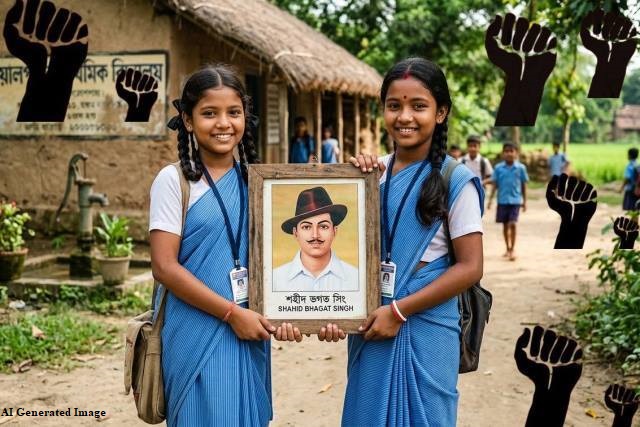
For Shanti Ghosh (15) and Suniti Chouduhry (14), two schoolgirls in Comilla (Chittagong, now in Bangladesh), Bhagat Singh and his comrades were icons.
Ritesh Shukla writes: “On 6 May 1931, Netaji Subhas Chandra Bose attended the annual conference of the Tripura District Students’ Union as chief guest. Suniti led the girls’ parade at the event. After the parade, she was appointed leader of the weapons-trained girls and entrusted with the custody of firearms. Later, (Nandini) Brahma (who trained the girls) asked Netaji what role women should play in war. He replied, “I would be very pleased to see you all on the front.” When Shanti asked him for an autograph, he wrote: “O Mother Power, take up arms in your hands for your honour.”
Meet Charles Geoffrey Buckland Stevens, District Magistrate of the Tripura district, then in Comilla. He seemed to be of the same ghastly breed as the infamous ‘Dyer the Butcher’ of the Jallianwalla Bagh massacre, finally assassinated by legendary Udham Singh in London, who made this project his only and ultimate goal in life. Mahatma Gandhi’s Salt Satyagraha-Dandi March began on 12 March 1930. He was arrested on May 4.
Following a crackdown across India, Stevens went berserk. Apart from the terror machine let loose by him, he faced allegations of sexual misconduct. He operated from his bungalow under armed protection.
Writes Shukla: “On 14 December 1931, a bullock cart stopped outside the District Magistrate’s bungalow. Laughing and chatting, Shanti and Suniti stepped down and approached the security guard. From their appearance and dress, they looked like ordinary schoolgirls. They asked for permission to meet Stevens and politely produced an application written in English, explaining that they needed the sahib’s approval to organise a swimming competition at their school…
“The police did not suspect the girls. They were allowed to enter the bungalow without being searched. Inside, Stevens was sitting in his office with the Sub-Divisional Officer Nepal Sen. The girls requested the orderly outside to deliver a note to the sahib. After reading it, both officers came out.
“Unbeknown to anyone, the girls had concealed a revolver each beneath their shawls. Addressing the District Magistrate as Your Majesty, they spoke with practiced politeness… Stevens granted permission for the swimming competition. Smiling, the girls asked him to write a note of approval and sign the application. Stevens and Sen went back into the office; after signing, Stevens came out alone…
“As he emerged, he saw that the girls’ demeanour had changed completely. Their shawls were cast aside, and each held a revolver aimed at his chest. Without hesitation, they pulled the triggers simultaneously. Stevens was killed on the spot.”
It was their revenge against the hanging of their icon: Bhagat Singh.
A revolutionary tribute, perhaps unprecedented in history. Perhaps, only the schoolgirls of Soviet Russia, who fought so valiantly and defeated Adolf Hitler’s army, could match this courage.
Hence, three scenarios are likely to emerge on and after May 4 in Bengal.
One, in the polls, it is Didi and entire Bengal versus Mr M, Respected Shri Gyanesh Kumarji and his SIR with over 90 lakh deletions of voters, and the massive paramilitary force in Bengal, also unprecedented in Indian electoral history.
In a free and fair poll, Didi will win hands down. No force can defeat her.
Two, in an un-free and unfair poll, backed by the might of a partisan State apparatus with zero justice as a priori (as it happened in the states where the BJP won contrary to poll predictions), BJP will have a fraudulent victory in a state where it is on the margins and where the majority care two hoots for Hindutva. Besides, Durga and Kali are cultural icons here – not Jai Shri Ram.
In this case, this will be final nail in the ravaged coffin of Indian democracy. The banana republic will start rotting now, for the world to see, in this heat.
Third, Bengal might explode, showing the way to other regions, especially Punjab and the South – sick of this crony-capitalist, quasi dictatorship hatched from Delhi by the BJP-RSS led by two Gujaratis.
And then will resurrect the memory of not only Khudiram Bose, Bagha Jatin, Master Surya Sen, Kalpana Dutt and Pritilata Wadeddar (Chittagong armed robbery), among other revolutionaries.
From the unwritten text books of unwritten history, will emerge the story of two brave schoolgirls of Comilla/Chittagong, holding a picture of Bhagat Singh, their icon.
Yes. Shanti Ghosh and Suniti Choudhury.