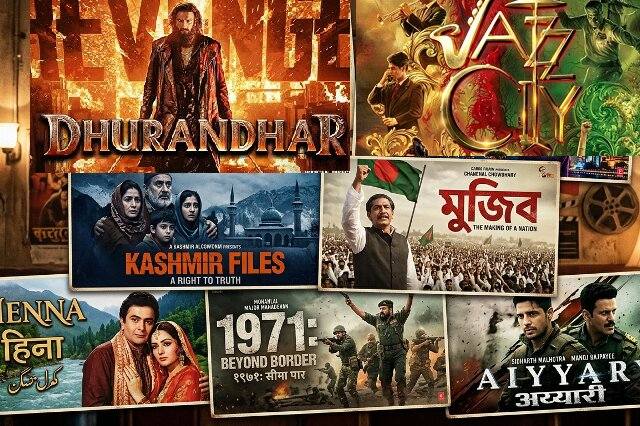
Bollywood’s Border Issues
Bollywood blockbusters Dhurandhar (original and its sequel) and Sony LIV’s web series Jazz City have revived a debate on what Indian cinema supposedly does to its smaller neighbours, who call it “cultural hegemony”.
With cultural and language affinity, India enjoys an advantage. But it rankles the public mind and raises nationalistic sentiments since cinema, unlike say, a machine, is a product of direct public consumption.
This ‘hegemony’ is also a commercial reality. Of the 1,500 to 2,500 films India makes annually, the world’s highest, Hindi-Hindustani cinema, dubbed ‘Bollywood’, is a major contributor. Global web platforms have broken territorial barriers, enabling, along with others, an increased Indian cinematic presence.
Among cinema’s pioneers, the Subcontinent both emulated and resisted Hollywood and European cinema and developed its own in multiple languages. But since the 1947 Partition, cinema, especially in India, Pakistan, and Bangladesh, has been heavily fraught with geopolitical tension, often resulting in bans and controversies.
Interestingly, the hegemony charge does not exclude plagiarism that has gone on famously. All are guilty. But that is a different story.
Since 1962, Pakistan has frequently banned Indian films for portraying it negatively. Some of them are offensively poking in the Pakistani eye. Contentious themes include historical disputes and religious sentiments.
Most finger-pointing is done on terrorism. Pakistan’s response has been poor: Waar (2013), Yalghaar (2017) and Zarrar (2022). The Indian avalanche, backed by huge budgets, technical gloss and actors popular on both sides of the border, is massive. Indian films like The Kashmir Files, The Kerala Story, Aiyaary and Salman Khan-starred Tiger have provoked bans, also in the Gulf nations.
Some Indian films depicting Pakistan negatively inspire a ‘nationalist’ tone at home that is also anti-Muslim. When the two get clubbed, Pakistan alleges that through them, India is pandering to its domestic ‘Hindutva’ agenda.
Conscious of being the birthplace of goddess Sita, Nepal protested in 2023 against a dialogue in Adipurush. Led by its current Prime Minister, Balendra Shah, it caused a temporary ban on Indian films. The birthplace of Mala Sinha and Manisha Koirala, Nepal is generally forgiving.
But Bangladesh, where most of Bollywood’s Bengali film personalities have roots, gets upset. Post-independence, the early years saw co-productions like Ritwik Ghatak’s Teetas Ekti Nadir Naam. So was Shyam Benegal’s last film Mujib (2023). But successive governments, while allowing select films intermittently, have historically restricted Indian film imports to protect local cinema. Many see Bollywood as a threat to local language and culture.
The current controversy over Jazz City centres on the series being “about Bangladesh, without Bangladesh.” The period drama has a refugee running a club in Calcutta (now Kolkata), getting drawn into the politics and intelligence operations of 1971. Popular Bangladeshi actor Arifin Shuvu plays the role fairly well, but Dhaka’s issue is with its treatment by director Soumik Sen, an Indian.
“The question isn’t just what stories are told. It is rather who gets to tell them, who drives them, and whose perspective dominates,” Jannatul Naym Pieal writes in The Daily Star (March 21, 2026). “The framing is subtle but unmistakable. History happens, but its momentum seems to come from elsewhere. If this feels like déjà vu, that’s because Bollywood has been doing this for decades. India’s role dominates the screen, while Bangladesh’s struggle fades into the background.”
The freedom movement is a sensitive issue in Bangladesh. Pieal strongly recommends: “Perhaps it’s time we started telling 1971 our way.”
Well thought! But the problem in Pakistan and Bangladesh, both being cinema pioneers, is that local films, despite best efforts, cannot keep pace with the growing domestic demand. While artists and filmmakers oppose the imports, the film distributors and exhibitors prefer Indian films to keep their audiences.
The decline in Bangladesh’s homegrown film industry has led to the closure of over 1,000 movie theatres in the past decade. As for production, at one point, nearly 100 movies were made each year. Now there are only 30 or 40.
In Pakistan, most bans came in the Ziaul Haq era. It was not always strictly enforced. Benazir Bhutto permitted the partial shooting of Raj Kapoor’s Henna (1991). Relaxation came in 2008 under another military dictator, Gen Pervez Musharraf. The film exhibitors were asked to provide an equal share of screening time between Indian and Pakistani films. The cinema halls were full, and new ones were built.
Fawad Khan, Mahira Khan, Ali Zafar and Saba Qamar acted in Indian films. But it boils down to bilateral relations. The tenures of Musharraf and, later, Nawaz Sharif saw brief periods without conflict. Post the Pulwama terror attack, however, the ban was re-enforced in 2019.
The long no-talks phase saw former premier Imran Khan clubbing “Hollywood and Bollywood” as ‘vulgar’ and promoting Turkish cinema as part of the “Islamic renaissance”.
Currently, despite a Supreme Court-backed ban by PEMRA, the official media regulator, Indian songs, including Dhurandhar’s Jaiye Sajana, continue to dominate the Pakistani music audience. The regulator demanded action against Geo TV for telecasting Asha Bhosale’s songs. The channel defended it, saying that it was only paying a tribute to Bhosale, who passed away last week.
This essay is neither meant to uphold Bollywood’s supremacy and its cultural/commercial dominance, nor to lament the response of India’s neighbours. It seeks a somewhat larger perspective.
Actually, India is also a ‘victim’ of what it is accused of. Only a few years younger than Hollywood and much of the European cinema, the Indian cinema has carved its own place and audiences at home and abroad. Yet, foreign filmmakers, with ‘colonial’ perspectives to suit Western audiences, play down Indians, their mythology, literature and events like the freedom movement. Indian characters are reduced to bit roles.
British films on Lord Mountbatten made in 1986 and 2017, for instance, projected him as the hero, and Indian characters, from Mahatma Gandhi onwards, were but incidental.
But then, filmmaking is an artistic enterprise with millions placed on the shoulders of its makers. One cannot quarrel with, say Richard Attenborough for choosing a British-Indian to play Gandhi.
Numerous Hollywood films have left out Indians from their narratives. For example, The Bridge on the River Kwai (1957) was a World War II film on the Burma campaign, which involved thousands of Indian soldiers. But there is none in that classic.
Talking of the World Wars, India was not partitioned then. In World War I, 74,000 to 89,000 Indians were killed, and 67,000 wounded. In World War II, military deaths alone were over 87,000, wounded/missing were 34,354 and 67,340 were taken prisoners of war (POW).
Add to them the civilian deaths. Estimates vary from two to three million. Most of them were during the 1943 Bengal famine, partly caused by the British government’s wartime food shortages and policy decisions. The last bit is for Bangladesh.
Neighbours ought to share the gain or loss, and the credit with India. Is anyone willing to do that?