Where is India in a Changing World
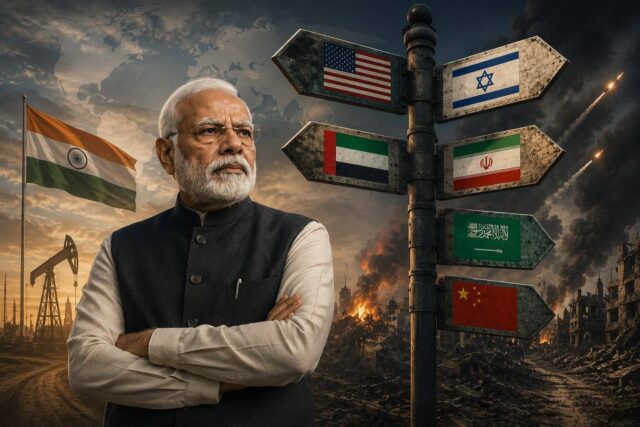
India is finally beginning to speak after weeks of silence over the conflict between Israel and Iran, a conflict that could yet drag the wider West Asian region into a far larger crisis. But the real issue is not what India has now said. It is what India can no longer do. As war spreads across West Asia, the old diplomatic map is collapsing. Alliances are shifting, energy politics is once again driving strategy, and the familiar labels of friend and foe explain less by the day. In that world, India looks less like a rising power shaping events than a country struggling to turn size and ambition into influence.
For years, India liked to see itself as a power that could stand near the world’s fault lines without being trapped by them. That confidence is now harder to sustain. Its growing defence ties with the UAE, its public sympathy for Israel and its broader tilt towards Washington all reflect a country adjusting to a harsher, more polarised world. That may be sensible. But it also means giving up some of the flexibility that once let India speak with real authority across the Global South. Why has that happened? Three reasons stand out.
The first is simple: the world that made non-alignment possible has gone. After decolonisation, newly independent states entered a Cold War split between the Soviet bloc and the American-led West. Many wanted time and space to secure their sovereignty rather than become proxies in someone else’s ideological fight. India, the largest of the postcolonial states, helped turn that instinct into the Non-Aligned Movement, alongside Egypt, Yugoslavia, Indonesia, Ghana and later Cuba.
The strategy suited India. Democracy and elite instinct pulled it towards the West; its economic model and reliance on Soviet arms pulled it the other way. Non-alignment was not just moral posturing. It was a practical way to preserve room for manoeuvre.
That logic no longer holds. The emerging order is not cleanly ideological. America remains the leading military and economic power. Russia still matters to India as an arms supplier, but it is no longer the Soviet Union. China, meanwhile, is Washington’s main strategic rival and, in effect, the second pole of the system. For India, that changes the calculation completely. The balancing act is no longer between Washington and Moscow, but between Washington and Beijing, while keeping Russia from slipping away altogether.
Unlike the Soviet Union, China has never been a power India could trust. The two countries remain divided by border tensions, rivalry and suspicion. China is also closely aligned with Pakistan, India’s main regional adversary, while Iran has grown more dependent on Beijing. Even the Non-Aligned Movement is no longer a space in which India can assume moral authority. China’s influence across much of that world now runs through trade, infrastructure, debt and diplomacy.
Non-Aligned Movement Is Gone
In that world, neutrality no longer delivers what it once did. From New Delhi’s point of view, non-alignment no longer guarantees influence and may not even guarantee security. That helps explain why India has moved closer to the American camp, even at the cost of narrowing its room for action elsewhere. What was once a doctrine of manoeuvre is now little more than an inherited slogan.
The second reason is that India’s ability to act as a broker has shrunk. Difficult relations with China, dependence on Middle Eastern energy and a stiffer diplomatic posture have reduced its room for manoeuvre. Pakistan, by contrast, has often shown more tactical flexibility, moving between larger power centres when it suited its interests and maintaining influence in parts of the Islamic world through the Organisation of Islamic Cooperation (OIC). Whether or not one wants to labour that comparison, the broader point is plain: India looks less like an independent mediator than it once did, and more like a state looking for cover in a harsher world.
The third reason is deeper: the character of India’s leadership. The generation that led India through decolonisation produced figures such as Jawaharlal Nehru, Vallabhbhai Patel and V. K. Krishna Menon—leaders with ideological confidence, international stature and a willingness to think beyond the next administrative problem. Whatever one thinks of their mistakes, they had strategic ambition. Under Nehru, India did not simply react to the post-war order; it tried to shape it.
A transformed world required a new generation of equally imaginative leadership. It is far from clear that India under the BJP has produced it. Mr Modi has often preferred technocrats and retired senior civil servants in some of the most sensitive roles. That may bring discipline and administrative efficiency. It is much less likely to produce strategic imagination.
Geopolitical Upheaval
Civil servants can be excellent administrators. But administration is not politics, and managerial competence is not historical judgement. Bureaucracies are built to reduce risk, avoid controversy and preserve continuity. Moments of geopolitical upheaval demand something else.
There is a deeper institutional problem too. Much of India’s governing structure remains an inheritance from colonial rule. Earlier generations of politicians mediated between that inherited apparatus and India’s own social and civilisational realities. An overreliance on the civil service risks preserving the shell of the state while draining it of political imagination.
From this perspective, India’s problem is not just a run of policy errors but a shortage of political vision. As Russia weakened and China rose, a more ambitious leadership might have moved earlier to ease tensions with neighbours, build a broader regional bloc and create stronger counterweights to Beijing. Instead, India has drifted into a narrower posture, retreating behind security logic and letting avoidable frictions harden.
The BJP is not short of intelligent political figures, and the wider Indian political class still contains people capable of strategic thought. Yet under a technocrat-heavy style of governance, such figures have too often been pushed aside in favour of officials who are loyal, disciplined and effective within a fixed line, but unlikely to challenge it. That may produce control. It rarely produces vision.
That is the real missed opportunity. A world in transition offered India the chance to turn its scale, confidence and postcolonial legitimacy into real leadership. Instead, it has too often looked cautious where it needed to be bold. Meanwhile, China—despite lacking many of India’s natural advantages in the region such as culture, language, religion and shared histories—has been more effective at drawing neighbouring states into its orbit and presenting itself as a dependable partner to parts of the developing world.
Mr Modi should rely less on bureaucratic management and make more room for politically grounded strategists with wider horizons. Capable civil servants will always be necessary, but they cannot substitute for leaders willing to take calculated risks and redefine India’s place in the world. The contrast between the 2019 Balakot strikes and Operation Sindoor shows how much India’s strategic signalling and regional environment have changed.
India still has time to recover a more independent and influential role. But that will take more than competent administration and careful positioning. It will take nerve, imagination and a clearer sense of national purpose in the international arena.