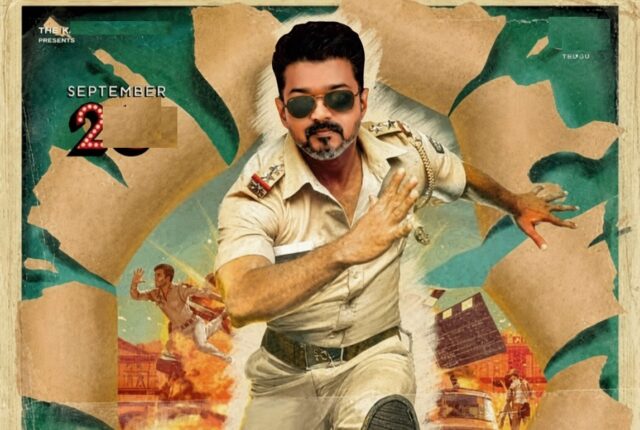
Phata Poster, Nikhla CM
The ‘interval’ of this ‘Kollywood’ (made in Madras, now Chennai) film is over. Vijay, the ‘angry young man’, has stopped romancing the heroine, singing and dancing his way into the hearts of the Tamils. He was the ‘Thalapathy’ (commander or leader), who solved the common man’s problems within his film’s runtime. Not anymore.
In the second half of this ‘film’, Thalapathy will not just play, but perform as Tamil Nadu’s chief minister. The ‘show’ has just begun, and not just for the Tamils, but also for the rest of India to watch. He has already set a good example for the nation by showing respect for those he has defeated, something glaringly absent in other states that had elections.
Chandrasekaran Joseph Vijay, Vijay for short, is an unusual name even for a child of Tamil cinema – son of a Christian film director and a Hindu playback singer. Although many of his films have grossed multiple crores and been shown internationally, and he has won awards as an actor and singer, he is largely unknown outside the state and the Tamil cinema realm, where he has reigned for nearly three decades.
He retired formally from cinema and entered the political arena with Tamilaga Vettri Kazhagam (TVK) barely two years ago. During the election campaign, the pollsters had mostly spoken of the ‘Vijay factor’, unsure of the political impact he could make. As the single largest winner, with 36 per cent of popular votes, he has taken them all by surprise.
In a sense, Vjjay represents the gulf between Tamil Nadu and the rest of India. That cultural and linguistic gap is now political as well, given his opposition to the Bharatiya Janata Party, which now dominates the political firmament, ruling at the Centre and in 21 states.
However, he is unlikely to get into a confrontation. He knows that funds for Tamil Nadu will have to come from New Delhi. Himself a man of means, reputedly worth ₹6.25 billion ($66 million), he has said he is not in politics to make money.
He has said that he will remain the sole power centre. But he could get help from several well-educated legislators, if social media posts about them are true.
The Rookie Politician
Tamil Nadu is a large, front-line state that has been governed relatively better than those in the North. But it will not be easy for Vijay, who has no experience in governance. Putting it cynically, only the faces change, including those from the tinsel town. Tamil Nadu’s great advantage is a good bureaucracy and a vigorous political system.
Much has already been written about his ending the duopoly of the Dravidian parties, DMK and Anna DMK, but not enough about the likely continuity that he could provide to the Dravidian movement with his reverence for EV Ramaswamy Naicker, the Periyar, and his emphasis on the Tamil language and culture and on social justice. He began his campaign by citing MG Ramachandran (MGR) and M Karunanidhi as his ‘role models’.
His comparison with MGR and Andhra Pradesh’s NT Rama Rao (NTR) is inevitable as they emerged from cinema to challenge entrenched political systems. Also, Jayalalithaa, who was a four-time chief minister. Yet they all belong to very different political eras. MGR straddled the 1970s and NTR 1980s, while Jayalalithaa was in and out of power, well into this century, till her death in 2016.
MGR, who broke from the DMK and founded the AIADMK in 1972, rose during the peak of Dravidian ideological politics, the Tamil cinema striking deep political roots amidst limited Television reach and the state having extensive social justice mobilisation. His forte was welfare populism, Tamil pride and emotional identification with the poor.
NTR, who emerged in 1982 amid Congress dominance under Indira Gandhi, nurtured resentment against “Delhi control” and transformed Telugu identity into a political movement with the slogan Telugu Atma Gauravam. (Telugu self-respect).
Taking in their respective cinema persona and political image, MGR was the benevolent protector who was generous, morally pure, a protector of the poor, a defender of women and was perceived as almost saint-like. Tamil audiences blurred the line between the actor and political saviour. This emotional transfer was unprecedented.
NTR was the mythological king who often portrayed Hindu gods, kings and epic heroes. For millions of Telugu viewers, he acquired an almost sacred aura. When he entered politics, many saw him not simply as a celebrity but as a civilisational figure.
Jayalalithaa, who began as MGR’s protégé, survived huge odds, including physical violence, pushed these programmes and became ‘Amma’ to the poor. She played politics at the national level and indeed, contributed to the downfall of one government. The ADMK has never really recovered from her death.
MGR remained within the Dravidian political tradition. But he softened the DMK’s ideological sharpness and made politics more personality-driven. NTR’s politics have permanently changed Indian federal politics by strengthening regional-party power nationally. Vijay appears ideologically lighter, less doctrinaire and more flexible.
Hero of a Different Era
Unlike MGR, Vijay is less paternalistic. Unlike NTR, he lacks mythological symbolism. Instead, he reflects: modern urban frustration, aspirational politics, anger at corruption and inequality.
Vijay belongs to a radically different age dominated by social media, of which he made effective use. It has been youth-driven politics and a decline in ideological loyalty. His challenge is therefore structurally harder in some ways.
While Karunanidhi’s DMK will have to survive, yet again, loss of power, the ADMK of MGR and Jayalalitha has just split, and NTR’s Telugu Desam Party is thriving under his son-in-law, N Chandrababu Naidu.
It is too early to place Vijay in their league historically. But if successful, he could be the first major digital-age regional populist leader, combining cinema charisma with social-media mobilisation.
Vijay is neither NTR nor MGR, nor Jayalalithaa, but he has taken two formidable Dravidian parties to the cleaners. His victory indicates a generational shift in voter preferences and a shift in the political landscape of an ideologically rooted State. The expectations are high, and both supporters and rivals are watching to see if he can deliver stable governance and continue to guide Tamil Nadu on its strong development trajectory.

• A Historic Rupture: Vijay’s ascent marks the first time in over 50 years that the DMK-AIADMK duopoly has been successfully challenged by a third force.
• Youth-Driven Mandate: His victory was fueled by massive mobilization of young voters and a digital-first campaign that translated cinematic “mass” appeal into electoral power.
• Coalition Blueprint: Leading a “post-Dravidian” era, Vijay formed a strategic coalition with parties like Congress and the VCK to secure a stable majority.
• Symbolic Modernity: His swearing-in (notably in a black suit rather than traditional white veshti) signals a shift toward a more contemporary and sleek political identity.
• High-Stakes Transition: The transition from a ₹200-crore superstar to a public administrator now faces the ultimate test: fulfilling grand welfare promises while managing the state’s debt.
