Can China Stabilise a Fracturing World Order?
As confidence in the United States has weakened in parts of the international system, more governments are turning to China as a steadier counterpart; the central question, however, is not whether China has the economic, diplomatic and military weight to expand its influence, but whether it can offer a persuasive organising vision for the next world order.
Over the last four centuries, the international system has increasingly been shaped by the spread of sovereign statehood, international law, representative government and human rights. After two world wars, Europe and the United States sought to embed these principles in a rules-based order and to promote them globally through diplomacy, institutions, incentives and, at times, coercive intervention.
This framework was institutionalised through bodies such as the United Nations, whose charter rests on sovereign equality while also promoting human rights, legal order and multilateral diplomacy. Not all states embraced the full package, but even many partial adopters engaged with its language and institutions, giving the post-war system broad normative reach.
That order now appears less secure because its principal architect, the United States, is showing less consistency in defending it. Washington’s recent posture has led many states to question the durability of American leadership and to explore alternatives or hedging strategies.
Russia India Factor
Among the major powers positioned to benefit from this shift, Russia retains military weight but lacks broad economic appeal, while India’s influence is rising but remains constrained by capability gaps. China, by contrast, is the only plausible challenger with both scale of capital and strategic reach.
China has built influence patiently through trade, investment, infrastructure finance and diplomatic restraint. Unlike the often-declaratory style of Western power projection, Beijing presents its external engagement as pragmatic, non-judgmental and mutually beneficial, which has increased its appeal across parts of the developing world.
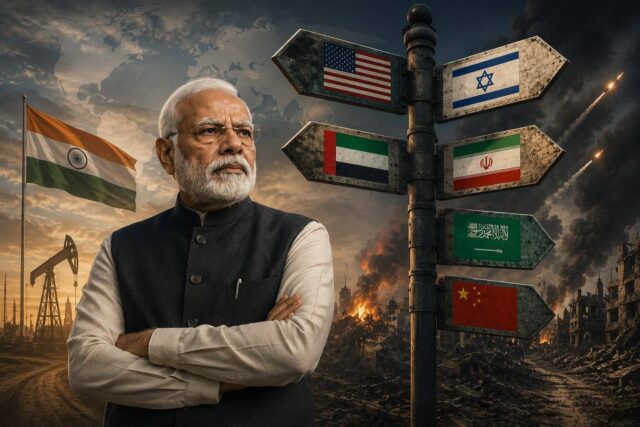
In recent Middle Eastern crises, China has projected caution rather than overt alignment, cultivating the image of a disciplined power that prefers distance from open conflict. At the same time, critics argue that its indirect strategic relationships with regional actors can still shape outcomes without requiring visible intervention.
China has also strengthened defence and technology ties with key partners in Asia, reinforcing the perception that it can alter regional balances through long-term capability building rather than dramatic military posturing.
More broadly, China has cultivated a wide network of states that see it as an economic partner, diplomatic shield or strategic counterweight to Western pressure. Its willingness to trade with sanctioned or politically isolated governments has deepened that constituency.
BRICS Backing
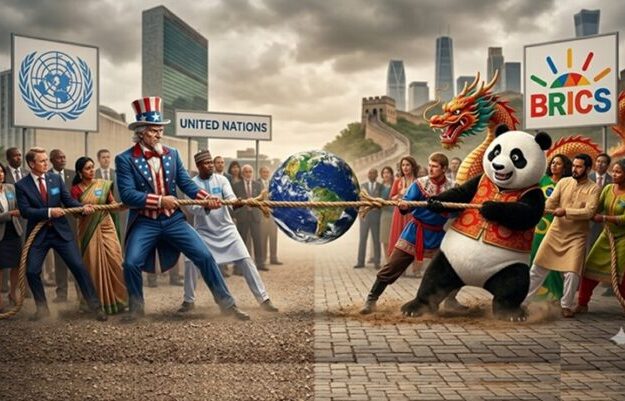
China has also invested heavily in platforms such as BRICS, which has expanded beyond its original membership and now presents itself as a vehicle for greater coordination among non-Western powers. Even so, it remains an evolving coalition rather than a fully coherent alternative order.
China’s rise rests not only on scale but on execution. It has reduced extreme poverty on a historic scale, built formidable industrial depth and established strong positions in strategic technologies, especially batteries, electric vehicles and solar manufacturing, where recent industry reporting indicates substantial global market leadership.
Because China has generally preferred commercial penetration and diplomatic positioning to direct military intervention, many governments view it as a less disruptive great power. That perception has widened its influence in the Global South and increasingly in parts of the Middle East.
Yet capability alone does not make a hegemon. China may be able to provide a period of stability, but stability is not the same as legitimacy, and legitimacy usually depends on a compelling political idea as well as material power.
Chinese leaders advocate a more multilateral and multipolar order rooted in sovereign states. But this is not a fundamentally new concept; it largely restates principles already embedded in the United Nations Charter, including sovereign equality and structured great-power management through the Security Council.
The post-Soviet era gave the United States an extraordinary strategic advantage, but it struggled to convert that moment into a durable and widely trusted settlement. Overreach, inconsistency and selective application of its own norms weakened the credibility of the order it led.
At its strongest, the post-war model rested on three pillars: sovereign statehood, legal and human-rights norms, and development through trade and economic integration.
Western powers did not always uphold these principles consistently, particularly on intervention and double standards. Even so, the language of democracy, law and rights retained global legitimacy; many states that violated these ideals still felt obliged to justify themselves in relation to them.
That is the strategic weakness in China’s proposition: it often objects to Western application of the current order without supplying a comparably developed normative framework of its own. Its argument is strongest as a critique of Western inconsistency, but weaker as a blueprint for a successor system.
In practice, China emphasises sovereignty above almost everything else. That position resonates with governments wary of intervention, but it mainly intensifies one established principle of the existing order rather than creating a broader political settlement for an era of fractured identities, transnational movements and contested legitimacy.
That matters because the sovereign state is not an uncontested unit everywhere. Many borders were products of empire rather than organic political communities, and many contemporary movements operate across borders or reject the state altogether.
Across several regions, armed groups, militias and ideological networks challenge the state’s monopoly on force without necessarily seeking conventional secession. That reality exposes the limits of any world order built on sovereignty alone.
Persistent internal fragmentation, separatist pressures and identity conflicts across multiple regions also show that many states remain politically incomplete, regardless of their formal international recognition.
Nor do the nation-state and universal-rights model sit comfortably within every civilisational or political tradition.
A genuinely post-Western order would therefore need to answer harder questions than China currently does: how to reconcile dignity with plural moral traditions, how to accommodate layered identities within states, how to manage cross-border communities, and how to adapt international institutions to actors that matter politically but are not states.
China’s emphasis on development and poverty reduction is important, but history suggests material advancement alone rarely sustains a world order. Durable systems usually pair prosperity with a story about legitimacy, purpose and belonging.
China’s own modern ascent and stability, after the fall of Qing dynasty and a turbulent period that followed, was also mediated through an imported universalist framework—Communism—later adapted into socialism with Chinese characteristics. That history underlines the importance of ideas, not just power, in structuring political transitions.
Anchor, Not Author
The most plausible near-term outcome is not Chinese replacement of the United States as a fully realised hegemon, but Chinese reinforcement of order during a period of American volatility. Even if Washington later restores some strategic consistency, the perception of interrupted reliability will be difficult to reverse quickly.
China, then, is best understood not yet as the author of a new world order, but as the most credible anchor in an interregnum: materially strong, strategically disciplined and increasingly indispensable, yet still short of the universal political vision required to define the next era.