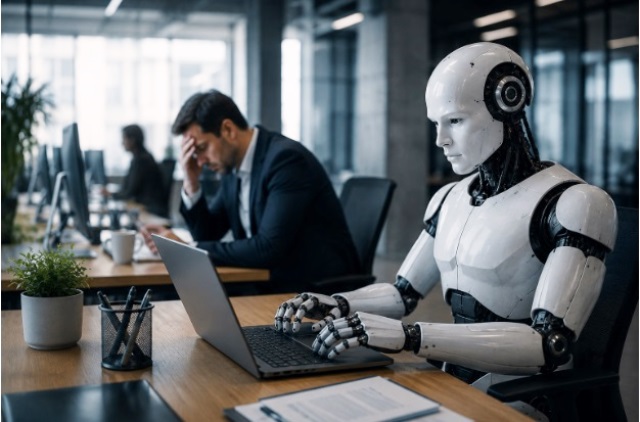
AI Replacing Workers: Progress or Threat to Livelihoods?
Akash, 35, who was a customer support executive at a private company in Gurugram last year, was given a clinical and efficient reason for his job loss. The company had been ‘optimising operations’ with AI systems that could process thousands of customer queries simultaneously. Automated systems that operate 24 hours a day could now manage what used to be entire teams. But, for Akash, the language of innovation meant a personal uncertainty. His experience is not unique, and there is a growing anxiety among workers across sectors. With the rapid growth of artificial intelligence, there is a question on whether this progression of technology will enhance opportunities or increase economic insecurity.
The advent of AI has revolutionized workplace discussions. Automation is no longer confined to factories or repetitive industrial labour. Now, software can generate reports, process legal documents, create graphics and even simulate human conversation. Tasks that were once thought to require human intelligence are now being done by machines. This change has brought about a mix of hope and dread.
Those who embrace AI say it’s a natural aspect of economic evolution. Innovation has a history of destroying old forms of work and creating new industries. Mechanisation of agriculture decreased the manual labour and increased the manufacturing. Some jobs were lost and others were created because of the internet. In this view, AI is not a destructive force but another step in the evolution of change.
There is some truth to that argument. AI has boosted efficiency in various sectors. Businesses can process information more quickly, at a lower cost and at a larger scale. In the medical field, AI helps with diagnosis and data management. Adaptive learning platforms in education are used to individualize teaching. AI is crucial for startups and tech companies to remain competitive on the global stage. Such developments have tremendous economic potential in a developing economy like India.
However, the public is still very concerned as the current transition is perceived as much faster and more pervasive than past ones. AI isn’t just impacting manual work, as previous technological breakthroughs have; it’s beginning to impact white collar professions as well. The uncertainty is a growing problem for accountants, writers, customer service agents and even software developers. The worry isn’t just losing a job, it’s losing relevance in the economy.
This is particularly noticeable in young professionals. A lot of people have invested years in learning new skills, and they’re now at risk of being replaced by robots. The faith in the stabilizing power of education is fading. Now, families who are looking to support their children in finding stable jobs face an uncertain labor market, characterized by algorithms and machine learning systems.
This admiration and apprehension often permeates public opinion regarding AI. Automation is valued for its convenience and yet people are concerned about its social impact. While a chatbot can make customer service more efficient, it also represents a lost person’s job. Self checkout systems in stores save time, but quietly they decrease jobs. Social displacement can be hidden behind technological convenience.
The situation is worse in a country like India, where millions are joining the workforce each year. Without massive automation, job creation will continue to be a problem. Increased adoption of AI could potentially exacerbate economic disparities if not properly managed. Workers with high skills may greatly benefit from working with AI, but workers with lower and middle skills may experience difficulties in adapting.
Meanwhile, it would be too early to say what the future will look like without human effort. Human oversight, creativity, ethics, and emotional intelligence remain crucial in the field of AI. Machines can process data efficiently, but they don’t have lived experience, they don’t have moral judgement. Empathy, negotiation and contextual understanding are important aspects of many professions which are not easily replicated by technology.
Perhaps more important than the question of whether AI will replace humans is whether societies are training workers to adapt to new jobs. Education systems continue to focus on memorization and standardized learning, instead of adaptability. Critical thinking, digital literacy, communication skills, and lifelong learning are likely to be the skills that are needed in the future workforce. You might have to re-invent yourself several times throughout your career.
Akash is looking for new opportunities and has started taking on-line courses in data analytics. His situation is a reflection of the disruption, and adaptation, that characterizes this moment. Artificial Intelligence is not all danger, not all promise. The extent to which it can be effective will be dependent on how societies will choose to deal with change.
Technological progress is not the only measure of progress. The real work is to ensure innovation empowers human potential, and doesn’t simply ignore it.