An Intellectual Who Chose Electoral Battlefield to Onscreen Sparring
On the day the newly elected BJP legislators gathered in Kolkata for the swearing-in ceremony of the opposition-led assembly contingent after the 2026 West Bengal elections, an unusual video caught the attention of political observers. Amid the chaos of the crowded venue and the oppressive Kolkata heat, one could spot Swapan Dasgupta, dressed in his trademark simplicity, clutching a card as hand fan and looking for a place to sit. It was a scene that seemed almost surreal.
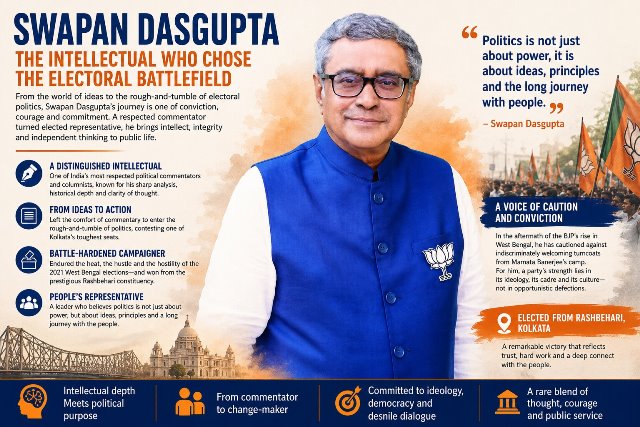
For decades, Swapan Dasgupta, now Finance Minister of West Bengal, had been known as one of India’s most influential political commentators, an intellectual voice shaping conservative discourse from newspaper columns, television studios, and policy forums. Seeing him jostle for space among party workers and newly elected legislators was symbolic of a larger transformation from an elite public intellectual into a grassroots politician.
Dasgupta’s journey into active politics is unlike that of most contemporary politicians. Educated at some of the finest institutions in India and abroad, and widely respected across ideological lines for his writing and political analysis, he built a reputation as one of the sharpest commentators on Indian politics. His columns combined historical depth with contemporary relevance, earning him a loyal readership among both supporters and critics.
Over the years, he emerged as one of the most articulate defenders of the Bharatiya Janata Party’s ideological worldview. Yet his role remained largely that of an interpreter rather than a practitioner of politics. He was the intellectual bridge connecting the BJP’s political aspirations with a broader audience of opinion-makers and the urban middle class.
The 2026 West Bengal Assembly election changed that when the BJP decided to field Swapan Dasgupta from the prestigious Rashbehari constituency in Kolkata, which many viewed as a symbolic candidacy not knowing that he has been nursing the seat for past few years. Despite the preparation, the constituency was hardly an easy battleground, and Dasgupta was not a conventional mass leader with a ready-made political base. Moreover, he was stepping into one of the most fiercely contested elections in recent Indian political history, where emotions, identities and political loyalties ran deep.
Campaigning in the sweltering Bengal summer, traversing neighbourhoods, attending corner meetings, interacting with local voters and enduring the relentless pressures of an election campaign, Dasgupta demonstrated a willingness to leave behind the comfort of intellectual engagement and immerse himself in the rough-and-tumble of democratic politics. For a man more accustomed to debating ideas than canvassing votes, it was a remarkable transition.
His victory from Rashbehari carried significance beyond the constituency itself. It represented the BJP’s attempt to combine intellectual capital with political mobilisation. More importantly, it showed that Dasgupta was willing to subject his ideas and convictions to the ultimate democratic test of the verdict of the electorate.
What distinguishes Swapan Dasgupta from many contemporary politicians is his ability to balance ideological commitment with independent thinking. Even after becoming an elected representative, he has not hesitated to express views that may not always align with prevailing political enthusiasm.
He has warned against indiscriminately opening the doors to political migrants from Mamata Banerjee’s camp. His concern reflected a deeper understanding of political organisation and ideological coherence. For him, a party’s long-term growth could not be built merely on the acquisition of defectors. Political expansion, he argued implicitly, must be accompanied by the development of a committed cadre and a distinct political culture.
This ability to think beyond immediate electoral gains has long been one of Dasgupta’s defining characteristics. He belongs to a shrinking class of politicians who see politics not merely as a contest for power but as a vehicle for ideas. His interventions often draw upon history, political philosophy and comparative experiences, lending a perspective that is increasingly rare in India’s fast-paced political environment.
At a time when public discourse is often reduced to slogans and sound bites, Swapan Dasgupta continues to represent the importance of intellectual engagement in politics. His journey from columnist to legislator illustrates that ideas and electoral politics need not exist in separate worlds.
That image from Kolkata of the distinguished intellectual searching for a seat while fanning himself in the humid heat may well serve as a metaphor for his political career. It captures a man who willingly stepped out of elite comfort zones and entered the crowded arena of democratic politics, determined to test his convictions among the people rather than merely write about them.
In an age of professional politicians and television warriors, Swapan Dasgupta remains an unusual figure: an intellectual who chose the battlefield.
(Sidharth Mishra is an author, academician and president of the Centre for Reforms, Development & Justice)