Military, Mullah & Mediator
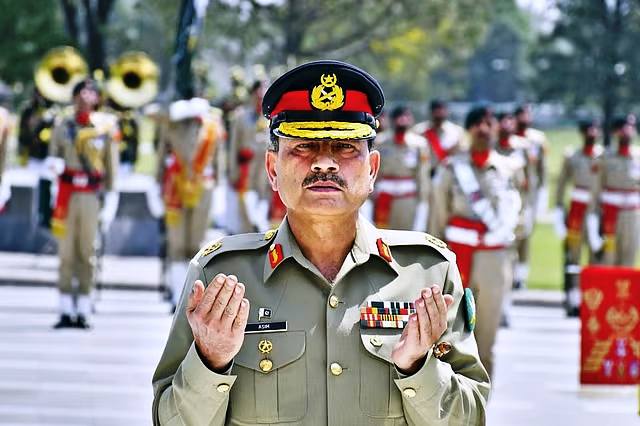
The most prominent Pakistani at the Islamabad International Airport last month, looking dapper in civvies and uniform, brushing his epauletted shoulders with the VVIPs pushing for elusive peace in the Gulf, was Field Marshal Syed Asim Munir Ahmed Shah.
He walked alongside, and not behind, his civilian boss, Prime Minister Shehbaz Sharif. Everyone knows that Asim Munir, having access to the White House in Washington, the royal palace in Riyadh and some of the top national leaders in the Muslim world, matters more than anyone in Pakistan.
Hours before the two-week ceasefire between the United States and Iran was due to expire, US President Donald Trump announced its extension. He named those who had urged him to do so: Munir and Sharif. Media reports later confirmed that Munir had several telephonic talks with Trump, no less, on March 23, before formally offering Islamabad as the venue on March 27.
This is no small feat, when Pakistan, forever seeking financial help to resurrect its economy, does not even recognise Israel, at whose prodding Trump launched the February 28 attack on Iran. It was just that Trump wanted to keep Israel out and strike a direct deal with Iran. And for that, he had already showered his affections on “my favourite field marshal.”
The peace moves have seemingly stalled with neither the US nor Iran ready to blink, and Russia has since entered the arena at Iran’s behest. But there is little to suggest that Trump’s Pakistan preference may change for the next round, whenever it takes place.
To Munir’s credit, and to his stars, he has moved from Operation Sindoor, not just staying on at the top, but also playing the Master of Ceremonies, as it were, in just one year. Indeed, Sindoor, it would appear by hindsight, was an unwanted interruption to this role that was determined by Trump when he attacked Iran, along with Israel, last summer.
White House Entry
The chief of the Pakistan Army has been an honoured guest of the White House on three occasions. The first was General Yahya Khan in 1970 on the eve of the Bangladesh crisis. The second was Pervez Musharraf in 2001, when Pakistan was needed for the US war in Afghanistan. Both also happened to be the president of Pakistan at the time. However, Munir is not the head of the government and the White House invitation on June 18 last year, along with PM Shehbaz Sharif, is unusual. It was to discuss regional security, including the Israel-Iran conflict.
This relationship was cemented on September 25 when the two presented a wooden box of rare earth minerals to Trump during a second high-profile meeting at the White House. Captured by the camera, a smiling Munir showed Trump a box containing samples of minerals like antimony, copper, and neodymium. Reports say a business deal involving Trump’s son-in-law, Jared Kushner, followed.
Pakistan was in the high-diplomacy loop once the conflict began on February 28 this year. Munir did as much effort, if not more, than the civilian leaders, all engaged in facilitating the peace talks. If Sharif or Deputy Prime Minister Ishaq Dar was in one capital, Munir was in another. He did much more than his usual ‘portfolio’, which requires staying in the loop with leaders who matter for Pakistan.
The time was when the Pakistani military chief’s visits were largely ceremonial or military-related. No longer so. Before Munir, his predecessor, General Javed Bajwa, discussed loans and projects abroad. Now the military, immune to civilian law, provides sinews to the civilian façade. With federal and provincial governments and all the legislative paraphernalia, Pakistan is still called a democracy.
Military Tradition
Since Ayub Khan (1957), Zia ul Haq (1977) and Pervez Musharraf (1999), there has been no military coup in Pakistan in the new century – it is not needed. Civilian leaders, having passed the military muster by turns, moved in and out of power, have come to accept, willy-nilly, the paramount and predominant role of the military, especially the army.
Munir may or may not be Pakistan’s best soldier. But he is at the top at the right time. Or, some would say, he made the times right. Whichever way one looks at the outcome of the four-day conflict with India and its impact on Pakistan’s internal dynamics, the fact remains that it was fortuitous enough for Munir to be promoted to field marshal. He is only the second, after Ayub, who had, of course, promoted himself.
In Munir’s case, the civilian government of the day passed the 27th Amendment to the Constitution to promote him, give him a fresh five-year term, and made him the Chief of Defence Forces (CDF), a new designation that places him above other Service Chiefs.
The statute change has drawn sharp criticism from opposition figures and independent analysts, who argue that this concentration of authority lacks precedent in Pakistan’s history. But then, seizure of power by the military and declaration of Martial Law have been validated in the past under the “doctrine of necessity.”
As for the civilian leadership, would this have happened under Nawaz Sharif? He was thrice removed from power for his streak of moving independent of the military. He has stepped aside to make way for his younger brother, Shehbaz. With Nawaz’s daughter Maryam as Punjab’s chief minister, the family provides the civilian façade.
Within the army, he who fights his way to the top wields enormous powers. Munir did that. He was in and out of favour with then-premier Imran Khan, who, like his arch-rival Nawaz, had wanted to grow out of the Khaki shadow. Imran is in jail after being voted out in a no-confidence motion in the National Assembly. One of his ‘sins’ was preferring Lt. Gen. Faez Hamid to Munir for the key job of the Inter-Services Intelligence (ISI) chief. Now, Hamid, too, is convicted and in jail.
Munir’s star rose once he quelled resistance from pro-Imran generals. It is always a touch-and-go tussle among the military brass in Pakistan, with the prime minister of the day having the casting vote. That is, if one takes an official view. Or heeds the allegation of another celebrated ISI chief, Lt. Gen. Hamid Gul. He once alleged that the incumbent of Pakistan’s Army Chief is decided in Washington. If Gul is to be believed, then that is the micro-level ‘management’. As per the old, famous adage: “Who rules Pakistan? Allah, Army and America – not necessarily in that order.”
Did the US have a role in Munir’s promotion? One can only speculate and will never really know if, and how, that happened.