Geopolitical Answers – Through a Diplomat’s Pen

Ambassador Sudhir T. Devare is “not neutral” and, to use a unique phrase India has coined to explain its position on the ongoing Ukraine-Russia conflict, is “on the side of peace,” in whatever he has done as India’s official representative abroad. That is what a good diplomat is supposed to be.

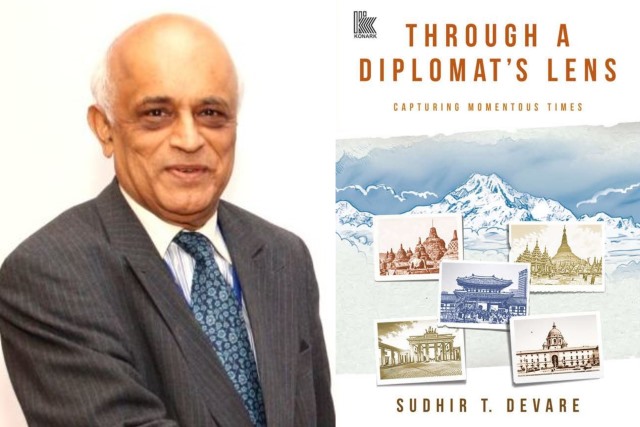
Having served in Moscow as a young probationer and when the USSR disintegrated, as India’s first envoy to Ukraine (concurrently to Armenia and Georgia), Devare feels a special affinity and concern. He devotes it the maximum space in his just-published memoir: Through a Diplomat’s Lens.

Pleading for an end to the “unending” conflict, he apportions blame on both, Russia for invading, and the Western powers for NATO’s eastward push. The United States and Britain, he recalls, reneged on their commitment at the start of the conflict in 2022. “This violation has rankled in the minds of the Ukrainian policymakers.”

Today, when the world’s once-mighty colonisers stand unable to ensure their own safety without America’s economic and military support, the Continent stands devastated by the worst conflict on its soil. The entire West is in turmoil, unable to find a solution to the continuing death and destruction of a people buffeted by global geopolitics gone awry.

As Europe’s problems become the world’s problems, to paraphrase what External Affairs Minister S. Jaishankar has said, Devare makes a telling point that a majority of nations, hit economically if not more, to which the West, unless directly concerned, pays only lip service, are unwilling to take sides. In an increasingly transactional and exploitative world, they cannot identify with either Russian aggression or the values the Western world preaches to others.

The genesis of the Ukraine conflict lay in the Soviet Union’s disintegration and the Western ‘triumphalism’. One issue was nuclear non-proliferation. Ukraine unilaterally and voluntarily gave up its 1,700 nuclear warheads. Despite this largest nuclear non-proliferation step, no firm guarantees were given to Ukraine, either by the US or Russia.

Ukraine’s people, Devare feels, now wonder if Russia would have “dared to attack” had it remained a nuclear power. But these are ifs and buts of a history that is never fair and just.

He is fully supportive of India’s current diplomatic stance, buffeted as it is by the US and Europe, and supports a negotiated settlement. Of India’s purchasing Russian oil at concessional rates, which saved USD 30 billion, he avers and but for that: “India would have been in a very precarious situation.”

ALSO READ: The Ukraine Peace Plan, Europe’s Hubris

Whatever its outcome, the conflict’s resolution may leave many issues unresolved and could lead to future disputes. Even East-West geopolitical changes, on which he delivers no value judgments. For now, Devare says the conflict has led to the proximity of Russia and China, who now believe in “a once-in-a-hundred-years opportunity that they should take full advantage of.”

His most tricky assignment, for four years, was in Sikkim, the Kingdom before its merger. The Political Officer, as the office was called, outsmarted the Chogyal, who wanted to retain independence as the king. Increasingly alienated from the poor Sikkimese, he squandered money on organising fashion shows in the US. He was deeply influenced by Hope Cooke, his Gyalmo, the American-born queen. Her presence was a matter of concern when India was watching the Chinese posture on the Sikkim-Tibet border.

But before she left, for good, Devare recalls her barging into his home with Holloween festival revellers one late evening and, to the shock of Sikkimese staff, demanding that the two dance!

In the Indian Foreign Service (IFS), key neighbourhood assignments are essentially to Pakistan, Afghanistan and China. Instead, Devare’s career took him to the east, to Burma (Myanmar) and beyond, to Indonesia. This made him one of the key enforcers of India’s Look East Policy (LEP). He had the ears of Prime Minister P V Narasimha Rao, the principal architect, and years later, of Jaswant Singh. It was “a kind of rediscovery” of ancient ties that has paid India and the region well.

The importance of the LEP, now the Act East Policy, can never be overestimated, whether in the 1990s or today. India is constantly seeking to be close to a region with cultural and economic links, away from a volatile West. The proverbial ice had to be broken with many of the ten countries, which were pronouncedly pro-West, looking suspiciously at India, which they felt was pro-Soviet. Among other diplomats, he aided Rao’s efforts, followed by Manmohan Singh, to join various multilateral institutions of ASEAN that India once ignored.

Without being preachy about what India could or should do, Devare records in some detail their past connections, Hindu and Buddhist, now Muslim in the case of Indonesia and Malaysia, which nurture deep multi-cultural moorings, as they evolve into modern nations, making rapid economic strides.

Devare has fond memories of the region, as he and his wife Hema, herself an accomplished scholar, delve into the cultural connections of fabrics and gods and goddesses.

Devare records that the advent of the conservative Wahhabi Islam in Muslim societies in the region has robbed them of some of the inclusivity that earlier existed when he witnessed them.

But he has a deeper lament about the ups and downs of democratic institutions he has witnessed in diverse societies: Burma (now Myanmar), Thailand and South Korea. The results have been diverse.

South Korea has prospered as an economic powerhouse and a regional player. But Burma, where the trend commenced in 1963, has seen more military than democratic functioning.

The military’s infusion into governance in many Asian societies may have brought some immediate relief, but it leads to long-term debilities. He laments this institutional aberration playing footsie.

Posted way back in 1980-82, more than 45 years later, Devare concludes the Burma chapter thus: “Living there and witnessing the situation was a disquieting experience. I sincerely believe that the people of Myanmar deserve a better future. My question is: Will that ever come to pass?”

He finds the world in “a poly-crisis” with “a sharp increase of violence everywhere”. India has to deal with the rise of China in the new millennium and attempts to redefine the global order.
Bollywood Yearender: A Look At Box Office Hits In 2025

Indian cinema has once again proven its box-office might in 2025, delivering a string of massive blockbusters that continued the trend set in previous years by ‘Jawaan’, ‘Pathaan’, ‘Animal’ and others.

From grand period dramas such as ‘Chhaava’ to the latest crowd-puller ‘Dhurandhar’, filmmakers and actors across industries have offered audiences a memorable cinematic experience this year.

As 2025 draws to a close with just a few days remaining, here’s a look at some of the biggest blockbuster films that dominated the box office this year.

Dhurandhar

This Ranveer Singh starrer movie is creating records at the box office, offering a perfect closure for Bollywood in 2025. The film is directed by Aditya Dhar and stars an ensemble cast of Akshaye Khanna, Sanjay Dutt, Arjun Rampal, and R. Madhavan, with Ranveer Singh in the lead roles.

Made in two parts, the first instalment follows a decade-long Indian intelligence operation in which an undercover agent infiltrates Karachi’s criminal and political underworld. The film was released on December 5 and is still running in theatres.

According to trade analyst Taran Aadarsh, the film’s domestic collection currently stands at Rs 730.70 crore, as shared on his Instagram. The second part of the movie is set to arrive in theatres on March 19, 2026.

Chhaava

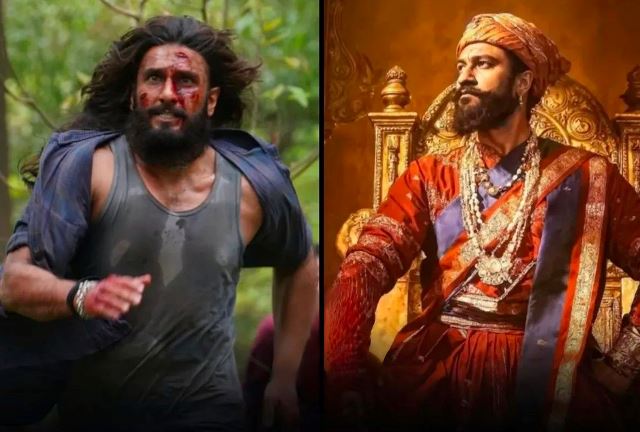
Despite the less decorated filmography of this year, 2025 began with a suprised entry of Vicky Kaushal’s period drama ‘Chhaava’ which shattered numerous box office records. It was directed by Laxman Utekar and starred Vicky Kaushal, Akshaye Khanna and Rashmika Mandanna in the lead roles. It was the first blockbuster of this year.

The film revolved around the story of Chhatrapati Sambhaji Maharaj, the son of Chhatrapati Shivaji, and his courage in defending his faith and country.

According to trade analyst Taran Aadarsh, the film earned over Rs 500 crore during its box office run, joining the blockbusters such as ‘Pushpa 2’, ‘Jawan’, ‘Stree 2’, ‘Gadar 2’, ‘Pathaan’, ‘Baahubali 2’, and ‘Animal’. The actor will be next seen in the film ‘Love and War’ alongside Ranbir Kapoor and Alia Bhatt. It is directed by Sanjay Leela Bhansali.

Kantara: A Legend Chapter 1

It was one of this year’s most anticipated releases, and it didn’t disappoint its fans. Directed by Rishab Shetty, ‘Kantara: Chapter 1’ revolves around the origins of Daiva worship in Tulunadu, tracing its roots back to the fourth-century Kadamba dynasty.

Shetty plays Berme, the protector of the Kantara forest and its tribal communities. The film also stars Rukmini Vasanth, Gulshan Devaiah, and Jayaram in key roles. The story follows the struggle between a royal family trying to seize control from the Daivas and the tribals who resist their rule. The supporting cast includes Rakesh Poojari, Hariprashanth MG, Deepak Rai Panaje, Shaneel Gautham, and Naveen Bondel.

According to Hombale Films, the film’s official production house, Kantara Chapter 1 earned over Rs 700 crore at the box office. The movie was praised by critics for its cohesive storytelling and stunning visuals. Rishab Shetty’s performance was widely praised by cinemagoers, which contributed to the film’s success.

Saiyaara

Ahaan Panday and Aneet Padda starrer ‘Saiyaara’ was one of the most surprising blockbusters of 2025. It was a romantic drama which was directed by Mohit Suri. The movie marked Ahaan Panday’s acting debut and first lead role for Aneet Padda.

According to trade analyst Taran Aadarsh, the movie earned over Rs 400 crore worldwide. The film narrates a romantic tale of Ahaan Panday and Aneet Padda. Ahaan played the role of a rock star in the movie. The film created buzz in the entertainment industry after its release, with the over-the-top response from the viewers, as many were reportedly spotted crying in theatres after watching the movie.

Mahavatar Narsimha

This animated film is the first instalment in the planned animated seven-part Mahavatar Cinematic Universe, based on the ten avatars of Bhagavan Vishnu.

‘Mahavatar Narsimha’ focuses on Lord Narasimha, the half-man and half-lion avatar of Lord Vishnu. Written and directed by Ashwin Kumar, ‘Mahavatar Narsimha’ has resonated with viewers across all age groups, with positive responses pouring in on social media.

Despite being an animated film, which often struggles at the Indian box office, ‘Mahavatar Narsimha’ has shattered box-office records.

According to Hombale Films, the film earned over Rs 100 crore at the global box office after 10 days of its theatrical release in India.

Lokah Chapter One: Chandra

Priyadarshan’s daughter, Kalyani Priyadarshan, shone bright in this superhero movie. In ‘Lokah’, actor Sandy plays the role of the antagonist, Inspector Nachiyappa Gowda, and is reported to have delivered a controversial dialogue that allegedly targets Bengaluru city and its women in the film.

Made under the banner of Dulquer Salmaan’s Wayfarer Films, ‘Lokah Chapter 1: Chandra’ has been written and directed by Dominic Arun.

Actress Kalyani Priyadarshan plays the role of a superhero in the film. Naslen, Chandu Salimkumar, Arun Kurian and Sandy also play prominent roles in the movie.

‘Lokah Chapter 1′ was released in theatres on August 28, 2025. The film has garnered praise from critics and viewers after its release. The film earned over Rs 300 crore worldwide, accoridng to Wayfarer Films’ Instagram handle.

Many movies amassed high box office totals but didn’t reach blockbuster status. It includes Aamir Khan’s Sitaare Zameen Par, Raid 2 and Sankrathiki Vasthunam among others.

The cinemagoers are now eagerly waiting for some of the highly anticipated movies like ‘Toxic’, Ranbir Kapoor’s ‘Ramayana’, ‘Love And War’, Salman Khan’s ‘Battle of Galwan’ and Sunny Deol’s ‘Border 2’ and others. (ANI)

Boman Joins Ram Charan, Janhvi Starrer ‘Peddi’

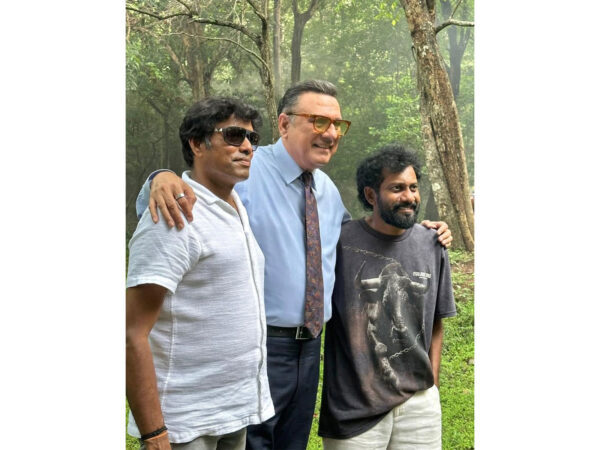
Veteran actor Boman Irani, who is known for his work in films such as ‘Munna Bhai MBBS’, ‘Lage Raho Munna Bhai’, ‘3 Idiots’, ‘Don – The Chase Begins Again’, and ‘Jolly LLB’, has joined the cast of Ram Charan and Janhvi Kapoor starrer ‘Peddi’.

The makers shared a behind-the-scenes photo from the set, capturing Irani alongside director Buchi Babu Sana and cinematographer R. Rathnavelu.

“An absolute honor working with this legend and true cinema lover, @boman_irani sir! A perfect choice for Buchi Babu’s script #peddi,” reads the caption along with the picture.

Check out:

Directed by Buchi Babu Sana, ‘Peddi’ is touted to be a rustic emotional drama, marking one of Ram Charan’s most intense roles to date. Ever since its announcement, the film has already built strong anticipation due to its scale, cast, and Rahman’s musical involvement.

In November, the makers unveiled the first single, ‘Chikiri Chikiri’. With AR Rahman’s magical music combined with Ram Charan’s effortless moves, the song has already struck a chord with fans, with many hailing the melodious track. Also, the stunning visuals accentuate the song even more, offering a glimpse of what ‘Peddi’ has to offer.

Earlier this year, a teaser titled Peddi First Shot was released on Ram Navami. It featured Ram Charan in a rugged avatar, walking into a dusty field, lighting a beedi, and delivering the line: “I have only one life to live, and I want to make the most of it.”

The film features Ram Charan, Janhvi Kapoor, Jagapathi Babu, Shiva Rajkumar, and Divyendu Sharma.

Directed by Buchi Babu Sana, ‘Peddi’ is presented by Mythri Movie Makers and Sukumar Writings under the banner Vriddhi Cinemas. The film is slated for a theatrical release on March 27, 2026. (ANI)

Allu Arjun’s Brother Sirish Announces Wedding With Nayanika In Fun Video

Wedding bells are set to ring in the Allu family as actor Allu Sirish has shared the date of his wedding with longtime partner Nayanika.

Allu Sirish took to Instagram on Monday to share the wedding date in a fun way. The actor posted a video in which he can be seen with his brother Allu Arjun’s kids, Arha and Ayaan, along with Bobby’s daughter Anvitha. The group recreated a popular meme that quickly caught attention online.

In the video, Anvitha and Arha ask Sirish about his marriage. Sirish and Ayaan reply that the wedding will take place on March 6, 2026. When the children then ask about a sangeet ceremony, Sirish gives a light reply saying, “We are South Indians! We don’t do it.”

Take a look

Earlier this year, Allu Sirish got engaged to Nayanika. The actor shared pictures from the engagement ceremony on social media. The event was attended by close family members and friends.

In the engagement pictures, Sirish was seen wearing a white traditional outfit, while Nayanika wore a red outfit with detailed work. The couple exchanged rings as family members cheered for them.

Allu Sirish is the younger brother of actor Allu Arjun. He made his debut as a lead actor with Gouravam in 2013. He later acted in films like Kotha Janta, Srirastu Subhamastu, Okka Kshanam and Urvasivo Rakshasivo. He was last seen in the 2024 film Buddy. (ANI)

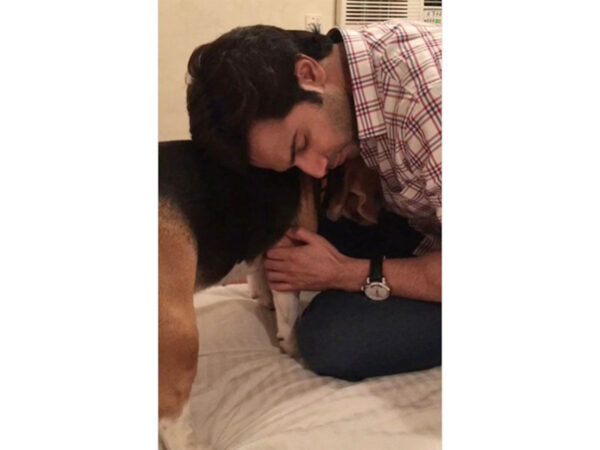
Varun Mourned The Loss Of His Beloved Pet, Angel

Actor Varun Dhawan mourned the loss of his beloved pet dog, Angel, who had been a part of his life for many years.

The actor took to his Instagram account on Monday to remember Angel as a loving and special member of his family.

Grieving the loss of his “wonderful pup,” the actor shared an emotional video tribute. The video showcased many precious moments he spent with Angel over the years. It included adorable selfies with Varun and his wife, Natasha Dalal, along with clips of Angel sleeping peacefully, running freely on the beach, and playing around the house. One clip also showed Angel holding an oil container in her mouth, while another showed her dressed like a diva in a cute Minnie Mouse-style dog jacket.

Take a look

Along with the video, Varun wrote a heartfelt note remembering Angel and thanking her for being a “wonderful pup” and a loving companion to their other dog, Joey.

“RIP Angel. Today heaven gained another angel. Thank you for being a wonderful pup and an amazing sister to Joey. We will miss you. See you down the road,” he wrote.

Soon after Varun shared the post, messages began pouring in from friends, celebrities, and fans.

Singer Sophie Choudry shared her condolences, saying that Angel is now “with the angels.”

“I’m so, so sorry. Angel is with the angels now,” she wrote. Filmmaker Zoya Akhtar also paid her respects, sharing a short message for Angel: “I am so sorry. RIP baby,” she commented. “I’m so terribly sorry,” Mouni Roy added.

Fans also filled the comments section with emotional messages. Many spoke about how close Angel was to Varun and shared words of support during this difficult time. (ANI)

Top Congress Leadership Holds Dharna In Shimla Against Changes In MGNREGA

Top Congress leadership in Himachal Pradesh, led by Chief Minister Sukhvinder Singh Sukhu, on Monday staged a dharna at the statue of Mahatma Gandhi at the historic Ridge Maidan in Shimla against what they termed the Union Government’s move to abolish the MGNREGA scheme and replace it with the proposed G-RMG Act.

The entire state Cabinet joined the protest, including Deputy Chief Minister Mukesh Agnihotri, Himachal Pradesh Congress Committee president Vinay Kumar, ministers, MLAs, and senior Congress leaders. The leaders sat in silent protest, holding placards to register their opposition to the proposed changes to the rural employment guarantee programme.

Speaking to reporters after the protest, Chief Minister Sukhvinder Singh Sukhu said the Cabinet had unanimously discussed the issue and decided to protest at the feet of Mahatma Gandhi.

“Today, our Cabinet held a detailed discussion on MGNREGA. The way MGNREGA has been destroyed, our Cabinet has taken a stand at the feet of Mahatma Gandhi. The scheme that was started in his name was meant to employ in villages,” Sukhu said.

He said that under MGNREGA, women, men, and elderly people could obtain work in their own villages.

“Earlier, the scheme was demand-driven. Works were planned based on demands raised by Panchayats, Panchayat representatives, Gram Sabhas, and local people. Now that the system has been terminated,” he added.

Sukhu alleged that MGNREGA had been converted into an allocation-driven scheme.

“Now the Central Government will decide and notify which works will be taken up. Panchayats, BDC members, and women workers no longer have a say in village development work. This has weakened decentralisation and Panchayat powers,” he said.

The Chief Minister said MGNREGA had been running successfully for the last 20 years and was the vision of former Prime Minister Dr. Manmohan Singh and former Congress president Sonia Gandhi.

“This change has virtually ended the spirit of the scheme. We believe MGNREGA should remain demand-driven, and wages should be paid as per Panchayat demands without central notification,” he said, adding that this was the reason for the peaceful protest.

Deputy Chief Minister Mukesh Agnihotri, addressing the media, described MGNREGA as the world’s largest employment guarantee scheme.

“For the last two decades, it has run very successfully, and money has reached directly to villages. That was the spirit of the scheme, and it strengthened rural livelihoods,” he said.

Agnihotri alleged that the BJP had opposed MGNREGA from the outset.

“Even earlier, there were indications that MNREGA would not be allowed to continue. Gradually, efforts were made to weaken and restrict it,” he said.

Referring to Mahatma Gandhi, Agnihotri said the entire Cabinet had protested against any attempt to dilute the scheme.

“Mahatma Gandhi’s name and ideology cannot be erased. His statues are present worldwide. Removing his name from a scheme reflects a certain mindset,” he remarked.

He further said that control had now been shifted upward from villages.

“Earlier, villages demanded work and funds were provided accordingly. Now it has become supply-driven. Decisions are notified from the top, and only then do work begin in villages,” he said.

Agnihotri accused the Centre of following a policy of weakening states and undermining decentralisation.

“This disempowers the common man and defeats the spirit of village empowerment. Removing Mahatma Gandhi’s name from any scheme is completely wrong and unacceptable,” he said.

Both leaders asserted that while governments may introduce new schemes, the legacy and ideology of Mahatma Gandhi should never be undermined, and vowed to continue raising the issue on behalf of rural workers and Panchayati Raj institutions. (ANI)

Former Haryana CM Hooda Hails Aravalli Range Order

Former Haryana Chief Minister Bhupinder Singh Hooda on Monday expressed his gratitude for the Supreme Court’s decision to stay its own order regarding the Aravalli mountain range.

He emphasised that the Congress party had also given notice on this matter during the winter session of the Haryana Assembly, but it was not accepted, underscoring that the Supreme Court’s decision will save the Aravallis.

Furthermore, he urged the Haryana government to clarify its stand in the Supreme Court. He said the Aravalli Mountains are like Haryana’s lungs; if they are damaged, there will be significant harm.

“The Supreme Court has taken suo moto cognisance in the Aravalli Hills case; the public’s voice regarding the Aravallis was heard in every state. We had also given a short-term duration notice in the Haryana Assembly session, but the government did not accept it. The Aravallis are the lungs of Haryana; the Haryana government should clarify its stand in the Supreme Court. If the lungs are damaged, the damage will be severe. We are very grateful to the Supreme Court. It takes suo motu cognisance in very few cases. The apex Court will save the Aravallis…” he said.

“I am grateful to the Supreme Court,” Hooda added.

The Supreme Court has “put in abeyance” its earlier decision (issued on November 20) to accept the Central Environment Ministry’s definition of the Aravalli Hills and the Aravalli Range. The acceptance of the said definition by the top court in November had exposed most of the Aravalli region to the possibility of being used for regulated mining activities.

A vacation bench of the Chief Justice of India (CJI) Surya Kant and Justices J.K. Maheshwari and A.G. Masih has also ordered the formation of a new expert committee to examine issues that need to be examined in terms of the definition of Aravallis.

The Court has also issued notice to the Centre and the four Aravalli States – Rajasthan, Gujarat, Delhi and Haryana, seeking their response to its suo motu case on the issue. (ANI)

Aishwarya Senger Reacts As SC Stays Delhi HC Order In Unnao Case

Aishwarya Senger, daughter of expelled BJP leader Kuldeep Singh Sengar, on Monday expressed anguish after the Supreme Court of India stayed the operation of the Delhi High Court order that had suspended her father’s life sentence in the 2017 Unnao rape case.

In a statement issued shortly after the Supreme Court’s order, Aishwarya Senger said the defence was not even allowed to advance arguments on the merits. “We couldn’t even start arguing on the merits of the case today, because she has changed her statement several times, changed the timing thrice, starting from 2 pm, 6 pm and then finally 8 pm.

“The AIIMS medical board found that she was over 18. The CDR records show that I was not at the location of the alleged incident. It has also come on record that she herself was on a call at the alleged time of the incident,” she said.

She added that her family has been battling the case for years. “I’ve been fighting for justice for the past eight years, but maybe the sorrows of me and my family mean nothing. We have been stripped of our dignity, our peace, and even our basic right to be heard. Still, I hope for justice. I request members of the media not to spread any misinformation,” she said.

Earlier in the day, a three-judge vacation bench of the Supreme Court, headed by Justice Surya Kant, along with Justices J.K. Maheshwari and Augustine George Masih, stayed the Delhi High Court’s December 23 order, which had suspended Sengar’s life sentence. The stay was granted while the Central Bureau of Investigation appealed the High Court’s decision.

While issuing a notice to Sengar, the Supreme Court made it clear that the High Court order would remain in force and that Sengar would not be released from prison. The bench noted that although such suspension orders are not ordinarily stayed without hearing the convict, the present case involved “peculiar facts”, including the fact that Sengar remains incarcerated in another case.

“We are conscious of the fact that when a convict or undertrial has been released, such orders are not ordinarily stayed by this Court without hearing such persons. But in view of the peculiar facts, where the convict is convicted for a separate offence, we stay the operation of the Delhi High Court order dated December 23. Thus, the respondent shall not be released pursuant to the said order,” the bench observed.

During the hearing, Solicitor General Tushar Mehta, appearing for the CBI, argued that for the Protection of Children from Sexual Offences (POCSO) Act, a “public servant” includes a person occupying a dominant position over a child. He submitted that Sengar, being a powerful MLA at the relevant time, clearly exercised such dominance, attracting the aggravated offence provisions.

Senior advocates Siddharth Dave and N. Hariharan, appearing for Sengar, opposed the CBI’s plea and contended that an MLA could not be treated as a “public servant” for aggravated offences under the POCSO Act.

The bench, however, expressed concern over the High Court’s interpretation of the term “public servant” under Section 5 of the POCSO Act, observing that such a view could lead to an anomalous situation where elected lawmakers are excluded while lower-level officials are covered.

The Delhi High Court had suspended Sengar’s sentence on the prima facie view that the offence of aggravated penetrative sexual assault under the POCSO Act was not made out against him. Despite that order, Sengar continued to remain in custody as he had not been granted bail in the separate case relating to the custodial death of the victim’s father.

Sengar was convicted in 2019 by a Delhi trial court under the Indian Penal Code and the POCSO Act and sentenced to imprisonment for the remainder of his natural life. The trial court had held that he fell within the definition of a “public servant” under the POCSO Act. (ANI)

CBI Kejriwal

Kejriwal Condemns Killing Of Angel Chakma

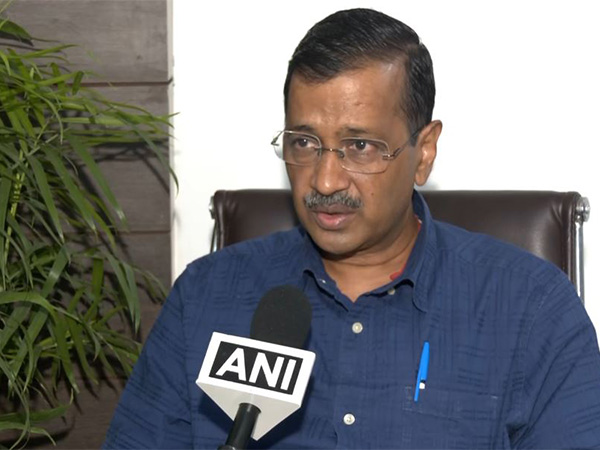
Aam Aadmi Party National Convenor Arvind Kejriwal on Monday termed the killing of a young MBA student from Tripura in Dehradun as “shocking and heartbreaking”, calling it a shame on the system and demanding strict action along with a national law against racism and hate crimes.

In a post shared on X, Kejriwal said, “Shocking and heartbreaking. A young MBA student from Tripura is stabbed to death in Dehradun because of his identity. This is not just a crime, it is a shame on the system. The country needs strict action and a national law against racism and hate crimes. Justice must be swift and exemplary.”

MBA student Anjel Chakma was attacked by a group of miscreants with knives and other blunt objects in Dehradun on December 9 and later died while undergoing treatment at a hospital.

Five people have already been arrested in connection with the incident. Among them, two accused are minors and have been sent to a juvenile reform home. Police are continuously conducting raids to arrest an absconding accused, on whom a reward of ₹25,000 has been announced. A police team has also been sent to Nepal in search of the absconding accused, according to the Uttarakhand CMO.

Earlier today, Uttarakhand Chief Minister Pushkar Singh Dhami expressed condolences and assured justice for Tripura student Anjel Chakma’s family. Dhami spoke with Anjel’s father, Tarun Prasad Chakma, and promised strict action against the perpetrators.

“This was a regrettable incident. We will ensure the culprits receive the harshest punishment,” he said.

Dhami assured support, stating, “We are with you in this hour of need. We’ll provide whatever help we can.”

According to Uttarakhand CMO, the Chief Minister told Tarun Chakma that Uttarakhand has never had such an atmosphere, as students from across the country and abroad come here to study. Therefore, this incident is distressing for everyone.

He further said that after the incident, he spoke with Tripura Chief Minister Manik Saha, Union Home Minister Amit Shah, and Defence Minister Rajnath Singh. (ANI)

‘Dhurandhar Effectively Exploits This-Is-New-India Flimflam’

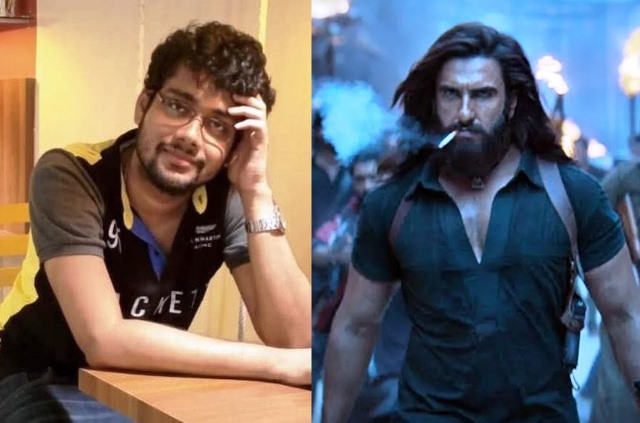
Amartya Acharya, a film critic and a senior faculty for 3D Printing Lab at Siliguri Institute of Technology, West Bengal, dissects Aditya Dhar’s political commercial formula:

The 210-minute film, directed by Aditya Dhar, is stirring up a plethora of opinions for justifiable reasons. Even if one considers Dhar’s one-film-old filmography as director and three-film-old producer-led films where the propagandistic tendency is clear, Dhurandhar stands out to me because of its genre trappings.

It is proficient in mixing the gangster film tropes with the espionage elements, following Hamza, a spy embedded within the Karachi underworld, investigating the nexus of the terrorist organizations, the ISI, and the underworld of Pakistan. The commitment to its world-building, in fleshing out the Lyari gang war and gang leader Rehman Dakait (played by Akshay Khanna), is quite praiseworthy, as is the film’s proclivity to build action set pieces without overuse of CGI and its indulgence in graphic violence.

What also makes the film work is its editing, whereby the 210-minute movie doesn’t feel bloated or inconsistent in its pacing. The chapter breaks—a Dhar staple—might help in identifying specific flaws within the film itself (the cartoonish portrayal of SP Chaudhury Aslam by Sanjay Dutt or Rakesh Bedi as a conniving political leader, the romantic subplot, which feels mostly unnecessary), but it also helps in maintaining a discernible and entertaining flow. It helps that the performances by a very talented cast, especially that of Akshaye Khanna as Rehman Dakait, and a restrained Ranveer Singh as Hamza, are remarkable.

However, the film stops short of greatness precisely because of its commitment to its messaging, the political bent it is clearly aiming towards, the sloppy integration of said political bent, as well as its use of footage of real events (audio and visual) to drive home its points. It is overt enough to be termed propaganda, without one discounting the craft that went into its making, a distinction that similar films of its ilk don’t enjoy.

The overwhelming narrative that is making Dhurandhar stand out even amidst the neutral audience is its somewhat realistic treatment as a film within the spy-gangster genre hybrid, a sharp 180 from the over-the-top, melodramatic, star-studded, James Bond-inspired films of the YRF Spy Universe, which is increasingly losing steam due to its heavily diminishing returns (War 2, also released earlier this year, had been heavily panned by critics and rejected by audiences).

I say somewhat, because even if one takes the above statement as gospel, Dhurandhar boasts of an ‘item number’ and a ‘love track’, similar trappings that had led to heavy criticism of the YRF Spy Universe films from a large section of the audience.

What also contributes to its box office popularity is it being part of a series of hyper-masculine films comfortable in violence that Bollywood has been offering since 2023’s release of Sandeep Reddy Vanga’s Animal. However, what makes it far different is its commitment to being squarely within the gangster genre, dealing with macho sensibilities, displays of violence, and paranoia.

There is a political commercial formula, part of a surge of political-leaning films, explicitly leaning towards propaganda that is heavily inspired by not just governmental policies but a majoritarian ideology that transcends common criticism being attributed to films like The Kashmir Files and The Kerala Story, where the craft and storytelling of said films are very much in debate.

Dhurandhar becomes somewhat more insidious precisely because those common criticisms cannot be applied to and thus made to dismiss the film, and thus the methodology of integration of messaging becomes far more effective as a result, overt or otherwise. The criticism would then be countered by the film’s vociferous supporters’ argument about the truth of the events not being accepted by the ‘establishment’ (read the critics), and thus contribution towards the film’s box office would be even more pronounced simply as a reaction to those criticisms.

The success of this genre of films represents the shift of a narrative to a “new India,” where aggressive/muscular nationalism becomes the dominant tone, an appeal primarily stemming from the country’s previous portrayal of being a defensive or ‘soft’ nation. As depicted in Dhar’s 2019 superhit film UriThe Surgical Strike, and his latest Dhurandhar, the statement uniting these two films—“Ghar me ghuske marenge”—is highlighting this new version of the country, not content to simply tolerate attacks on itself but rather respond in kind.

ALSO READ: The Beef And The Battleship

It flattens complex geopolitical or emotional issues into binary—good vs evil—ensuring that majoritarian anxieties get heavily highlighted. It allows for the audience to successfully participate in exclusionary sentiments guilt-free, framed as patriotism, or a contextualization of the truth that past films had failed to portray. Because their cinematic value is far more potent than other films of their ilk, the risk of entertainment and propaganda blurring becomes more prominent.

The comparison with Pathaan seems a bit misframed because both Pathaan and Dhurandhar are approaching the same element of patriotism from opposite ends. While Dhurandhar is insidiously peddling in majoritarian anxiety, Pathaan is trying its best to appeal to nationalism, either overtly or through the conception of the protagonist, without explicitly resorting to jingoistic tendencies.

I am going to go out on a limb and state that in terms of media consumption, the pandemic had been a great equalizer because it led to the dominance of streaming services, opening up viewers to regional content that satisfies the palate of the consumer far more effectively than Bollywood.

If one wishes to trace back to when the shift began, one can point to the overwhelming success of SS Rajamouli’s Bahubali duology, as the moment of imperceptible shifting. The pandemic became a great equalizer. Now, utterly exposed to the commercial-driven films of Telugu cinema, the content-driven stories of Malayalam films, the social messaging baked within the commercial templates of masala films that usually defines Tamil cinema, and other regional industries like the Kannada and Marathi film industries, the Indian movie-going palette would truly be diverse.

Bollywood, as a result of said diverse palette, as well as the proliferation of streaming-exclusive web series content, will undergo an identity crisis that it is still undergoing to this day. Other than a superstar like Shah Rukh Khan, who proved himself to be a major box-office draw in 2023, Bollywood has been failing in not just replicating its own successes; it is also failing in replicating masala filmmaking because the current crop of filmmakers are unaware and untested within the contours of mainstream filmmaking.

I would be remiss not to point out that in the race of box office, the mid-budget Bollywood film has almost disappeared. Filmmakers like Dibakar Banerjee find their films like Tees stopped from being released; films like Homebound, Humans in the Loop, Jugnuma, or even Nishannchi find themselves saddled with show times in the theatres, unfriendly to the audience, or with limited releases restricted only to metro cities, which results in the theatrical business of these films inevitably crashing out.

It is further compounded by the streaming services being far more reticent in showcasing artistic freedom ever since the controversy surrounding 2021’s web series Taandav, and thus streaming services censuring films from their catalogue, or indulging in safer, more traditional content with a barely discernible edge.

As told to Amit Sengupta