Budget Session: LS To Debate President’s Address For 18 Hrs

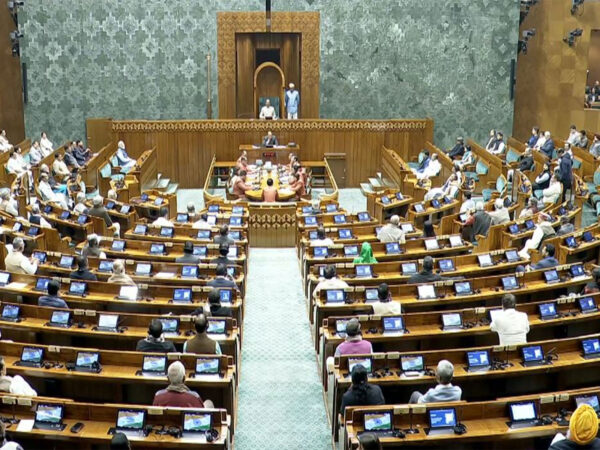
The Government has allotted 18 hours in the Lok Sabha for discussion on the Motion of Thanks to the President’s address to the joint session of Parliament during the Budget Session.

The discussion will be held on February 2, 3, and 4.

The decision was made at a meeting of the Lok Sabha’s Business Advisory Committee (BAC) on Thursday.

Prime Minister Narendra Modi will reply to the Motion of Thanks on the President’s Address in the Lok Sabha during the Budget Session of Parliament on February 4.

Sources said the Lok Sabha will hold a general discussion on the Union Budget for 2026-27 on February 5, 9, 10, and 11. A total of 18 hours has been allotted for the discussion.

Union Finance Minister Nirmala Sitharaman is expected to reply on February 11.

At an all-party meeting held on Tuesday, opposition parties urged discussions on a range of issues, including the restoration of MGNREGA, the ongoing SIR of poll rolls, and the UGC controversy.

Meanwhile, the Lok Sabha was adjourned on Thursday afternoon and will again meet on February 1 at 11:00 am.

Finance Minister Sitharaman tabled the Economic Survey of India in Parliament today for the 2025-26 financial year, setting the stage for the Union Budget, which will be presented on Sunday, February 1.

This year, the Budget presentation falls on a weekend. FM Sitharaman is set to present a record ninth consecutive Union Budget on February 1, marking a significant milestone in India’s parliamentary and economic history.

The tabling of the Economic Survey ahead of the Budget follows the long-standing tradition of outlining the state of the economy before detailing future fiscal plans.

The Economic Survey of India is regarded as the nation’s official annual “report card” on the economy. It provides a comprehensive, data-backed review of the economy’s performance over the previous year and offers a broad roadmap for future policy direction. As the government’s flagship annual report, it reviews key economic developments over the past 12 months.

Prime Minister Narendra Modi addressed the media outside Parliament ahead of the Budget Session 2026 highlighted India’s strong growth trajectory, describing the start of this quarter as “very positive” and calling a self-confident India “a ray of hope for the world today.”

The PM said that the country has boarded the “Reform Express” and has emerged from long-pending problems while working towards long-term solutions. He said it is time to find solutions, not create hurdles, ahead of the Budget Session.

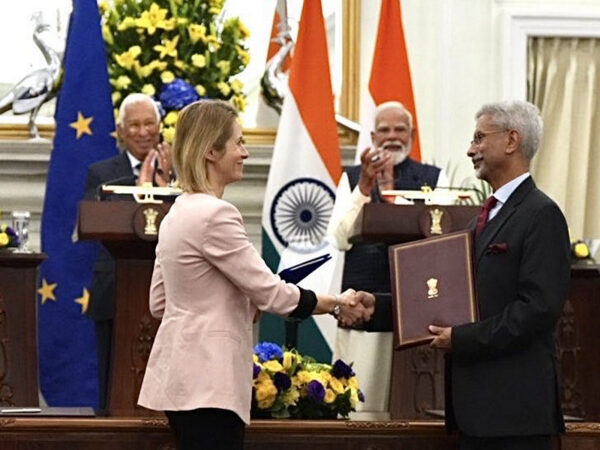
Further, he praised the India-European Union Free Trade Agreement (FTA), describing it as “Free Trade for Ambitious India, for Aspirational Youth, and for Aatmanirbhar India.”

He expressed confidence that Indian manufacturers would utilise the agreement to strengthen their capabilities, calling the FTA a major step toward building a confident, competitive, and productive India.

The Budget session will span 30 sittings over 65 days, concluding on April 2. The two Houses will adjourn for a recess on February 13 and reconvene on March 9 to enable the Standing Committees to examine the Demands for Grants of various ministries and departments. (ANI)
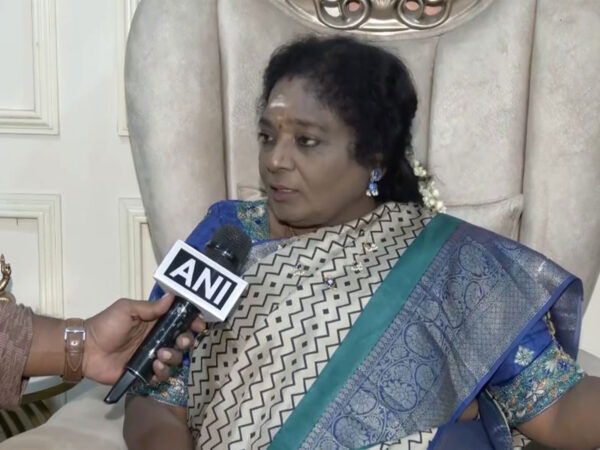

BJP’s Tamilisai Soundararajan Slams DMK Govt Over Chennai Triple Murder Case

BJP leader Tamilisai Soundararajan on Thursday slammed the DMK government over the recent triple murder case in Chennai and said that it clearly showcases the lawlessness in the state.

She underlined the incidences of drug abuse and urged the government to address the issue seriously. She said that such incidents cause panic and insecurity among the general public.

“This clearly indicates the lawlessness in Tamil Nadu. Because of the high incidence of drug abuse, and politically discriminatory opinions revealed by the Chief Minister and the Deputy Chief Minister about the other states… There is a sense of insecurity among people, as well as among people from other states. So it is a social calamity that we have to take very seriously. It is not an isolated murder case,” Soundararajan said.

“They were killed in a very popular place in the centre of the city. All of these create fear among the people. This insecurity among the people should be taken into account. Chief Ministers should be more serious about such things,” she added.

Earlier, the victim, identified as Gaurav Kumar (24), was found dead with cut injuries on his head and face after residents noticed blood oozing from a sack near a popular two-wheeler showroom on Monday morning. His body was found stuffed inside a gunny bag in Indira Nagar, Adya.

Following the murder, the victim’s wife and child were reported missing, prompting large-scale search operations by multiple police teams.

On Wednesday, Chennai Police conducted searches at several locations, including the Perungudi dumpyard, Adyar estuary and the banks of the Cooum River, in an effort to trace the missing bodies.

The search led to the recovery of the body of the couple’s two-year-old son from near the Cooum River at Madhya Kailash. Police said efforts are still underway to locate the woman’s body.

In connection with the case, five Bihar workers have been arrested. The accused have been identified as Sikandar (33), Narender Kumar (45), Rabindranath Tagore (45), Bikas (24), and another worker. Police suspect the crime was committed by individuals known to the victim.

Police are also probing whether Munita Kumari, the wife of the deceased, was sexually assaulted before she went missing. Officials stated that this can be confirmed only after the recovery of her body and completion of the postmortem examination.

Further investigation is underway. (ANI)

Varun Dhawan Speaks About Hairline Fracture On ‘Border 2’ Sets

Actor Varun Dhawan has revealed that he suffered an injury on the sets of ‘Border 2’ and had a hairline fracture.

Taking to his Instagram handle, Varun shared a clip from an action sequence in which he is seen lying down after the hit.

“The worst injury i ever got on border 2. I smashed my tail bone into a rock when i tried avoid banging into the camera . It was the worst pain i ever felt. O sustained a hairline fracture on the tailbone which i feel i am still healing from,” he wrote in the caption.

The actor also revealed that his team helped him continue the shoot for the rest of the day as he struggled to walk.

“Thankful to my team for helping me continue that day i could barely walk but we kept going. Grateful for the journey,” Varun added.

As soon as the post was shared, fans quickly rushed to the comments and shared their concerns. They also wished for the actor’s quick recovery.

Varun Dhawan, who essays Param Veer Chakra awardee Hoshiyar Singh Dahiya, in the war drama film, has been receiving overwhelming positive reactions from fans and film industry insiders alike.

Border 2, which was released in theatres on January 23, is inspired by the true events of the 1971 India-Pakistan War and showcases how the Army, Navy, and Air Force fight together as one force. It brings Sunny Deol back in uniform once again.

The film also stars Ahan Shetty and Diljit Dosanjh in the lead roles.

According to trade analyst Taran Adarsh, ‘Border 2’ opened with solid figures on the first day with Rs 32.10 crore. With a bumper collection over the extended weekend, the film has earned Rs 231.83 crore domestically. (ANI)

Delhi HC Upholds Conviction In 1995 CBI Bribery Case

The Delhi High Court has dismissed a criminal appeal arising from a 1995 CBI trap case, upholding the trial court’s conviction and sentence under the Prevention of Corruption Act.

The Court held that the findings of guilt were not infirm and reaffirmed key procedural principles governing corruption trials.

Briefly put, in 1995, a complaint was filed alleging that the appellant, while posted as an Assistant Sub-Inspector at Police Post Shakur Basti, demanded illegal gratification of Rs 10,000 from the complainant to stop harassing him in connection with complaints initiated by the complainant’s brother.

The amount was later reduced to Rs 5,000, after which the CBI laid a trap and recovered tainted currency.

Rejecting the challenge to the conviction, the High Court ruled that the prosecution had proved demand and acceptance of illegal gratification through the complainant’s testimony, supported by surrounding circumstances and positive phenolphthalein test results. The Court observed that minor inconsistencies in witness statements did not affect the core of the prosecution case, particularly when the accused’s presence at the spot remained unexplained.

The Court also addressed the contention that the case should be dismissed for the passage of nearly three decades since the FIR was registered.

It categorically held that “mere delay is no reason to disbelieve or discard the entire prosecution case,” noting that no material prejudice had been demonstrated on account of the delay.

While affirming the conviction, the High Court issued important guidance on trial procedure. It clarified that statements recorded under Section 161 of the CrPC can be used only for the limited purpose of contradiction, strictly in accordance with Section 145 of the Evidence Act.

The Court further cautioned trial courts against the incorrect practice of “declaring a witness hostile” or allowing a prosecutor to “cross-examine” their own witness, emphasising that permission under Section 154 of the Evidence Act merely allows leading questions during examination-in-chief.

Upholding the validity of the sanction for prosecution and rejecting objections relating to delay in forensic examination, the Court concluded that the evidence on record fully supported the findings of guilt. Accordingly, the appeal was dismissed, and the conviction, along with concurrent sentences of up two 2.5 years of rigorous imprisonment, was affirmed. (ANI)

Ajit Pawar

Ajit Pawar Laid To Rest With State Honours In Baramati

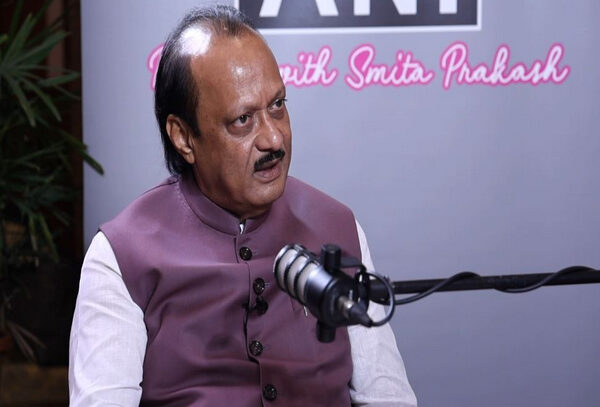
The last rites of Maharashtra Deputy Chief Minister Ajit Pawar were carried out with full state honours at the Vidya Pratishthan ground in Baramati, where his sons lit the funeral pyre and carried out the final rituals.

Several prominent leaders and dignitaries, including Union Home Minister Amit Shah, Maharashtra Chief Minister Devendra Fadnavis, Union Minister Nitin Gadkari, Nationalist Congress Party (Sharadchandra Pawar) chief Sharad Pawar, and actor Riteish Deshmukh, attended the funeral and paid their last respects.

A large number of people also gathered at the Vidya Pratishthan ground to bid a final farewell to the Nationalist Congress Party leader, reflecting the widespread public mourning over his demise.

Earlier in the day, full state honours were accorded to Maharashtra Deputy CM Ajit Pawar, on Thursday as his mortal remains were taken to the Vidya Pratishthan ground for the last rites.

Ajit Pawar’s wife, Sunetra Pawar, and sons, Party and Jay, were present on the occasion. Senior Congress leader Sushil Kumar Shinde, along with his daughter Praniti Shinde, also arrived to attend the funeral set to take place at the Vidya Pratishthan ground.

Supporters of Ajit Pawar chanted “Ajit Dada Amar Rahe” as his mortal remains were brought to the ground. His son Jay Pawar, nephew Rohit Pawar, and other family members were also present.

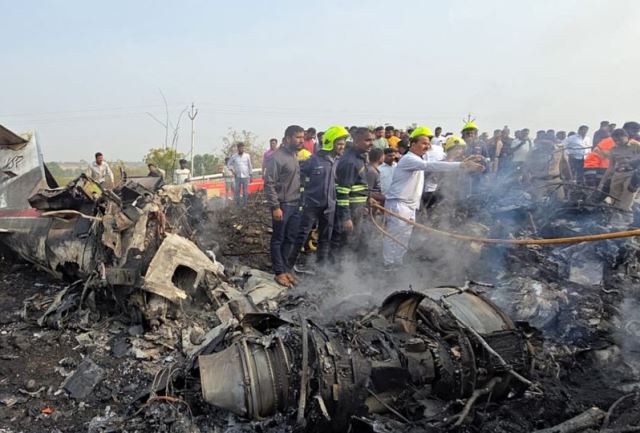
Earlier today, officials from the Directorate General of Civil Aviation (DGCA) and forensic teams reached the crash site in Baramati to investigate the plane crash that claimed the lives of Maharashtra Deputy Chief Minister Ajit Pawar and five others. The aircraft had crash-landed in Baramati on Wednesday morning. NDRF personnel and DG are present here. NDRF personnel and Maharashtra DGP were also present at the site for the investigation.

The Pune Rural Police have registered an Accidental Death Report (ADR) at the Baramati Taluka Police Station in connection with the crash and have initiated further investigation.

“Pune Rural Police have registered an Accidental Death Report (ADR) at Baramati Taluka Police Station in connection with the air crash in which Maharashtra Deputy Chief Minister Ajit Pawar lost his life. Further investigation initiated,” a police official from Pune police said.

Union Minister Raksha Khadse termed the incident heart-rending and said Maharashtra would not see another leader like Ajit Pawar.

“The accident yesterday is heart-rending. Nobody had thought that something like that would happen. We were all sad to hear the news yesterday. I think Maharashtra will not have any other leader like Ajit Dada. He worked in the interiors. He was a good leader who played a big role in Maharashtra’s development,” Raksha Khadse told reporters.

Ajit ‘Dada’ Pawar died on Wednesday in a plane crash at Baramati airport, leaving behind a long career of ups and downs in politics. He was headed to Baramati to attend a public rally for the Zilla Parishad Elections.

Ajit Pawar was born on 22nd July 1959 in Deolali Pravara, Rahuri taluka, Ahmednagar district.

He was known among the people as “Ajit Dada” for his tireless efforts on behalf of the people of Maharashtra and his ability to stay connected to them and the soil.

In addition to making significant contributions to government administration, Pawar oversaw the management of various cooperative organisations, including Milk Unions and Federations and sugar factories.

Ajit Dada’s leadership journey began and continued across institutions such as milk unions, cooperative societies, sugar factories, and banks, and took a new direction in 1991 when he was elected to the Lok Sabha. He would later vacate the Baramati seat for his uncle Sharad Pawar. Since then, he has held many more positions, including MLA, Minister of State for various critical government departments, and Deputy Chief Minister of Maharashtra.

Ajit Pawar was the longest-serving Deputy Chief Minister of Maharashtra non-consecutively. He served in the position for six terms within various governments. He had worked as deputy chief minister in the cabinets of Prithviraj Chavan, Devendra Fadnavis, Uddhav Thackeray and Eknath Shinde.

In November 2019, he engineered a split in the NCP, joined a government led by the Bharatiya Janata Party, and became the Deputy Chief Minister. In February 2024, the Election Commission awarded the party name and symbol to the faction headed by Ajit Pawar.

Despite this, Ajit Pawar was known to be very close to his uncle, Sharad Pawar, under whose guidance he began his political career. In the recently held Pune and Pimpri-Chinchwad Municipal Elections, the two rival factions of the NCP formed an alliance and presented a united development agenda for Pune.

Ajit Pawar was famed for his straightforward approach and frankness. He is survived by his wife, Sunetra Pawar and two sons, Jay and Parth Pawar. (ANI)

Supreme Court Stays New UGC Regulations Amid Uproar

Amid an uproar around the country, the Supreme Court on Thursday stayed the University Grants Commission (Promotion of Equity in Higher Education Institutions) Regulations, 2026.

The new UGC regulations, notified on January 23, were challenged by various petitioners as being arbitrary, exclusionary, discriminatory and in violation of the Constitution as well as the University Grants Commission Act, 1956.

The Top Court said that, for now, the 2012 UGC regulations will continue to apply. The Court opined that there is complete vagueness in Regulation 3 (C) (which defines caste-based discrimination), and it can be misused. “The language needs to be re-modified,” the Court said.

The new regulations, introduced to curb caste-based discrimination in colleges and universities, require institutions to establish special committees and helplines to address complaints, especially from students belonging to the Scheduled Caste (SC), Scheduled Tribes (ST), and Other Backward Classes (OBCs) categories.

The new rules notified by the UGC on January 13, which update its 2012 regulations on the same subject, have sparked widespread criticism from general category students, who argue that the framework could lead to discrimination against them.

Earlier on Wednesday, students, mostly belonging to the general category, staged a protest at Delhi University’s North Campus against the newly notified University Grants Commission (UGC) equity rules, demanding their immediate withdrawal.

The protesting students claimed that the rules promote discrimination on campuses instead of equality. They pointed out that there was no binding provision for the representation of general category students.

However, Union Education Minister Dharmendra Pradhan on Tuesday sought to allay concerns over the new UGC regulations, assuring that the law would not be misused and that there would be no discrimination in its implementation.

Speaking to the reporters, Pradhan said, “I assure everyone there will be no discrimination and no one can misuse the law.”

On Tuesday, students in Lucknow staged a protest in front of Lucknow University, raising slogans against the UGC policies.

Earlier, Shyam Sundar Tripathi, Vice President of the BJP Kisan Morcha from the Salon constituency in Rae Bareli, had resigned from his post, citing dissatisfaction over new UGC policies. Tripathi announced his resignation in a letter written to Prime Minister Narendra Modi.

“Due to the black law, like the reservation bill, brought against the children of the upper caste, I am resigning from my post. This law is extremely dangerous for society and also divisive. I am completely dissatisfied with the bill. There is great resentment. I do not support this reservation bill. Supporting such an unethical bill is completely against my self-respect and ideology,” read the letter written in hindi. (ANI)

Black Box Of Ajit Pawar’s Plane Recovered: Ministry

The Ministry of Civil Aviation said on Thursday that the black box of the ill-fated aircraft, which crashed in Baramati on Jnauary 28 and killed Maharashtra deputy chief minister Ajit Pawar, has been recovered. The investigation is progressing expeditiously.

In a post on X, the Ministry noted that, “Ensuring a thorough, transparent, and time-bound inquiry remains a top priority”.

The Ministry said that a team of three officers from AAIB, Delhi, and another team of three officers from the DGCA, Mumbai Regional Office, reached the crash site on 28 January. “The Director General, AAIB, also arrived at the site the same day. The investigation is progressing expeditiously, and the black box of the ill-fated aircraft has been recovered. “

“The Ministry of Civil Aviation (MoCA) remains fully committed to completing the investigation within a defined timeframe, strictly in accordance with established Standard Operating Procedures (SOPs) and laid-down guidelines. The investigation has been initiated in accordance with Rules 5 and 11 of the AAIB Rules, 2025,” the Ministry said.

Officials probing the plane crash that claimed the life of Maharashtra Deputy Chief Minister Ajit Pawar and five others have recovered the voice recorder and flight data recorder from the accident spot.

The Ministry of Civil Aviation (MoCA) confirmed that the equipment has been recovered from the site.

Funeral preparations are underway at the Vidya Pratishthan ground in Baramati for the Nationalist Congress leader.

Supporters of NCP chief and Deputy CM Ajit Pawar gathered outside Ahilyabai Holkar Government Medical College to pay their final respects as his mortal remains were taken out.

The funeral procession for Maharashtra’s longest-serving Deputy CM (non-consecutively) will start from the Vidya Pratishthan campus (Gadima) at 9 AM, pass through the city for people to pay their respects to Pawar, and culminate at the Vidya Pratishthan Ground for the funeral, scheduled for 11 AM.

The mortal remains of Maharashtra Deputy Chief Minister Ajit Pawar will be carried in a decorated rath for his ‘Antim Yatra’ today.

The chariot is adorned with flowers and features Pawar’s image and a board reading “Swargiya Ajitdada Pawar amar rahein” (Long live Ajit Dada Pawar).

Ajit ‘Dada’ Pawar died on Wednesday in a plane crash at Baramati airport, leaving behind a long career of ups and downs in politics. He was headed to Baramati to attend a public rally for the Zilla Parishad Elections. (ANI)

Delhi HC Summons Priya Kapur in Family Trust Case

The Delhi High Court on Thursday issued summons to Priya Kapur and 22 other defendants in a civil suit filed by Rani Kapur seeking cancellation of the Rani Kapur Family Trust, which is stated to be valued at several thousand crore rupees.

The Court, however, declined to grant any immediate interim relief, including an order to maintain the status quo over the trust.

A single-judge Bench of Justice Mini Pushkarna clarified that, at this stage, it was only issuing summons in the main suit and notice in the application seeking interim relief. Observing that the trust was not a newly created one, the Court said it would consider the interim prayers only after hearing all parties. The defendants have been directed to file their replies within four weeks, after which the interim application will be taken up.

Senior Advocate Vaibhav Gaggar, appearing for Rani Kapur, took the Court through the background of the dispute and developments following the death of industrialist Sunjay Kapur in June last year.

He alleged that immediately after Sunjay Kapur’s death, Priya Kapur took steps to gain control over the family assets and is now the beneficiary of nearly 60 per cent of the estate, with the remaining 40 per cent going to the children, leaving the plaintiff with no share.

Gaggar argued that it was inconceivable that Rani Kapur would have, within six months of her son’s marriage, voluntarily executed a trust, divested herself of all assets and agreed that, upon her son’s death, the entire estate would pass to others.

Gaggar further contended that Rani Kapur was the sole settlor, trustee, and beneficiary of the earlier family trusts, and that the Rani Kapur Family Trust was created without her informed consent. He alleged that the signatures attributed to her on the trust documents were not hers and claimed that the estate required urgent protection, asserting that “something is seriously wrong” in the manner in which assets were being dealt with.

Senior Advocate Akhil Sibal, representing Priya Kapur, strongly disputed the allegations and termed them a “complete falsehood”.

He submitted that the suit itself was not maintainable and said that a plea would be filed seeking its dismissal. “A trustee is challenging the trust. That cannot be done in law,” Sibal argued, adding that videographic evidence of the notarisation and execution of documents, including signatures, would be placed on record. He also opposed the grant of any interim relief at the threshold stage.

Counsel appearing for other defendants raised objections regarding maintainability and the arraying of a large number of parties. The Court observed that all relevant documents, including trust deeds, minutes of meetings and financial records, would have to be disclosed and that no material facts could be suppressed from judicial scrutiny.

Advocate Saakaar Sardana, appearing for Rani Kapur’s grandchildren the children of her daughter Mandhira Kapur Smith told the Court that the grandchildren were beneficiaries under the original registered Dr. S.K. Family Trust but have now been deprived of their inheritance. He said they are before the Court to protect their rights and are supporting their grandmother’s case.

After hearing, the Bench directed that the plaint be registered as a suit, summons be issued and accepted, and notices be issued in the connected interim applications, including those seeking disclosure and production of documents. It also appointed actor Karisma Kapoor as the next friend of minor defendants Samaira and Kiaan Kapur.

The matter will be taken up next after completion of pleadings, when the Court will consider the application seeking interim relief, including the prayer for maintenance of status quo over the trust.

Rani Kapur has recently moved the Delhi High Court against her daughter-in-law, Priya Kapur and the children of actor Karisma Kapoor, challenging the formation and administration of the RK Family Trust.

She has alleged that the trust was created without her informed consent and resulted in her complete exclusion from assets that originally belonged to her.

According to the plaintiff, the disputed transactions took place when she was unwell after suffering a stroke and was dependent on her son for managing her personal and financial affairs.

She has claimed that she was assured her estate remained secure and under her control, even as steps were allegedly taken that adversely affected her ownership rights.

The suit further alleges that she was made to sign documents without being properly informed of their contents or legal implications, and that some documents were signed in blank. These acts, she claims, were part of a larger design to restructure the family estate through the trust to her detriment.

Through the suit, Rani Kapur has sought cancellation of the RK Family Trust and restoration of her estate, contending that the trust was brought into existence through misrepresentation, undue influence and without her informed consent. (ANI)

India Well Placed Against Tariff Shocks, Fragmentation: Survey

Even as global trade faces renewed disruption from unilateral tariff actions and rising geopolitical tensions, India’s economy has demonstrated resilience, with strong domestic fundamentals helping offset external headwinds, the Economic Survey 2025-26 has said.

The Survey notes that the global economic environment has become increasingly uncertain, with trade policy now shaped more by strategic and political considerations than by multilateral rules.

“Trade policy is now shaped primarily by security and political considerations rather than efficiency or multilateral rules,” it observed, warning that the global system has become “less coordinated, more risk-averse, and more exposed to non-linear outcomes.”

Referring to recent tariff actions by the United States, the Survey recalled that the announcement of additional penal tariffs on Indian exports came as a surprise, especially when India was expected to be “one of the early winners in the new tariff regime of the United States.”

The developments led to downward revisions in growth forecasts and heightened volatility in global markets.

However, the Survey underlined that India’s growth momentum remained intact. “Growth is good; the outlook remains favourable; inflation is contained; banks are healthy; and corporate balance sheets are strong,” it stated, adding that policy dynamism and structural reforms helped sustain economic activity despite external pressures.

At the same time, the document highlighted a broader paradox confronting the economy.

“The paradox of 2025 is that India’s strongest macroeconomic performance in decades has collided with a global system that no longer rewards macroeconomic success with currency stability, capital inflows, or strategic insulation,” it said.

The Survey pointed out that heightened global uncertainty, driven by trade conflicts, geopolitical realignments and weakening rule-based systems, has had a visible impact on capital flows and investor sentiment. Financial markets, it noted, tend to react first, with uncertainty triggering a wait-and-see approach that delays investment and raises risk premia.

According to the Survey, emerging market economies are more vulnerable to such uncertainty. While global trade growth is projected to slow sharply in 2026, “trade policy uncertainty is likely to have a more pronounced impact on the trade volumes of EMDEs than on those of advanced economies.”

For India, the external risks manifest less as immediate macroeconomic stress and more as intermittent pressure on exports, capital flows and currency stability. The rupee, the Survey observed, “does not accurately reflect India’s stellar economic fundamentals” and is “punching below its weight,” partly due to global risk aversion.

Nevertheless, the Survey underlined that an undervalued currency has also helped cushion the impact of higher American tariffs on Indian goods. At the same time, India’s export sector has shown adaptability, with diversification toward alternative markets helping maintain overall export growth even as shipments to the US moderated in certain sectors.

Looking ahead, the Survey cautioned that the principal risk lies not in any single external shock but in prolonged global fragmentation. “Fragility, uncertainty and episodic shocks are increasingly structural features of the system,” it noted.

Despite these challenges, the Survey maintained an optimistic outlook, projecting steady growth supported by domestic demand, healthy balance sheets and sustained reform momentum. “The outlook, therefore, is one of steady growth amid global uncertainty, requiring caution, but not pessimism,” says the survey. (ANI)

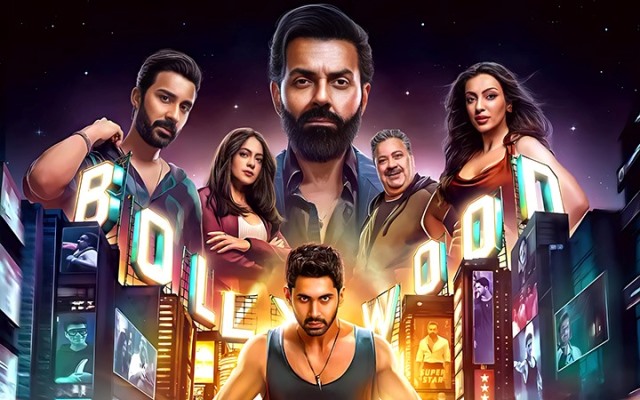
Delhi HC Rejects Wankhede’s Defamation Suit On ‘The Ba***ds of Bollywood’

The Delhi High Court has rejected the defamation suit filed by Indian Revenue Service (IRS) officer Sameer Wankhede over his alleged portrayal in the Netflix series ‘The Ba***ds of Bollywood’, which references the Aryan Khan case, holding that it lacks territorial jurisdiction to entertain the plaint.

Justice Purushaindra Kumar Kaurav passed the order while upholding the preliminary objection raised by the defendants. The Court directed that the plaint be returned to plaintiff Wankhede for presentation before a court of competent jurisdiction. It further granted liberty to the plaintiff to apply under Order VII Rule 10 of the Code of Civil Procedure, if he so desires.

With this judgment, the High Court declined to entertain Wankhede’s defamation claim.

Wankhede had approached the Court seeking interim directions against Shah Rukh Khan’s production house Red Chillies Entertainment and OTT platform Netflix, including the removal of certain scenes from the series, alleging that they were defamatory and harmed his reputation.

The suit related to Episode 1 of the series, in which a character is portrayed whom Wankhede claimed closely resembled him in appearance, conduct, and mannerisms.

Opposing the plea, Red Chillies Entertainment and Netflix contended that the Delhi High Court lacked territorial jurisdiction, arguing that the suit ought to have been instituted in Mumbai. Senior advocates Neeraj Kishan Kaul, appearing for Red Chillies, and Rajiv Nayyar, for Netflix, submitted that both Wankhede’s residence and Red Chillies’ registered office are located in Mumbai.

The defendants further argued that the series is a fictional and satirical work set during a Bollywood success party and does not depict the Cordelia cruise raid. Netflix also submitted that the mere fact that the series was created and directed by Aryan Khan does not establish malice or warrant judicial interference.

Appearing for Wankhede, senior advocate Jai Sai Deepak argued that the suit was maintainable in Delhi as the alleged defamatory impact was primarily felt in the national capital. He submitted that departmental proceedings involving Wankhede are based in Delhi, several media interactions following the release of the series occurred in the city, and both Netflix and Red Chillies undertook substantial promotional activities in Delhi.

Deepak also contended that the actor portraying the character had acknowledged representing Wankhede and that media reports had independently identified the character as him, portraying him in a negative light. (ANI)