‘Huge Negligence’: Mumbai Mayor Tawde On Metro Pillar Collapse

Mumbai Mayor Ritu Tawde on Saturday reached the spot where a portion of a cement metro pillar collapsed during the construction work and fell on an auto-rickshaw, killing one person, while leaving three injured. She said that the incident is a result of “huge negligence” and stressed upon looking into the matter to understand exactly what has happened.

Speaking to the reporters, she said, “I have reached here now. I also want to speak with the MLA and understand exactly what has happened here…This is a huge negligence. I came to know that the parapet body was fitted here yesterday itself. Did they follow the safety norms? Traffic movement below should have been stopped for the time being. The injured have been admitted to hospital, one person has died…” she said.

The incident occurred near the Johnson & Johnson Company in Mulund, Maharashtra.

The deceased has been identified as Ramdhan Yadav, according to the Brihanmumbai Municipal Corporation.

Other injured individuals have been identified as Rajkumar Indrajeet Yadav (45), who is in a critical condition, Mahendra Pratap Yadav (52), and Deepa Ruhiya (40), who are in stable conditions.

The Mumbai Metropolitan Region Development Authority (MMRDA) on Saturday said that the Metro project team is present at the site of the pillar collapse, carrying out the relief operations in close coordination with the BMC and disaster management authorities.

“Today, around 12:15 PM, an accident occurred near pier number P196 during the construction of the ongoing Metro line in the RAJV (Milan) area close to the Mulund Fire Station. A section of the parapet fell from a height and struck an auto-rickshaw passing by. In this incident, two people were injured and have been immediately shifted to a nearby hospital. Considering their condition, all necessary medical assistance is being provided. The Metro project team is present at the site, and rescue operations are underway at a war footing in coordination with BMC, Mumbai Fire Brigade, Mumbai Traffic Police, and the Disaster Management Authority,” MMRDA wrote on X.

Further details are awaited. (ANI)

YouTuber Ruchi Tiwari, Claims Attack By Left Wing Students At DU

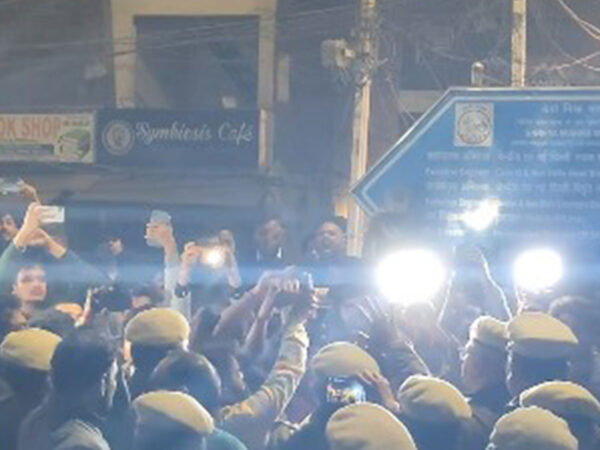
A women Journalist, Ruchi Tiwari, who was reportedly assaulted during a protest at Delhi University’s North Campus on Friday, has alleged that she was targeted by a mob of nearly 500 people. The victim claimed that the crowd turned violent after inquiring about her caste and identity while she was discharging her professional duties.

Speaking to ANI, the woman journalist Ruchi Tiwari said, “Video is everywhere, people can judge by themselves as to who provoked whom…I am a journalist who was there to cover the protest. One of the media personnel said my name to draw my attention. I went up to them, they then asked my full name and caste.”

“The entire crowd came towards me and attacked me. This is clear in the video. About 500 people attacked me. They just have fake narrations and fake allegations. The girls around me whispered rape threats in my ears just because I am a Brahmin; “aaj tu chal, tera nanga parade niklega,” is what they said. The men around me were saying that they would teach me a lesson. The girls had held me by the arms and neck. This is an attempt to murder. I had fallen unconscious, but the Police did nothing, ” she further claimed.

Ruchi Tiwari alleged that the reason the mob targeted her for her caste and that she was now registered an FIR in the case.

“A boy there was signalling to others to take me away. Did they want to kidnap me?… My clothes were being torn…I was being improperly touched. They were goons, they cannot be students…I was attacked due to my caste. Nobody supported me, only a few Law Faculties showed humanity, and I came out with their help as well as with that of a few women Police personnel…FIR has been registered, I trust the law…The incident occurred for about half an hour…There was mob lynching there, I escaped somehow is a big deal for me.” she claimed.

On the other hand, Prasenjeet Kumar, AISA National General Secretary alleged that Tiwari had pushed another YouTuber and that caused the fracas.

“Students had gathered in support of UGC…It was a peaceful program. But amid all this, a YouTuber pushed another YouTuber who hails from the Bahujan community and attempted to disturb our program. They started manhandling our people; in turn, our people tried to push them to the side. There has been no fight or manhandling as such,” Prasenjit said.

He further said that a deliberate attempt is being made to create such an atmosphere.

“Not just in DU, we have seen this happen in Allahabad – how the people of ABVP beat up the students there. Yesterday in DU, a YouTuber was placed at the front, and we saw the kind of slogans that were raised in front ofthe Police Station. This is a laughable situation. Police are not taking any action. They want to provoke people into ending the demonstration. They can see that people across the country are standing in support of UGC regulations…No manhandling had occurred. Several such YouTubers come to pro-UGC programs and raise such slogans and push people. The right-wing YouTubers come with their agenda; this is an attempt to disturb our program. ABVP is complicit in this…This was premeditated by the people of ABVP, Prasenjit Kumar added.

ABVP Delhi State Secretary Sarthak Sharma said, “An attack on the media, which is considered to be the fourth pillar of democracy, is highly unfortunate. The history of Left-wing politics has been marked by the encouragement of violence, and students of the University of Delhi have decisively rejected such ideologies. Frustrated by their declining relevance, these groups are resorting to new tactics to remain in the media spotlight. The cowardly act of manhandling a woman journalist reflects their true character.”

The ABVP has demanded strict action from the Delhi Police and the university administration against those responsible.Meanwhile, the All India Students’ Association (AISA) issued a counterstatement, alleging that it was their members who were targeted during the protest. (ANI)

Supriya Sule Says Father Sharad Pawar Is In Good Health

Nationalist Congress Party (SP) MP Supriya Sule said that her father, Sharad Pawar, has been advised to resume his daily routine work only after resting at home for a couple of days.

The NCP SP chief was discharged from Ruby Hall Clinic in Pune, following treatment for chest congestion and breathing difficulties.

Supriya Sule shared the update on X, stating, “Respected Pawar Saheb is in good health and has been discharged by the doctors. He has been advised to take rest for three to four days. Accordingly, he will rest at home and thereafter resume his daily routine work. Saheb was admitted to Ruby Hall Clinic in Pune for treatment.”

She added, “During this period, dignitaries from various fields across the country and the state, as well as citizens who love him, sent their best wishes. He sincerely thanks everyone for inquiring about his health. Along with this, he also expresses heartfelt gratitude to the doctors, nurses, and supporting staff at Ruby Hall Clinic who treated and took care of respected Pawar Saheb.”

This came after Sule had informed, “Baba has developed chest congestion and will need a 5-day course of antibiotics. Fortunately, all other vital parameters are normal. Thank you all for your kind words and continued support. A heartfelt thank you to all the doctors from the bottom of my heart.”

The hospital confirmed, “The medical team has advised him to take adequate rest for a few days, following which he may gradually resume his routine work and public engagements.”

Earlier, Doctor Simon Grant said, “Pawar is in good health and has recovered well. He will be discharged today. The medical team has advised him to take adequate rest for a few days, following which he may gradually resume his routine work and public engagements.”

NCP (SP) leader Rohit Pawar also provided updates, saying, “Sharad Pawar’s health is very good right now. His tests have been done there. He has not been kept in the ICU. He has been kept in a private room there. He doesn’t need any support there right now. Once the reports come, it will be decided whether he will be kept in Pune or Mumbai.”

He added, “Pawar came here in a private vehicle, and everything is normal.”

Rohit Pawar urged party workers to avoid visiting the hospital, stating, “I, Supriya Tai, the doctors, the party workers, and people from across Maharashtra will provide regular updates.” (ANI)

Modi Dedicates 50 State-Of-The-Art Electric Buses For Bhavnagar

Prime Minister Narendra Modi inaugurated development projects in Assam worth over ₹5,450 crore on Saturday. On the occasion, he also dedicated 50 e-buses for Bhavnagar under the PM-eBus Sewa Scheme.

The PM-eBus Sewa Scheme promotes clean, reliable and sustainable urban transport through electric buses in cities across India. In its initial phase, buses have been allocated to Maharashtra (Nagpur), Chandigarh and Assam (Guwahati). The Gujarat Urban Development Mission is the state nodal agency under the Urban Development and Urban Housing Department responsible for implementing the scheme in Gujarat. In future, 750 buses are planned to operate across eight cities of Gujarat under this scheme.

Bhavnagar is the first city in Gujarat to receive 50 buses under the PM-eBus Sewa Scheme. With 100 buses planned, the city’s public transport facilities will see significant improvement. These buses are air-conditioned, equipped with CCTV cameras for security and designed to be accessible for Divyangs (persons with disabilities).

Eventually, e-bus services will be introduced in eight cities across Gujarat, with 250 buses in Vadodara, 100 in Rajkot, 100 in Bhavnagar, 100 in Gandhinagar, 50 in Jamnagar, 50 in Junagadh, 80 in Gandhidham and 20 in Navsari. Gujarat is playing a leading role in building the required infrastructure and technical systems for electric buses. As part of a coordinated national effort, this initiative marks an important step towards environmentally friendly transport. (ANI)

PM Modi Pays Homage To 2019 Pulwama Attack Bravehearts

Prime Minister Narendra Modi on Saturday paid tribute to the CRPF personnel killed in the 2019 Pulwama attack, recalling their bravery, devotion, and service to the nation.

He said their courage continues to inspire every Indian.

In a post on X, PM Modi wrote, “Remembering the brave heroes who laid down their lives in Pulwama on this day in 2019. Their devotion, resolve and service to the nation remain forever etched in our collective consciousness. Every Indian draws strength from their enduring courage.”

Earlier in the day, Vice President CP Radhakrishnan also paid humble respects to the brave CRPF personnel.

The Vice President remembered their sacrifice, saying that it is forever engraved in Indian history and will continue to inspire the nation for ages.

“I pay homage to the brave personnel who laid down their lives in the Pulwama terror attack. Their supreme sacrifice will forever remain etched in the nation’s memory and continues to inspire us to build a strong and secure India,” he wrote.

Jammu and Kashmir’s Pulwama district witnessed one of the deadliest terror attacks when as many as 40 CRPF personnel were killed when their convoy was targeted on the Srinagar-Jammu National Highway on February 14, 2019.

The convoy comprised 78 buses in which around 2,500 personnel were travelling from Jammu to Srinagar.

Pakistan-based terror outfit Jaish-e-Mohammad claimed responsibility for the attack, saying it was caused by a suicide bomber, according to a local news agency.

However, India launched a series of counter-terror operations, including airstrikes at terror camps in Pakistan, marking a significant escalation.

The Pulwama terror attack not only triggered heightened tensions between India and Pakistan but also led to global discussions about cross-border terrorism and security in Jammu and Kashmir. It is marked as the ‘Black Day’ to remember the 40 brave CRPF soldiers who laid down their lives in the attack. (ANI)

10-Month-Old Alin Sherin Abraham Becomes Kerala’s Youngest Organ Donor, Saves Five Lives

A 10-month-old Alin Sherin Abraham has become Kerala’s youngest organ donor, giving new life to five recipients after being declared brain-dead at the hospital.

Her parents, Arun Abraham and Sherin Ann John, made the decision to donate her organs.

The infant’s liver, two kidneys, heart valve and corneas were donated. A six-month-old baby undergoing treatment received the liver, becoming the youngest in the state to undergo a posthumous liver transplant. The kidneys were allocated to another child, while the heart valve and corneas were also transplanted to patients in need.

Health Minister Veena George expressed heartfelt gratitude to the grieving parents, saying their decision would help save multiple lives.

Alin suffered brain death following a road accident on February 5 at Pallam Borma junction in Pathanamthitta district, where a car coming from the opposite direction collided with their vehicle. She sustained severe injuries, and her mother and grandparents were also critically hurt.

After initial treatment in Changanassery and Tiruvalla, the child was shifted to Kochi, where she was declared brain-dead on February 13. The family consented to organ donation soon after.

The organs were transported from the hospital to various medical centres in Thiruvananthapuram under the coordination of KNOS (Kerala Network for Organ Sharing), with support from the Home Department.

Authorities said the donation stands as a powerful message of hope amid tragedy. (ANI)

AI-171 Crash: Air India’s Settlement Problematic, Lawyer Advises Families Not To Sign

Attorney Chuck N. Chionuma, representing the families of over 105 victims of the Air India Flight AI-171 crash, advised not to sign the proposed settlement terms offered by the airline, and urged families to wait for the AIP data before making any decisions.

While speaking to ANI, Chionuma said, “My advice is not to sign this, but to wait for the AIP data to be released so we know who the culprits are. Then you’ll be able to assess what the real damages are and what you are given before you sign such a document.”

“The document applies to every jurisdiction where any claim is brought. It requires the families to indemnify and hold these companies harmless, regardless of where the claim is brought,” he added.

The proposed settlement terms require families to release Air India and its parties, including manufacturers, operators and government entities, from all current and future liabilities. Chionuma argue that it is unfair to sign away their rights before the investigation is complete.

He added that some families have already received the proposed settlement terms but were advised not to accept them.

“Three families have received the proposed release and settlement terms from Air India, and we have advised all of them not to accept it. The settlement proposed by Air India is problematic in several respects. It not only releases Air India from current and future liabilities for the deaths of family members, but it also releases practically everyone in the world, including the airline manufacturers, component manufacturers, aviation operators, and even governmental entities. The liability they are indemnifying against has no limit. To make things even worse, the document also goes as far as requiring the families and other parties to hold Air India harmless against any future claims. It is not advisable for anyone to sign these documents,” Chionuma told ANI.

On Thursday, Air India announced the initiation of the final compensation process for families affected by the tragic crash of Flight Al-171 in Ahmedabad last year.

In a statement released by the airline, Air India expressed deep understanding that no monetary amount can compensate for the loss of a loved one. However, providing clarity on final compensation represents a significant step for the grieving families.

The airline has already provided initial interim payments of ₹25 lakh to the families of the deceased. Additionally, the process for ex gratia payments of Rs 1 crore per deceased family, funded through the Al-171 Memorial and Welfare Trust established by the Tata Group, is currently underway.

Air India emphasised that the final compensation offers are fair, compliant with applicable legal frameworks, and calculated individually based on specific circumstances. These payments are structured on a “full and final” basis following standard industry practices to bring closure to the matter.

As part of the agreement, families accepting the final amount are required to confirm they will have no future claims against Air India or related parties, including original equipment manufacturers, airports or government agencies. The airline highlighted the importance of this clause to ensure the settlement is truly conclusive and to prevent any subsequent direct or indirect claims. Air India stressed its commitment to transparency and compassion in communications with the families. It has advised them to seek independent legal advice before making a decision and has offered support options throughout the process.

Last year on June 12, Air India flight AI-171, a Boeing 787-8 aircraft, crashed soon after it took off from Ahmedabad’s Sardar Vallabhbhai Patel International Airport, killing 260 people, including 229 passengers, 12 crew members, and 19 people on the ground. (ANI)

India Is Entering Into Trade Deals Because It Is Ready To Compete Globally: PM Modi

Prime Minister Narendra Modi has said India’s free trade agreements are being widely discussed and analyzed globally and the country is entering into trade agreements with countries in different parts of the world as it is full of self-confidence and ready to compete with the world.

Addressing the ET NOW Global Business Summit 2026 here, PM Modi said the past decade has been one of unprecedented development for India, marked by strong delivery and by efforts that have strengthened our democracy.

He said India is riding the Reform Express and the government has made the Budget not only outlay-focused but also outcome-centric.

He noted that the government has regarded technology and innovation as the core drivers of growth.

“There’s a lot of discussion these days about India’s FTAs. As soon as I entered here, people started asking me about it… Have you ever wondered why these trade deals with developed countries didn’t happen before 2014?… Because, there’s been a shift in the government’s vision, policy and intention. There’s a shift in India’s potential… Does a rich person marry a poor girl in a village? We faced the same situation globally. When the country was beset by policy confusion and scams and frauds galore, who could have trusted India?… We are able to sign these trade deals because today’s India is full of self-confidence and ready to compete with the world,” he said.

PM Modi said the world is moving towards a new world order. The Prime Minister remarked that after the Second World War, a new global order had emerged, but seven decades later that arrangement is breaking down and the world is moving towards a new order. He questioned why this is happening and explained that the earlier system was built on a One Size Fits All approach. He noted that it was assumed the world economy would remain at the core, supply chains would stay strong and reliable, and nations would be seen only as contributors. He highlighted that this model has now been challenged and is losing relevance, with every country realizing it must build its own resilience.

“The century of change you are talking about, and I say this with immense responsibility, India is going to be a massive foundation for this… India will drive the world’s growth. India will become the engine of world’s growth… The world is moving towards a new world order. The system established then was based on the idea of ‘one size fits all’. It was then assumed that the world economy would be at the core,” he said.

“In this system, nations were viewed solely as contributors. But today, this model is being challenged… Today, every nation is realising that it has to build its own resilience. What the world is discussing today, India made that its policy in 2015 itself. India had made its vision clear in the founding document of ‘Niti Aayog’, that India will not import even a single development model from any other nation,” he added.

The Prime Minister said that an Indian reform that has taken the world by storm in the past decade is UPI.

“It’s not just an app; it’s a testament to the remarkable convergence of policy, process, and delivery. UPI is reaching citizens who could never have imagined the benefits of banking and finance. This reform wasn’t done out of compulsion. It was our conviction. The conviction was the inclusion of citizens to whom the previous governments had not reached. ‘Jise koi nahi poochhta, use modi poojta hai’,” he said.

The Prime Minister said that as the country’s economic power has grown, the Centre has empowered the states in equal measure.

“From 2004 to 2014, states received Rs 18 lakh crore through tax devolution. However, between 2014 and 2025, this amount increased to Rs 84 lakh crore. If we include the Rs 14 lakh crore proposed in this year’s budget, the total comes to Rs 100 lakh crore,” he said.

He said this year’s budget has propelled the Reform Express forward.

“While the budget covers many aspects, I would like to highlight two key factors: capital expenditure (capex) and technology. As in recent years, infrastructure spending has been increased, reaching Rs 17 lakh crore. The multiplier effect of capex is significant–it enhances the country’s capacity and productivity, and also generates employment across multiple sectors. Announcements such as the construction of five university townships, economic regions in tier-2 and tier-3 cities, and seven high-speed rail corridors represent investments in the future of our youth and the nation,” he said.

The Prime Minister said that during the pre-2014 period, reforms in India were often driven by sheer compulsion rather than proactive planning.

He emphasized that reforms born out of compulsion never yield proper results for the nation. He expressed pride that in the past eleven years, reforms have been carried out with conviction, across policy, process, delivery, and even mindset. He stressed that if policy changes but processes and mindset remain the same, reforms remain only on paper, which is why his government worked to transform the entire system.

PM Modi elaborated on process reforms, citing the example of cabinet notes, which earlier took weeks or months to prepare, slowing development. His government made decision-making time-bound and technology-driven, ensuring that files could not remain pending indefinitely, and the results are visible today.

Citing the example of railway over-bridge approvals, which earlier took years and required multiple clearances, PM Modi said it has now been streamlined, leading to rapid infrastructure growth. He also highlighted border infrastructure, recalling that earlier even a simple road in border areas required permissions from Delhi, creating barriers for local decision-making. Post-2014, his government empowered local administration, resulting in fast-paced border infrastructure development.

“For example, the 1991 economic reforms were implemented only when the country was on the verge of bankruptcy and had to mortgage its gold reserves. Similarly, the National Investigation Agency (NIA) was established in response to the 26/11 terrorist attacks. When the power sector was in crisis and grid failures became frequent, the Congress government addressed the issues in the sector out of compulsion rather than foresight,” PM Modi said.

He recalled that when the last decade began, India was the eleventh largest economy, and amidst turmoil there were fears of decline, but today India is rapidly advancing to become the world’s third largest economy.

Underlining that India will be a major foundation for the Century of Change, PM Modi noted that India currently contributes more than sixteen percent to global growth and expressed confidence that this contribution will continue to rise year after year. He affirmed that India will drive global growth and emerge as the new engine of the world economy.

Underlining that India’s new outlook is reflected in the budget as well, the Prime Minister highlighted that earlier discussions around the budget focused only on outlay–how much money was allocated, what became cheaper or costlier, how many new trains were announced–without questioning the outcomes of those announcements. He emphasized that his government”made the budget outcome-centric along with outlay-centric”.

PM Modi noted another major change in Budget, stating that before 2014, off-budget borrowing dominated discussions, whereas now off-budget reforms are the focus.

He recalled reforms outside the budget such as next-generation GST, the creation of NITI Aayog in place of the Planning Commission, the abrogation of Article 370, the law against triple talaq, and the enactment of the Nari Shakti Vandan Adhiniyam. The Prime Minister underlined that whether announced in the budget or outside it, the Reform Express continues to gain momentum.

Underscoring that over the past decade, technology and innovation have been recognized as core drivers of growth, with the promotion of startup and hackathon culture, PM Modi noted that India now has more than two lakh registered startups working across diverse sectors. He added that the government has encouraged risk-taking and rewarded innovation, with visible results. He stated that this year’s budget strengthens these priorities, particularly with significant announcements for sectors such as biopharma, semiconductors, and artificial intelligence.

PM Modi remarked on the difference in vision, noting that some question why he speaks of 2047 and developed India, dismissing it as uncertain. He countered that if freedom fighters had thought similarly, India would never have achieved independence. He stressed that when the nation comes first, every decision and policy is for the country. The Prime Minister affirmed that the government’s vision is clear–to continuously work towards making India developed. He added that whether or not today’s generation remains till 2047, the nation and its future generations will, and therefore it is the duty of the present to dedicate itself so that the future is secure and bright.

The Prime Minister remarked that the world must now be prepared to live with disruptions, noting that their nature will continue to evolve but systems will change rapidly.

He highlighted the disruptions already visible due to artificial intelligence and emphasized that AI will bring even more revolutionary changes in the future, for which India is ready.

He said that in a few days, the Global AI Impact Summit will be held in India next week with participation from numerous countries and technology leaders from across the world. (ANI)

Zubeen Garg’s Wife Garima Shares Update On Singer’s Death Case

In the ongoing death case linked to singer Zubeen Garg, the Court of the District and Sessions Judge on Friday examined documents filed by the two accused, Shyamkanu Mahanta and Siddhartha Sharma.

After the hearing, Zubeen’s wife, Garima, spoke with the media and informed them that Siddharth Sharma filed a discharge petition during the last hearing, with arguments scheduled for February 16.

She added that further proceedings in the matter will take place on the same day, marking a crucial development in the case.

“Siddharth Sharma had filed a discharge petition on the last hearing. The argument will be held on the 16th… everything will be done on 16th,” Garima said.

Advocate Apurba Sarma told ANI, “Today, the case was fixed for hearing on the petition filed by Shyamkanu Mahanta. It has been heard, and an order will be passed on the 16th. Shyamkanu Mahanta filed a petition to refreeze his bank accounts. So, that has been heard, and an order will be passed on the coming 16th. Siddharth Sharma has filed three more petitions, and he is seeking all the documents, including digital copies of all the documents submitted before this court. The prosecution has objected to all of them, and the objections will be heard on February 16th, and the Court will pass an order on that day… We demand from the Government of Assam and India that a fast-track court be established that will conduct daily hearings…”

Last month, the family of Zubeen Garg had written a letter to Prime Minister Narendra Modi, urging the constitution of a special court, expedited trial in Assam and appropriate diplomatic-legal intervention in Singapore following his death on September 19, 2025.

In the letter, the family described Garg as “not only a member of our family but a cultural voice of Assam and India’s North-East”, adding that his sudden passing left behind a grieving family and millions of followers seeking clarity on the circumstances of his death.

Taking to her official handle, Zubeen’s wife, Garima Garg, shared the letter, which reads, “Respected Sir, We, the family of Late Zubeen Garg, humbly place this memorandum before you with faith in the constitutional authority of your office and in the commitment of the Government of India to justice, dignity, and the rule of law. Zubeen Garg was not only a member of our family, but he was also a cultural voice of Assam and of India’s North-East.”

Garg, who died in Singapore in September last year, was “severely intoxicated” and had drowned in the waters off Lazarus Island after declining a life jacket, a Coroner’s court was told, according to a report by Lydia Lam in Channel NewsAsia (CNA).

The iconic singer, 52, was at a yacht party on September 19, 2025, and initially wore a life jacket but removed it and later declined to put on a second one offered to him, the chief investigating officer told the court in the opening of the inquiry, according to the news report.

At the time of the incident, he was “heavily intoxicated”, and several witnesses saw him attempting to swim back to the yacht before he went limp and began floating face-down in the water, the report said. (ANI)

‘New Chapter’: Expert Lauds BNP Landslide Victory, Says Resetting India Ties Key Priority

Shafqat Munir, Senior Fellow at Bangladesh Institute of Peace and Security Studies, described the victory of Bangladesh Nationalist Party (BNP) in the 13th National Parliamentary Election as marking a “new chapter,” highlighting that a democratically elected government will now shape the country’s foreign policy.

Speaking on the potential for revitalising India-Bangladesh ties, Munir said the relationship has experienced “quite a few ups and downs in recent times,” but expressed optimism about the future.

“This indeed marks a new chapter because we will now have a democratically elected political government with a very resounding mandate. Together, we will be able to repair and revitalise the relationship as it has gone through quite a few ups and downs in recent times. But to do that, the first task for both sides would be to rebuild trust and address the trust deficit that has developed. The messages emanating from the Indian leadership are indeed steps in the right direction,” he told ANI.

On PM Modi congratulating BNP chairman Tarique Rahman on the party’s landslide win, Munir described the Prime Minister’s outreach as “a very important gesture.”

He said, “This is a very important gesture by Prime Minister Modi. Resetting the ties with India and revitalising our relationship with India will be a key priority for the new government. That will have to be done by both sides, by rebuilding trust and confidence.”

Munir described the recent election as “a great day for Bangladesh” and called it a “resounding victory for BNP.” He further highlighted that the elections were peaceful, with minimal violence, and that voter turnout was high.

“This is a great day for Bangladesh. It is a resounding victory for BNP. It was a very peaceful election with very little violence and people came out in large numbers to vote. It’s a great beginning for Bangladesh, but the real journey lies ahead. The new government’s first priority would be to ensure stability. The nation comes together once again because significant healing and reconciliation are required. The key operational task for the new government would be to reset the economy and set all the economic priorities right,” he told ANI.

The message comes amid a wave of international acknowledgements following the BNP-led alliance’s landslide success in Thursday’s polls, alongside the official declaration of results for 297 parliamentary constituencies by Bangladesh’s Election Commission (EC).

Results for Chattogram-2 and Chattogram-4 remain suspended and will be announced later, while the outcome of one other constituency was deferred earlier, as reported by Prothom Alo.

In the parliamentary results for these 297 seats, the BNP and its allies secured a decisive 212 seats, marking a landslide victory. (ANI)