Ajith Pillai, a seasoned journalist based in Chennai, says while AI cannot replace human intelligence it will be widely used as a ruse by companies to justify downsizing. His views:
The AI International Summit 2026 was an embarrassment for the government, especially given the hype surrounding the event. The arrangements were substandard. Social media reflects how visitors, who had paid, had a harrowing time. A stream of VVIP visitors hindered movement, and there were complaints about poor connectivity at the venue.
From what one gathers, the summit was organised to achieve two objectives: (a) to emphasise India’s position as a major player in the IT sector by showcasing its innovations; and (b) to roll out the red carpet for tech billionaires to invest in the AI sector in India. To achieve the second objective, the Union Budget had promised a 21-year tax holiday, till 2047, for foreign players investing in data centres in the country.
Remember, hyper-scale generative AI-compatible data centres are essential to support future generative AI innovation and training. That these data centres cause environmental damage and consume huge amounts of electricity and clean water was perhaps not given serious consideration. Neither were the widespread protests against such centres in the US, Europe, and Latin America.
Attracting foreign investment, which would reflect in higher GDP figures, was clearly the government’s sole priority. In any case, when was water scarcity for ordinary citizens and farmers a real concern?
Failing meet green objectives by burning additional fossil fuels to generate electricity has usually been dismissed as a topic for discussion only at carbon-emission seminars!
It is likely that the government will attract investment from Silicon Valley. One will hear of several new partnerships being forged with big Indian businesses. With a lucrative tax holiday and a supportive government, why won’t Big Tech find India attractive?
As for the first objective of showcasing local innovation, the Summit began on a farcical note that attracted much media attention. For reasons known to the organisers and the government, UP-based Galgotias University, better known for its political affiliation than its scientific tradition or research, was allotted a high-profile pavilion. It showcased a ₹350-crore AI ecosystem that it claimed had been developed by its faculty and students.
ALSO READ: Bureaucrat at AI Summit Dispels Fears of Job Loss
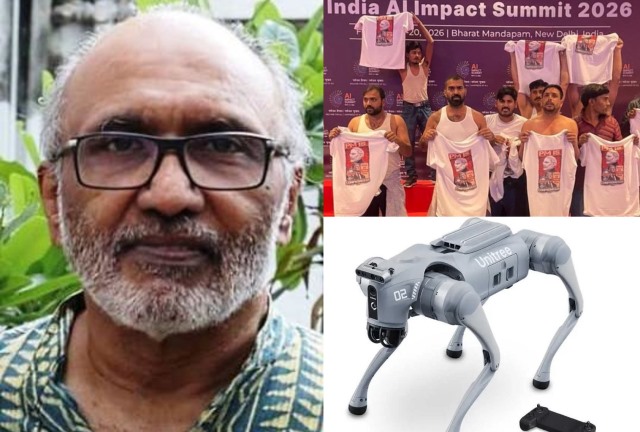
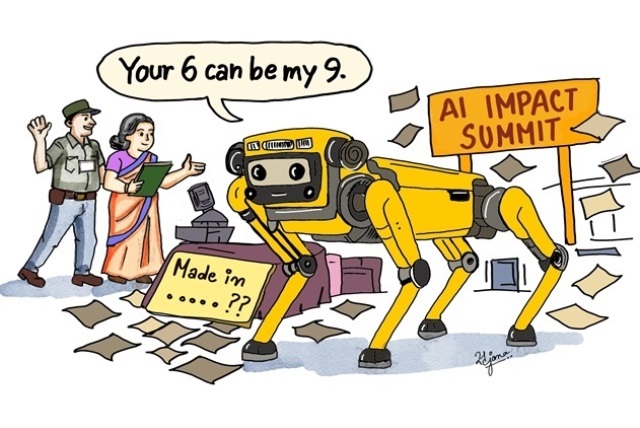
On display was a robodog, ‘Orion’, which was presented as a proprietary, “Made in India” creation developed at the University’s “Centre of Excellence”. But the claim was immediately contested by visitors who identified Orion as “Unitree Go2”, manufactured by the Chinese robotics company, Unitree. If that was not enough, a “soccer drone arena”, also on display as an original, was a Korean product, “Stryker V3 ARF”, available online.
Galgotias were asked to leave the Summit in shame, and their pavilion was sealed off. The robodog controversy became a joke, and cartoonists had a field day.
All said and done, the AI summit left a sour taste, although much of the mainstream media, predictably, has been declaring it as a resounding success.
Generative AI is the new buzzword in Silicon Valley. It is artificial intelligence designed to produce output that would normally require human intelligence by applying machine learning techniques to large datasets. It is supposed to work wonders and take over jobs that humans do.
But the jury is still out on this claim. Every time a new model comes out, the press is inundated with news of how doctors, artists, lawyers, journalists, designers, musicians, and what have you will lose their jobs. When Claude Sonnet 4.6 and Claude Opus 4.6, new models from Anthropic, were released earlier this month, reports surfaced that all white-collar jobs will be taken over by AI.
Later, feedback suggests that the latest crop of generative AI may not be as good as it is made out to be. In fact, a Microsoft study found that AI models in the market are not good at deciphering layered or complex commands as humans can.
So, jobs may not be lost on the scale as predicted, and AI may end up being a tool that assists humans. But it is widely used by companies to justify downsizing, spread fear among their workforce, and underpay their staff. One often hears of tech companies that over-hired post-COVID, jettisoning staff and blaming it on AI.
It is the dream of corporates to run companies on a skeletal staff to enhance profits. Also, the dream of techno overlords in Silicon Valley is ‘world domination’, and they think this is possible through AI, which they believe can render humans redundant.
International information arbitrage today is in the hands of a few players, such as Google, Amazon and Microsoft. Many of our big corporates would like to join that select club.
Does a country like India need generative AI? It perhaps does if it can improve the lives of ordinary folk. There is a school of thought that believes artificial intelligence can be beneficial across various areas. But for corporates, it is a way to exercise control over people and politicians. India, with a growing population of the unemployed, needs jobs. Tech that steals their livelihood cannot be seen as a positive by any reckoning.
To understand the business of data centres, one must understand what tech companies call the cloud. It is a network of remote, internet-accessible servers that store, manage, and process data.
The cloud exists physically, not in outer space, but in data centres located all over the world. It consists of networked computers, servers, and storage systems. These facilities are operated by providers like Google, Amazon, Microsoft. They store data and run applications, making them accessible via the internet. Almost all online companies depend on cloud providers for their operations.
Cloud is known as the new real estate. The more of it you own, the more powerful you are in a world dependent on the internet. So, the big players are keen to create their own cloud space. Indian big business would also like a slice of the cloud and would be happy riding piggyback on Silicon Valley’s techno-feudal overloads, who are looking to set up more and more data centres to grab more of that cloud space.
Generative AI requires mega data centres with large-scale computational resources for generative AI training. Such centres must have super-efficient hardware components to be effective. These hyper-scale outfits are known to guzzle water and power, and can disrupt the electric supply, and can depress the water table in areas surrounding them. This is why there have been protests against them in the US, Europe, and Latin America. In the US alone, $98 billion worth of data centre projects were delayed or cancelled last year.
So, Big Tech had to find new pastures, and India is laying out the red carpet. The unfortunate part is that many of them might be located in water-deficient states like Rajasthan, parts of UP, Maharashtra, Andhra Pradesh, West Bengal and Tamil Nadu. Data centres will initially be located near cities, but many fear they could soon move into the hinterland, where land is cheaper.
As for employment, much of the work related to data centres will be generated during the construction phase. Once it becomes functional, even a large data centre will require fewer than 200 permanent employees.
As told to Amit Sengupta