Recycle Metal to Reduce Mining

I got a sweater the other day produced in Bangladesh, as good as you get anywhere but picked up by my daughter in the United States. The south Asian country in spite of serious political unrest, which has its expected fallout in the economy has managed to increase its share of US garment imports to 10.56 per cent in the first quarter of this year from 8.85 per cent in 2024.

The success in exports in a demanding market like the US is because of price competitiveness of Bangladeshi manufacturers not only due to comparatively low wages compared with China and India, factory ability to readily adopt design changes required by buyers, thanks to skilled manpower, advantage of low currency value and steady order shift from China. The other big manufacturer-exporters of garments, including India, Vietnam and Indonesia have also gained from China plus one policy of the Western countries.

Once you get a new garment, the tendency is to look at the label first before putting it on. You are curious about the brand, the origin of the garment, and also the fibre composition. What took me by surprise with the sweater I got is, as the label says, it is made with “a minimum of 40 per cent recycled materials.” The product has 60 per cent cotton and 40 per cent polyester.

I was told by my daughter, who is living in the US for over a decade and upholds eco-activism that the ranks of concerned Americans buying recycled products are fast growing. Going beyond, they have voted for green products and use of metals from copper to aluminium to steel sourced from secondary sources. What gives satisfaction to environmentalists is to the extent scrap from end-life products is recycled, industry reliance on mining of ores will be curbed. In the process of recycling of metals, electricity saving is considerable, almost to the extent of 90 per cent when seen against primary route of metal making. See, how environment friendly then is secondary route of producing metals.

Then in most instances, opening of new mines leads to displacement of original peoples whether in Australia, India or Brazil. Governments in ores bearing countries have come under growing pressure from civil society to ensure that mining groups take the rehabilitation of displaced people seriously. After all, tribal communities have been in occupation of the lands for centuries that they are asked to vacate to make room for mines.

So, the issue here is ethical and the mining groups are never short of funds. Mercifully, in more and more countries in the West, corporates and also final consumers will ungrudgingly pay a premium for anything made doing the least possible harm to the environment and also ethically.

Textiles offer the possibility of becoming an important part of circular economy and at the same time their recycling will curb carbon emissions and pollution. Besides saving natural resources like water, which is in short supply in majority of countries (India too faces high water stress) and electricity, recycling will ease pressure on waste disposal.

Environmentalists will say, less the use of textile dyes, which are found to be toxic and potentially carcinogenic, better it is for human beings and the environment. Eternally desirous of breathing fresh air free of floating pollutants and seeing the sky not covered by smoke, I appreciate the thoughts that have gone into making the sweater with 40 per cent recycled materials. Whoever will be using a garment like that will find the wear extra comforting.

Whether the recycling relates to minerals, especially the critical ones such as copper, lithium, nickel, cobalt and rare earths or textiles, the success of initiatives in that direction will depend much on policy environment. Looking at the scene globally, there is a positive movement in framing of new policies and regulations and sanctioning of financial incentives to promote recycling.

The International Energy Agency’s Critical Minerals Policy Tracker focussing on 22 countries found introduction of over 30 new policy moves related to critical minerals recycling since 2022. The policies, according to IEA tracker, fall into four categories: “Strategic plans, extended producer responsibility (EPR), financial incentives and cross-border trade regulations. Some also include regulatory mandates such as industry-specific targets for material recovery, collection rates and minimum recycled content.”

Let’s consider the indispensability of recycling for “security and sustainability” of critical minerals supply for transition to clean energy. As the transition gains in momentum across the continents, critical minerals such as copper, lithium, nickel, cobalt and rare earths will meet with higher and higher demand creating compulsion for fresh large investments in mines expansion and opening of new deposits. For importers of such minerals, relief will come by way of developing a robust infrastructure for collection of metals to be found in end of life be it vehicles, machinery, ships or a range of engineering products. The more the supply of secondary metals through scaling up of recycling, greater will be the mitigation of “environmental and social impacts related to mining and refining.” This besides, recycling will reduce the pressure of waste disposal.

But as it continues to happen, the use of recycled materials has failed to grow in sync with demand rises for metals. For example, IEA says in a report that in the case of copper, which has critical applications in electricals, the share of secondary supply, including direct scrap use, in total demand for the metal is down from 37 per cent in 2015 to 3 per cent in 2023. Nickel fared even worse where the share of recycled material in the same period retreated to 31 per cent from 35 per cent.

According to the report, aluminium benefiting from well-coordinated industry intervention by supporting collection of used metal and its remelting and supportive government regulations has, however, seen the rise in share of recycled metal’s use from 24 per cent to 26 per cent.

IEA says, “a successful scale-up of recycling can lower the need for new mining activity by 25 to 40 per cent by 2050 in a scenario that meets national climate pledges.” In case the pledges made by different nations are fulfilled, then recycling or secondary production will lead to cut in new mines development by 40 per cent for copper and cobalt and 25 per cent for lithium and nickel by 2050.
Recycling Is The Only Solution To Manage e-Waste Hazards

India would have been in a better position today to handle the enormous quantities of electronic waste or e-waste in shorter form had it taken note of the serious health and environment damages caused to Guiyu in south China’s coastal province Guangdong where almost every family was engaged in processing imported and indigenous e-waste. What would you expect Guiyou township to become when the people there were extracting valuable materials such as gold, silver and copper from e-waste in makeshift workshops in their backyards without any protection?

As e-waste items would be given acid bath and incinerated and much of that happening by the side of the river, the water got polluted. Remains of heavy metals such as lead, tin and chromium removed from e-waste in a crude fashion settling on ground made the once rice and other crops growing Guiyou barren. The toxic air and water in 54 sq km Guiyu were also the reason for the children having high levels of lead in their blood that would compromise their intelligence and damage development of central nervous system and miscarriages level being much higher than national average.

The health and environment disaster that clumsy recycling continued to wrack on Guiyou, the world’s most notorious dumping ground for e-waste, invited unrelenting global criticism that made an embarrassed Beijing to ask  Guangdong provincial authorities to be quick on cleanup operation. The place rightly earned the moniker the world’s graveyard for e-waste. Farming ruined, Guiyu residents were left with no alternative but to depend on e-waste processing for sustenance.

This being the reality, what Guandong decided in December 2013 and finally executed in 2015 was to move the family run recycling workshops numbering more than 1,200 to an industrial park built at a cost of 1.5 billion yuan ($233 million). While the ones that refused to move their work to the park were banned, those who came in went through many mergers ending in about 30 big operations. The park has enforced strict discipline by way of checking what e-waste comes in for processing and what recovered materials go out.

The reason for deliberating on Guiyu crisis and its resolution by way of official intervention in so many words is because China’s response to combat a health and environment disaster could act as an alert for New Delhi to cope with the fast developing crisis centring e-waste. There is no way we can pretend ignorance that India is the world’s fifth largest generator of e-waste after the US, China, Japan and Germany. The accumulation of such waste and its open air processing as was the case in Guiyu till a few years ago or as is to be widely seen with roadside dismantling of lead acid batteries in our cities and countryside is nothing short of our sitting on an environment and health destroying time bomb ticking away.

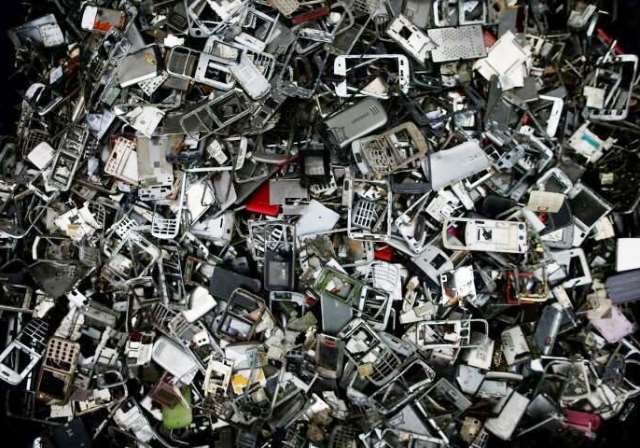
Conservatively estimated India’s annual output of e-waste is 2 million tonnes and not more than 5 per cent of that is recycled. Even then for that recycled amount it will not be claimed that much of dismantling of discarded e-materials from smartphones to computers to new age TVs is done scientifically in an ideal environment like what now obtains at Guiyu. Generation of e-waste is not confined to traditional IT products. From air conditioners, refrigerators, washing machines, vacuum cleaners to small appliances such as toasters, irons and coffee machines all now have components that leave e-waste at the end of useful life. Indian rich and the middle class constitute a consumer society with a rising disposable income. Then consumer loans available from banks and other financial institutions help in buying all kinds of things, including electronic products. No wonder the market for consumer electronic products in the country continues to grow at an annual rate of 15 per cent defying major demand slump for automobiles and the whole range of fast moving consumer goods.

Two factors contributing to the growing menace of build-up of e-waste are: First, an unaccountable number of smartphones, laptop computers and several other electronic products come into the country with Indians returning from abroad. Knowing how much such products are appreciated here, foreigners visiting India also bring these as gifts. Second, purely for commercial reasons producers of consumer electronics items, particularly smartphones will launch new products – in most cases an apology for refreshed – at regular intervals to lure customers to buy these and discard the ones with still useful life.

People need to be made aware of the consequences of 95 per cent of e-waste accumulating in individual residences – a south Asian phenomenon of common disinclination to get rid of old things – offices and factories, out in the open and in landfills. Electronic equipment contain toxic materials such as lead, zinc, nickel, chromium and barium. Lead left in the open will cause harm to human health with children in particular suffering damages to blood, kidneys and nervous system. We are seeing here how workers engaged in dismantling end of life vehicles in an archaic fashion suffer health problem. There is mindless throwing here of e-waste in the open but when it gets heated under the sun, toxic chemicals are released in the air to environmental detriment. Leave e-waste in landfills, the toxic elements will seep into groundwater whose use will prove damaging to human health and growing of crops as was seen at Guiyu.

Seeing the emergence of a major crisis, the UPA government enacted e-waste management rules in 2011 and the NDA regime further inserted teeth to the rules twice in 2016 and 2018. But the initiatives have not yielded the desired results in the absence of simultaneous build-up of public awareness of the menace facing them. Thankfully, more recently marketing outfits such as Flipkart, which was acquired in May 2018 by Walmart and Tata group owned Croma have got into the act in tie-ups with some major electronic brands for collection and sending e-waste to centres where it is processed in an environment friendly way.

Let the domestic and foreign companies with manufacturing outfits here follow the example of Apple which is committed to reusing as much of materials recovered from e-waste as possible in its new products. To give an example, Apple is using 100 per cent recycled rare earths in a key component in its new series of iPhones. Finally, the rate of recycling of e-waste in India will depend on motivating consumers to return end of life products to retailers and for that get a decent discount for their new purchases. At the same time, all the stakeholders will have to see that government authorised recycling centres in good numbers which will take care of the health of workers come up in different parts of the country.