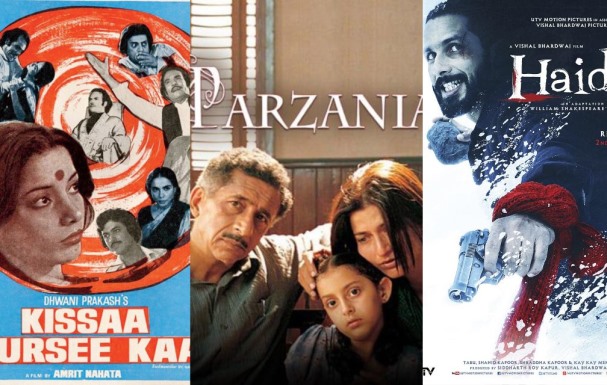
A banned book, or film, or any work of art, popular or niche, always manages to resurface. Not only does the ‘prohibition’ and deliberate denial create a craving for this inaccessible stuff, but many actually search and seek out the book or film, so as to fulfil their forcibly suppressed curiosity.
It’s a natural, instinctive human craving. The more you deny, the longing for it becomes many times more insatiable and intense.
For instance, how can you kill authentic ideas, or creative imagination, aesthetic images or sound, words or sentences, poetry or song, or any work of meaningful creativity, by blocking it from the public domain? You just can’t do it; they will fly on the wings of desire, imagination and rebellion. They will search and seek out meaning in the dark. They will rediscover and resurrect in multiple forms of revelations.
Here denial is a form of dictatorship. A political denial of an aesthetic and creative product – you might agree or disagree with it. This denial seems deliberate. And, thereby, there will always be people, young and old, who would choose to defy this deliberate, dictatorial, diabolical act.
Adolf Hitler’s Mein Kampf is widely available on roadside book stalls, so is Nathuram Godse’s Why I assassinated Gandhi – you might agree or disagree. No one has asked them to be banned in India.
Similarly, a banned organisation only flourishes – while it goes underground. Look at the RSS. The ban on RSS did not change its support base among its followers, with hate politics as their historically proven trump card. That is their bread and butter.
Banned thrice, first after the assassination of Mahatma Gandhi, nothing much changed in its cadre base despite the ban. Indeed, it is a fact that they flourish only parasitically, when the State is under their control, because they have no history of rebellion, sacrifice, grassroots struggles, or sustained resistance to power establishments. They chose to not fight the British. And we know about the famous ‘apology letter’!
They made no sacrifices during the freedom struggle in which they did not participate, while young revolutionaries like Bhagat Singh, Ashfaqullah Khan, Ramprasad Bismil, Sukhdev, Rajguru and Khudiram Bose were being hanged, or condemned across long distances on the sea to the dingy torture cells of kala paani in the Andamans. Hundreds were jailed in terrible conditions. Earlier, Birsa Munda, in his early 20s, was killed in prison, his rebellion brutally crushed. Even after the Jallianwala Bagh Massacre in Amritsar, they did not change their ways.
They backed Adolf Hitler and the genocide by the Nazis. Then they supported the Holocaust, the gas chambers, and the mass murder of 6 million plus Jews, now they seem to be doing exactly that, tacitly or otherwise, on the genocide in Gaza, while the Zionists have turned mass murderers.
ALSO READ: The Palestinian Rebellion 2.0
What else prompts the BJP regime to stop all peaceful protests in Delhi and elsewhere, against the genocide, whereby thousands of women and children have been targeted and murdered by Israel? When the whole world, in tens of thousands, especially in the West, are protesting on the streets?
Does India stand with Palestine as always, or, is it now, an ally of Israel?
Or, why did they choose to not allow internationally acclaimed films on Palestine for a prestigious international film festival in Trivandrum in Kerala from December 12 to 19, 2025?
Apparently 19 films did not get ‘censor exemptions’. The I&B Ministry, with all its wisdom, stopped 19 films and prohibited their screening at the festival.
These include one of the greatest films in the history of world cinema, The Great Dictator, Charlie Chaplin’s caricature of Adolf Hitler, and the Soviet-era black and white classic, a favourite of filmmakers and film scholars, Sergei Eisenstein’s Battleship Potemkin. The surprising decision, obviously, raised a controversy – though with this regime in New Delhi, nothing surprises anymore.
The Great Dictator: No film buff has missed this film. Millions have seen it many times, and it will be continued to be seen by generations to come. Like most of Chaplin’s great films, including Modern Times, made on the post-depression era in the early 1930s, and a scathing commentary on the cruelties of industrial capitalism, the Orwellian state and factories with their compulsive reduction of workers into objects of hard labour — with no human essence, dignity or identity.
The famous scene of Chaplin, the nut and screw worker, doing his starkly alienated job, repeated again and again, surrounded by ugly machines, tells a story. So much so, when he is not tightening one screw after another, his body and hands are still moving in mechanical motion.
A human being, this worker, thus, has been reduced into a meaningless, mechanical object, a tiny cog in the wheel of profit and exploitation, a mere spare part in a gigantic machine.
Battleship Potemkin, Sergei Eisenstein’s Soviet-era classic, made in 1905, seen in every film club by students across the globe, with its black and white montage, is marked as one of the great learning curves of modern cinema. The scene of the ‘Odessa Steps’, with the Tsar’s army firing indiscriminately and killing ordinary folks, and that incredible shot of a child in its baby carriage, solo and solitary, rolling down the blood-soaked staircase, has been hailed as a ‘masterpiece moment’ in world cinema.
The rebellion of sailors on a ship became a metaphor of revolutionary uprising, and is often hailed as the starting point of the Bolshevik revolution of 1917 led by Vladimir Iliych Lenin.
As for the I&B ministry decision, filmmaker Adoor Gopalakrishnan said, “All these movies are very important movies in the history of cinema. If they say it cannot be screened then that is because of ignorance. The movie Battleship Potemkin can be considered a textbook to study cinema. People who have no clue about all these are doing this. The authorities should reconsider this decision.”
Resul Pookutty, head of the Kerala Chalachitra Academy and organiser of KFFI, said that the I&B ministry did not provide any reasons for the denial.
Chief Minister Pinarayi Vijayan took a strong stand. He told the Chalachitra Academy to go ahead, screen all films as scheduled, and ignore the Centre’s order. Thereby, many of these films were screened, and the ministry cleared 13 additional films, including Palestine 36, Beef, Heart of the Wolf, Bamako, Battleship Potemkin, Red Rain, Riverstone, The Hour of the Furnace, Tunnels: Sun in the Dark and Timbuktu.
Palestine 36 is a recent, prestigious production on the early history of the occupation backed by the British, made by a woman director, and is pitched to bag many awards in international film festivals. Only the Israeli regime would want to stop this film.
Six films were still not allowed, due to the absence of ‘mandatory political clearance’ from the Ministry of External Affairs (MEA). The films stopped were: All That’s Left of You, Clash, Flames, Eagles of the Republic, Yes, and A Poet: Unconcealed.
In a video message captioned, ‘Unprecedented times, unprecedented decisions’, Pookutty said, “I am happy to let you know, dousing all the fire on the controversy regarding the film screenings at IFFK, we are going ahead with all the screenings as scheduled as per the notification issued by government of Kerala. And Long Live Cinema.”
Pinarayi Vijayan had spoken sharply against the denial of ‘censor exemptions’ to the films including the Spanish hip-hop film BEEF. He said, “They did not give permission for the movie BEEF. Why? Because for them, beef has only one meaning. But the film was not related to the beef we eat. It is based on Spanish hip-hop culture, where ‘beef’ refers to conflict or rebellion.”
As for films on Palestine, he said: “The Union government’s position on Palestine is evident once again, as Palestinian movies were not given permission. This appears to be a politically motivated decision… IFFK will always stand and resist any kind of anti-democratic or fascist steps.”
(The latest unconfirmed news is that the highly-acclaimed films on Palestine, including Palestine 36, were not screened. I hope it is not true.)