“Freedom is what you do with what’s been done to you.”
—Jean-Paul Sartre
The spontaneous uprising comes in waves. It has its own seasons.
The Spring Revolution following the hard winter struggle.
Sometimes, it becomes all quiet on the JNU front for a while; we used to call it “the silence of the graveyard”. For reasons not difficult to comprehend, when a particular union becomes stagnant, conformist and compromised; or, repression is at its peak, and the relentless struggle experiences fatigue.
However, a movement in retreat is not a movement in retreat. It never gets defeated.
JNU will never be defeated. That is its restless, radical, revolutionary inheritance. It’s stream of consciousness. Its inner soul and existential realism. Its essence of freedom and its progressive politics.
I have always believed, a truly authentic movement is never defeated. It can never be defeated — by not even the mightiest and most evil and vicious force on earth. A movement in retreat is not defeat. It’s merely a pause. The red star is waiting for the moonlit tide to rise. Then it will shine, the red star, and show the way.
As a Latin American wall writing said: The dawn is no longer an illusion.
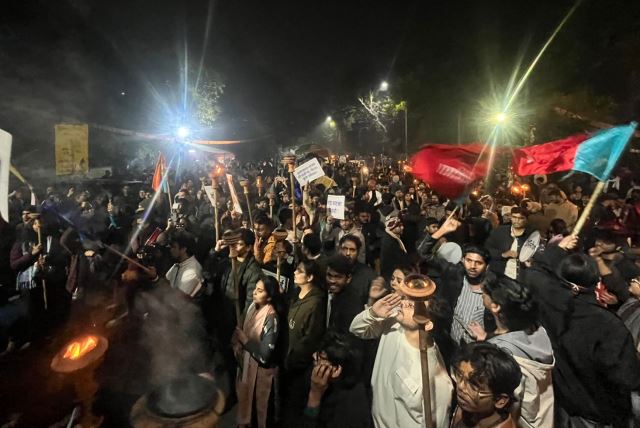
Another long march has yet again begun in JNU. A new generation of brave, gutsy, resilient young minds with hearts full of passion and the quest for justice, fearless and free, are out on the streets, in this spring sunshine, in the sensuous nocturnal expanses, marching, singing, shouting slogans in chorus, holding hands and sparkling torchlights, walking through the February flowers and the majestic trees, in the lanes and bylanes between the hostels, women and men, defiant and daring to dream.
They hate JNU for its progressive and liberal ethos and inheritance, where you learn and unlearn in the classroom and outside the classroom, on the streets, in the library canteen, under the beautiful trees and the nocturnal rocks, on the stones outside the famous Ganga dhaba, in the corridors of the schools, in seminars, in the late night public discussions in packed hostel messes; you learn new visual narratives through fabulous world cinema on make-shift screens, surrounded by the kaleidoscopic landscape of posters and graffiti on the walls.
It’s secular enlightenment with critical thinking and debate and discussion as its scaffolding. Like the Rodin poster during our days in the 1980s which said: I might not agree with you, but I will fight for your right to express.
Or the Sorbonne May ’68 slogan, written on the wall, during the rainbow students’ uprising in 1983 and 1989: Give Flowers to the Rebels who Failed!
They hate this essence of a campus whose heart beats with the margins all over the world, against injustice and inequality, for failed causes and victorious revolutions: Ho ho Ho Chi Minh… We shall fight we shall win… The people united shall always be victorious… still resonating in the massive students’ movements in the campuses and streets of America and Europe.
Undoubtedly, this relentless struggle in the campuses of the West, against the genocide in Gaza, has now filtered into the great historical inheritance of JNU, telling us the story that all movements, through time and space, inspire each other, weave horizons of a collective symphony, touch each other’s soul, speak a language which only the young and the eclectic can understand.
As Che Guevara said: “Above all, try always to be able to feel deeply any injustice committed against any person in any part of the world. It is the most beautiful quality of a revolutionary.”
I would say, that is the most beautiful quality of a human being.
That is why they hate JNU.
This is because they neither have the quest for enlightenment, not the deep affinity with the history of struggles, of alliances with the poorest, workers and farmers, for women’s liberation and Dalit rights, for the liberation of humanity. That is why they did not join the freedom movement and chose to be lackeys of the British — when Bhagat Singh, Ashfaqullah Khan, Khudiram Bose, Sukhdev and Rajguru, among other young brave hearts, the greatest revolutionaries and martyrs of the freedom movement, were hanged – chasing freedom for India and its people.
That is why, all they have is hate politics. Ask them to fight for human rights and the rights of the poor, they will look the other way. They compulsively avoid sacrifices. They only flourish as parasites – under the protection of the State and the status quo.
And who is the current role model? War criminal, mass murderer, international pariah: Benjamin Netanyahu, who continues to preside over an ongoing genocide in Gaza.
After the first wave of repression in 2016 hounded JNU, with cooked up fake charges, branding JNU anti-national etc, (which could never stick but did the damage anyway), and the long struggle with students jailed and ABVP goons let loose on the campus with apparent police protection, the unfinished circle has returned yet again. Hence, the red star has reappeared, between the graffiti and the slogans, shining bright, showing the way to the rainbow coalition.
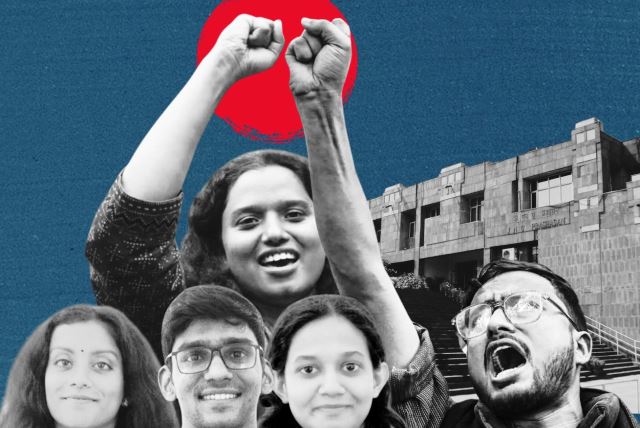
This time led by a JNUSU, the students’ union, with three feisty, formidable, unafraid women leaders who are refusing to back down, come what may, leading from the front — the young vanguard of a young, glorious struggle.
What is the purpose of facial recognition surveillance in a campus where students celebrate their freedom with utmost responsibility, decency and dignity?
Where the library is packed till late in the night with students bent over their books, taking notes, writing tutorials? Where academics and former student leaders are now giving discourses to students in the open air? (I too was invited for the famous lecture series at the Freedom Square in 2016 and after). And it does not matter if you are from the School of International Studies or Social Sciences or Languages, students of JNU know it too well that knowledge is liberation. Even in the midst of a hard struggle.
I remember Jawaharlal Nehru’s words on the university prospectus when we first joined the campus as eclectic youngsters, which remains its ideal and idealism: “A university stands for humanism, for tolerance, for reason, for the adventure of ideas and for the search of truth. It stands for the onward march of the human race towards ever higher objectives.”
Guess who was the great actor and progressive thinker its founding father and the students invited for the first JNU convocation: Balraj Sahni. Since then, no convocation has been held, but, from Derrida to Chomsky, a spectrum of great thinkers, filmmakers, actors, writers and academics from India and all over the world have come to share their thoughts with eager students in packed halls and auditoriums. Former student leaders would join, carrying the torchlights of the past. This is the oral tradition of JNU which nourishes its soul, and its legacy of enlightenment and struggle.
One former vice-chancellor said, during the May 1983 students’ movement, when hundreds of students went to Tihar Jail: JNU students are not violent – they are argumentative.
Now, when they are detaining and arresting students for protesting peacefully, the students remain stoic and steadfast. The long march has just about started. And the journey is the destination.
Give flowers to the rebels… they are showing us the way…