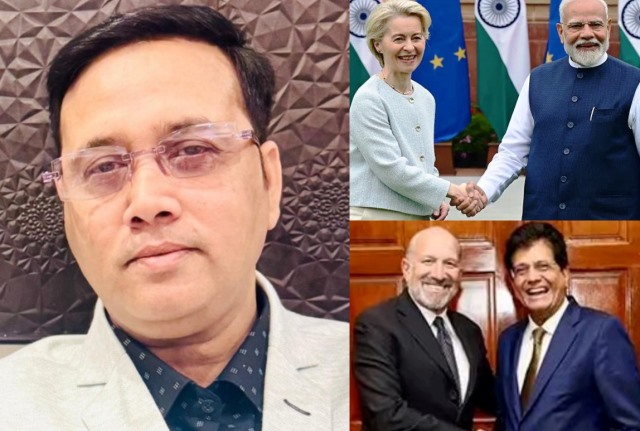
‘Trade Deals With US & EU Will Integrate India Into Global Economic Order’

Dr Rishi Vivek, faculty, Economics at ANM PG College in Balia (UP), says India has played its cards well to strategically de-escalate trade tensions with major partners. His views:

Both the United States and the European Union are among India’s largest trading partners, yet the nature of engagement, sectoral composition, policy frameworks, and long-term implications differ significantly. To give a brief insight, while the US is a single-country partner, the EU represents a bloc of 27 member states, giving it a unique regulatory and institutional complexity.

India generally enjoys a trade surplus with the US, largely due to strong services exports and pharmaceutical shipments. On the contrary, the trade with the EU is more balanced and though India often runs a moderate surplus in goods, the US relationship is heavily services-driven, whereas India–EU trade remains more goods-oriented.

However, India and the US do not have a Free Trade Agreement (FTA) and therefore disputes are managed through dialogue mechanisms such as the Trade Policy Forum. There have been disagreements over tariffs, digital taxes, intellectual property rights, and visa policies. The absence of a comprehensive trade agreement commands that trade expansion is shaped more by market forces than by formal tariff reductions. In contrast, India and the EU are negotiating a comprehensive Free Trade Agreement, along with investment protection and geographical indications agreements.

Talking about the salient features of the India-US deal, the details of which have started surfacing reliably, it is a major strategic de-escalation of trade tensions through reciprocal tariff and energy shifts. The primary component of the deal includes tariff reductions, energy shift, market access and procurement, selective liberalization, and strategic alignment.

ALSO READ: ‘Indo-US Deal Will Trigger Job Loss In MSME Sector’

In addition, the India-EU Free Trade Agreement, which was dubbed as the “mother of all deals,” is a landmark pact that removes tariffs on over 96% of EU imports into India and over 99% of Indian exports to the EU. The crux lies in reciprocal access: India gains duty-free access for labor-intensive goods (textiles, leather, marine), while the EU gains access for automobiles, wines, and machinery.

The key aspects include massive tariff reduction, immediate zero-duty access to key sectors like textiles, apparel, leather, marine products, gems, jewellery and toys, drastic cuts to high tariffs on key sectors of the EU, services and labour mobility, strategic shifts and sustainability and compliance.

While the India-EU trade, especially after the FTA, could transform manufacturing, green industries and regulatory frameworks, the India-EU trade is regulatory-intensive, sustainability-focused, and manufacturing-oriented. Both partnerships are complementary rather than competitive.

For India’s long-term economic growth, balancing these two relationships is crucial. The US supports India’s digital and strategic ambitions, while the EU strengthens industrial capacity and environmental standards. Together, they anchor India’s integration into the global economic system and enhance its standing as a major power in the 21st century.

Regarding numerous allegations floating on various platforms, I would advise caution that people must not fall prey to misinformation and interpret wisely after thoroughly going through both the deals in black & white. We must rely only on authentic source of information such as traditional mainstream media like established newspapers and magazines; and not popular sources of information like digital platforms, dubious websites, messaging apps and, sometimes, even select noisy news channels.

As told to Rajat Rai

‘Indo-US Trade Deal Will Trigger Loss of Jobs in MSME Sector’

Samali Banerjee, who is pursuing her Master’s in Economics from the South Asian University, New Delhi, shares her thoughts on tariff wars and their implication. Her views:

Before opening up a discussion on the recent tariff impositions by the United States of America on countries across the world, and India, it is imperative to understand how tariffs work. That can be better understood in context of the recent trade deal between the USA and India. An Interim Agreement, touted as the way forward for “reciprocal and mutually beneficial trade”, was drawn up on 6 February, 2026, and is set to come into effect from 13, February, 2026. This begets an investigation into the extent of reciprocity and mutuality of this stop-gap accord.

The first couple of clauses say that India will reduce or entirely eliminate tariffs on all industrial goods and most agricultural products coming from the USA to India, while the USA will impose on India a reciprocal, ad-valorem tariff of 18% on goods originating in India, “including, textile, apparel, leather and footwear, plastic and rubber, organic chemicals, home décor, artisanal products, and certain machinery”. 

This 18% tariff imposed by the USA means an additional 18% over and above the existing prices at which these goods are being sold to the consumers in the USA. This placed nearly 64% of the increased cost burden of the goods on the importers in the USA in June 2025.

But this is projected to decline to only 8% by June 2026, as it ultimately gets passed on to the American citizens and final consumers who then shoulder nearly 67% of this price increase due to tariff, and pay to their government as a sort of domestic tax. Only if the exporting country is desperately in need of the exports to continue, will they reduce the export price (and thus shoulder the tariff burden), so that the importing country doesn’t experience a (sudden and) large rise in prices, thereby ensuring the amount of goods exported do not experience a sudden decline.

Why then would a government in an electoral system wish to bring about such an abrupt change in a policy that affects the entire citizenry at a time when a large portion of the population is already dealing homelessness crisis, increasing high cost of living, unaffordable healthcare and education, amongst other issues in America?

One is because the country wishes to reduce imports by imposing export tariffs on their trading counterparts. That can be because they want to strengthen domestic production, as was India’s logic when domestic, infant-industry protection was a key agenda in policy-making.

However, in a globalised work of fragmented but deeply intertwined supply-chains, such a drastic reduction in overall imports (with a 10% baseline tariff on all countries) would only aggravate the domestic producer’s difficulties. The other reason is also related to how the USA calls the tariffs reciprocal in all their policy-documents.

When trading countries set the same tariff rates, on the same goods, it is referred to as reciprocal tariff. So if India imposed 18% on American imports and USA counteracted with 18%, then, it would have been reciprocal, which this deal clearly is not. The term ‘reciprocal’ was used to indicate a tariff rate that would bridge USA’s trade deficit, i.e. balance out the volume of exports and imports.

Having established that the current exorbitant tariff rates are not doing much for the citizens of the USA, the discussion can be opened as to how much mutual benefit are Indians going to get out of this deal.

India’s core competence lies in cheap labour, especially for “goods originating in India” like textile, footwear, apparel, etc. A large hit will basically befall the MSME sector, which is the second largest source of employment after agriculture. As an immediate (and USA’s intended effect), the quantum of exports are bound to decline. As a consequence, especially if there is no proportionate increase in domestic demand — which seems very unlikely given how the Budget 2026-27 continues to pay heed to supply-side measures, most business-owners dabbling in this export market would choose to downsize in this uncertain economy so as to reduce losses.

A direct consequence will be unemployment of those workers who get meagre wages, if not a plain reduction in wages. A large chunk of those workers would then be forced to revert to the farm sector (since it has a relatively large elasticity to absorb workers), or push them to the precarious gig economy.

This is at a time when MGNREGA has been diluted with VB-G RAM G, and there is widespread protest on the new Labour Codes which further precaritises workers, by diluting guaranteed rights into schemes, like doles.

Under these circumstances, India continued with bridging and building relationships with other trading partners, (like it did with importing cheaper Russian oil, after USA’s sanctions on Russia, around the time when the tariff wars were just announced), alongside focussing more on the domestic demand.

I would have liked to have gone more into more depth and talked about sectoral impact, including MSME and agri, along with discussing why USA’s behaviour is imperialistic in nature, but I am limiting my thoughts to this.

As told to Amit Sengupta