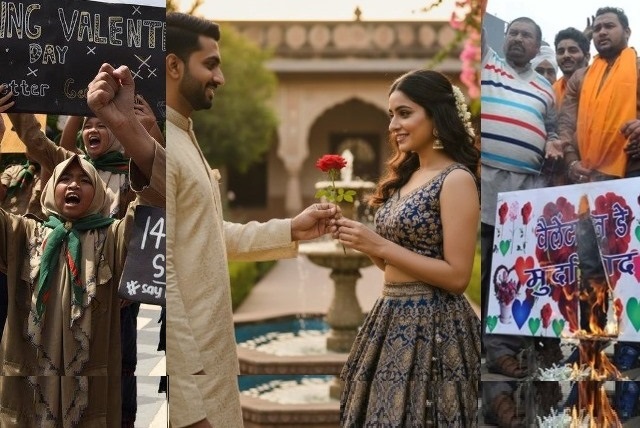
Valentine’s Day is no longer just a date on the calendar. It has become a social stage where love, morality, the market, and politics all stand face to face at the same time. The irony hidden behind a symbolic title like “वैलेंटाइन के लड्डू: हैप्पी एंडिंग या दी एंड” (an article by Namita Joshi published in Navbharat Times) lies precisely in this. We present love as something sweet, like a laddoo, yet often hesitate to grant the freedom to actually taste it.
The question is not whether love is good or bad; the real question is whether we allow it to be lived at all or whether we bind it every time with one condition or another.
In Indian society, the public expression of love has long been a source of discomfort. Within the four walls of the home, love is considered sacred; but when the same love appears on a park bench, in college corridors, or in social media photographs, it becomes a “threat to culture.”
Valentine’s Day brings this unease into sharp focus. On one side there is the glitter of flowers, cards, chocolates, and special offers; on the other, moral policing, warnings, and at times even violence.
In this conflict, love turns into a “laddoo” — sweet to look at, but surrounded by a hundred questions before one dares to eat it.
The market celebrates this day with unrestrained enthusiasm. Love is packaged and sold in heart-shaped cushions, couple deals, and romantic dinners. A deeply personal experience is converted into a consumer product. The irony is that the same society which raises fingers at public displays of affection readily accepts this aggressive commercialization.
Perhaps because opposing it is inconvenient. As a result, the meaning of love slowly slips away from sensitivity and intimacy toward spectacle and buying-and-selling.
For young people, Valentine’s Day often feels like a test. Should they express their feelings? Should they share a photograph? Should they live their love quietly, hiding from the eyes of family and society? This generation is trapped between dual expectations—on one side, the call for openness and freedom; on the other, the discipline of tradition.
In such a situation, a “happy ending” is possible only when love is not treated as a crime, while “the end” arrives when fear, shame, and pressure break relationships apart.
This is where Namita Joshi’s article’s satire makes its impact. It does not raise the flag of any one side; instead, it holds up a mirror. It asks: does love need a certificate? Will its value be decided by age, caste, class, or gender? And most importantly, does love always have to justify itself?
These questions are uncomfortable, but necessary. Because when society runs away from questions, it also loses its answers.
Opposition to Valentine’s Day is often voiced in the name of “Indian culture.” But culture is not a fixed object, it evolves with time and grows through dialogue. Love lies at the core of every culture. Suppressing it does not protect culture; it shrinks it.
At the same time, blind imitation is not the solution either. What is needed is balance—where love is respected and individual dignity remains secure.
Ultimately, “Valentine’s Laddoos” compels us to reflect on how we want to live love, with fear or with trust. A happy ending is not a cinematic closure but where love is given space with ease, acceptance, and responsibility. And “the end” does not come when a relationship ends, but when society shuts down dialogue. Perhaps the solution lies in this alone, neither to turn love into an idol of worship nor to drag it into the dock as a crime, but to accept it as a human experience. Only then will these “laddoos” truly taste sweet; otherwise, despite all claims of sweetness, they will continue to stick in the throat.
(Sidharth Mishra is an author, academician and president of the Centre for Reforms, Development & Justice)