Rajnath Lauds Successful Test Of Indigenous MPATGM

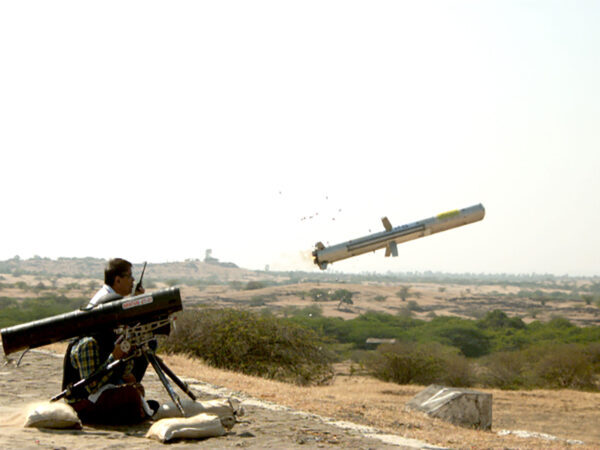
Defence Minister Rajnath Singh on Monday congratulated the Defence Research and Development Organisation (DRDO), its industry partners and the defence industry after the successful flight test of the Third Generation Fire & Forget Man Portable Anti-Tank Guided Missile (MPATGM) with top attack capability, describing it as an important step towards Aatmanirbhar Bharat.

In a post on X, RMO India said, “Third Generation Fire & Forget Man Portable Anti-Tank Guided Missile (MPATGM) with top attack capability was flight tested successfully against moving target by the Defence Research and Development Laboratory (DRDL), Hyderabad. Raksha Mantri Shri @rajnathsingh has complimented DRDO, DCPP Partners and Industry for the successful test of Fire & Forget Man Portable Anti-Tank Guided Missile with top attack capability and termed it an important step towards AatmanirbharBharat.”

According to a release from Ministry of Defence, Third Generation Fire & Forget Man Portable Anti-Tank Guided Missile (MPATGM) with top attack capability was flight-tested successfully against a moving target in KK Ranges, Ahilya Nagar, Maharashtra by DRDO’s Defence Research & Development Laboratory, Hyderabad on January 11, 2026.

The indigenously developed MPATGM consists of state-of-the-art indigenous technologies like Imaging Infrared (IIR) Homing Seeker, all electric Control Actuation System, Fire Control System, Tandem Warhead, propulsion system and high performance sighting system, which are developed by DRDO’s sister laboratories namely Research Centre Imarat, Hyderabad, Terminal Ballistics Research Laboratory, Chandigarh, High Energy Materials Research Laboratory, Pune and Instruments Research & Development Establishment, Dehradun.

The Thermal Target System was developed by Defence Laboratory, Jodhpur to simulate the target tank. The IIR seeker is well accomplished with day and night combat operation capability. The warhead is capable of defeating modern main Battle Tanks. Bharat Dynamics Limited and Bharat Electronics Limited are the Development-Cum-Production Partners (DcPP) for the weapon System. The missile can be launched from Tripod or Military Vehicle Launcher, a release said.

Raksha Mantri Rajnath Singh has complimented DRDO, DcPP Partners and the Industry for the successful test. He termed it as an important step towards Aatmanirbhar Bharat.

Congratulating the team, Secretary, Department of Defence R&D and Chairman DRDO Dr Samir V Kamat said that the trial target was successfully conducted, thereby leading the weapon system for induction into the Indian Army, a release added. (ANI)

Cong Must Realise That Parties Perish, Ideologies Survive

At the foundation day ceremony of the Indian National Congress toward the end of December last year, party president Mallikarjun Kharge asserted that the Congress, as an ideology, would never die. At the same function, Leader of the Opposition Rahul Gandhi described the Congress as “the voice of India’s soul,” a force historically aligned with the weak, deprived and hardworking sections of society.

These were powerful declarations and in many ways response to a discomforting truth that veteran leader Digvijaya Singh had recently articulated. Singh, speaking both on social media and later in the Congress Working Committee, suggested that the party could emulate the Rashtriya Swayamsevak Sangh (RSS) in rebuilding its organisation. His remarks came at a time of repeated electoral setbacks, the latest being the rout in Bihar, which once again laid bare the feeble organisational skeleton of the party.

Kharge may be right that ideologies do not die easily. But political parties do. The lesson from the decline of the Left is stark. When ideas lose organisational muscle, they retreat into classrooms. If Congress wants to remain more than a chapter in history books, it must move beyond nostalgia and moral posturing and begin the slow, disciplined work of rebuilding from the ground up.

A section within the party now believes that slogans, roadshows and moral assertions are no substitute for deep structural rebuilding. Rahul Gandhi’s high-decibel campaign around “vote chori” may energise supporters online, but elections are won by booth strength, local credibility, trained volunteers and sustained contact with voters. Bihar exposed precisely what Congress lacks, presence on the ground.

This is not a new diagnosis. In 1998, when Digvijaya Singh was Chief Minister of Madhya Pradesh, the Pachmarhi session had already identified core problems that the party had lost its social base in North India, coalitions were becoming inevitable, and Congress was failing to attract ambitious youth and competent professionals. More than Twenty-five years on, little has changed. If anything, the gaps have widened.

Unlike the BJP, Congress today lacks a cultural, social and economic ecosystem that nurtures loyalty and produces leaders organically. The RSS has built schools, shakhas, training centres, service organisations, ideological forums and disciplined cadres for nearly a century. It did not contest elections but created a parallel civic and cultural universe. The BJP benefits from this reservoir.

If political rivals have developed a successful model, there should be no shame in learning from it. Ideology alone will not sustain Congress. Marxism lives in textbooks, but Left parties have nearly vanished from the Indian political map. Congress risks a similar fate if it remains content with rhetoric.

No election is won at television studios or through social media hashtags. The BJP invests systematically in booth workers, page in-charges and micro-level databases. Congress requires a simple, disciplined structure of committed volunteer responsible for every 50–60 households, trained in voter outreach, grievance recording, and mobilisation. This means long-term training, not temporary election-time contract workers.

Many Congress workers are unable to articulate what the party stands for beyond generic secularism. The RSS trains cadres through study circles, camps and literature. Congress, too, needs schools of political training, not to create blind loyalty, but to create informed leadership grounded in constitutionalism, social justice and democratic values. Without conviction, organisation becomes hollow.

Congress historically built its coalition around farmers, workers, lower middle classes and minorities. Today, it appears unsure of its economic message. Programs that speak to jobs, MSMEs, urban housing, farmer income stability and welfare delivery reforms must be sharpened and explained by local leaders. A party that does not speak concretely to aspiration loses relevance.

Youth Congress and the students body NSUI have weakened drastically. Younger faces are often used only for optics and discarded when they threaten existing hierarchies. Congress must create clear ladders of progression from campus to higher levels. Regular internal elections, transparent criteria and mentorship programs would allow talent to emerge organically.

Congress historically thrived when it connected with social reformers, cooperatives, trade unions, farmer groups and cultural associations. Re-establishing relationships with grassroots movements on issues of environment, labour rights, women’s safety, digital privacy, and education can help re-anchor the party in everyday life, beyond election season.

In the era of social media, narratives do matter. Congress often reacts instead of setting the agenda. It needs disciplined spokespersons, region-specific messaging, and a research backbone that anticipates attacks rather than merely responding. Equally important is communicating success where Congress governs as visible governance builds credibility

The BJP’s rise took decades (including the era of its predecessor Bharatiya Jana Sangh). The RSS invested quietly, without instant electoral returns. Congress, accustomed to power, still looks for shortcuts. Organisational rebuilding requires a social infrastructure outside the political party. They did exist in Congress universe once but now all in a state of decay.

(Sidharth Mishra is an author, academician and president of the Centre for Reforms, Development & Justice)
IMD cold Wave Nothern INdia

Delhi Freezes At 2.9 Degree Celsius; AQI Remains Poor

New Delhi reeled under an intense cold spell as temperatures dipped sharply across the national capital, with Ayanagar recording the lowest minimum temperature at 2.9 degrees Celsius, according to the India Meteorological Department (IMD).

Several parts of the city witnessed cold wave conditions on Sunday night, with minimum temperatures plunging close to the three-degree mark. Palam recorded a minimum temperature of 3.0 degrees Celsius, its lowest in several years. IMD data suggests that similar cold conditions are likely to persist through the day.

At Safdarjung, the minimum temperature was 4.8 degrees Celsius on Sunday night and is expected to drop further to around 3 degrees Celsius tonight. The Ridge station recorded a minimum temperature of 3.7 degrees Celsius, while the maximum temperature there reached 18.8 degrees Celsius.

Furthermore, air pollution levels remained a concern. According to the Central Pollution Control Board (CPCB), Delhi’s overall Air Quality Index (AQI) stood at 293, falling under the ‘poor’ category as of 7 am on Monday. This marked a slight rise compared to Saturday’s AQI reading of 291.

As per AQI classification, a reading between 0 and 50 is ‘good’, 51 to 100 ‘satisfactory’, 101 to 200 ‘moderate’, 201 to 300 ‘poor’, 301 to 400 ‘very poor’ and 401 to 500 ‘severe’.

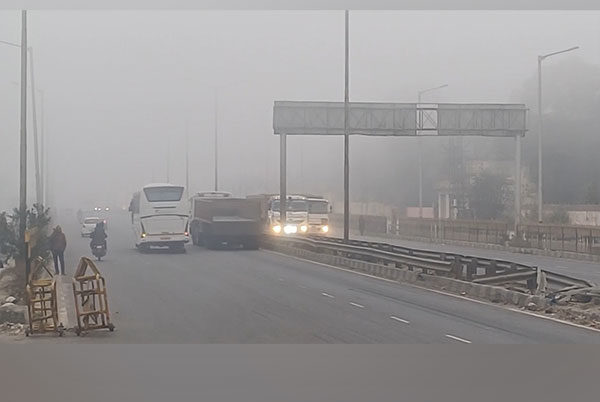
A thin layer of fog blanketed areas such as Dhaula Kuan and Sarai Kale Khan during the early morning hours.

Meanwhile, cold conditions have persisted over the past few days. The capital woke up to a windy and chilly Sunday morning, with temperatures around 6.6 degrees Celsius in the early hours. A thin layer of smog reduced visibility across several areas, adding to the discomfort faced by residents.

On Saturday, the minimum temperature dipped to 5.4 degrees Celsius, with rainfall reported in parts of the city. On Friday, minimum temperatures hovered around 5 degrees Celsius as cold weather continued to grip the capital.

Meanwhile, rehearsals for the 77th Republic Day parade are underway on Kartavya Path amid harsh winter conditions. (ANI)

PM Modi, Chancellor Merz Fly Kite Depicting Lord Hanuman

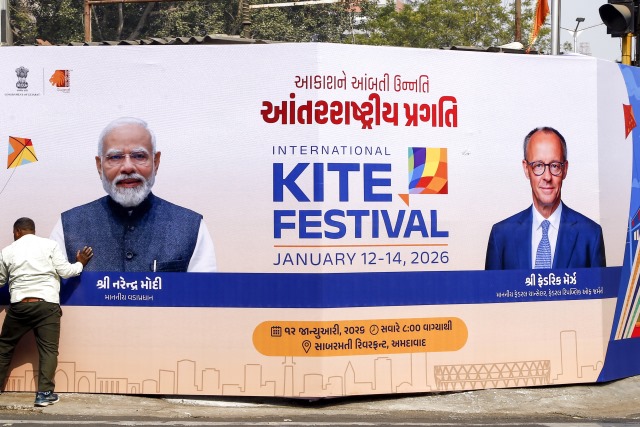
Prime Minister Narendra Modi and German Chancellor Friedrich Merz on Monday participated in the International Kite Festival 2026 at the Sabarmati Riverfront, where the leaders were seen flying a kite depicting Lord Hanuman.

Chancellor Merz’s participation comes during his first official visit to India, underscoring the cultural and diplomatic significance of the event.

Earlier, the two leaders jointly inaugurated the Kite Festival at the Sabarmati Riverfront in Ahmedabad and participated in the event, underscoring the blend of cultural celebration and diplomatic engagement between the two nations.

Visuals from the event show both leaders interacting with participants and enjoying the vibrant festivities, which attract kite enthusiasts from across the country and abroad.

With Makar Sankranti just a few days away, the International Kite Festival will run for three days, concluding on January 14, with participation from 135 international kite enthusiasts representing 50 countries. Alongside them, 65 flyers from across India and 871 local participants from Gujarat will also take part in the event.

Prior to the festival’s inauguration, PM Narendra Modi welcomed German Chancellor Merz to the Sabarmati Ashram in Ahmedabad.

After his arrival at the Ashram, both leaders paid floral tributes to the Father of the Nation, Mahatma Gandhi. Merz also signed the visitors’ book there.

The visit is part of Chancellor Merz’s official trip to India, aimed at strengthening bilateral ties between India and Germany, and coincides with celebrations marking 75 years of diplomatic relations and 25 years of the India-Germany Strategic Partnership.

Earlier today, the German Federal Chancellor arrived in India for a two-day official visit to the country since assuming office.

According to a Ministry of External Affairs post on X, Chancellor Merz was warmly received by Gujarat Governor Acharya Devvrat at the airport upon his arrival in the western state. The visit came at the invitation of PM Modi.

Merz will be in India from January 12 to January 13. Both leaders will also hold bilateral engagements from 11:15 am onwards at Mahatma Mandir in Gandhinagar.

The two leaders will review progress on the India-Germany Strategic Partnership, which recently marked its 25th anniversary.

Their discussion will also focus on further intensifying cooperation in trade and investment, technology, education, skilling and mobility, while advancing collaboration in key areas of defence and security, science, innovation and research, green and sustainable development, and people-to-people ties.

On January 13, Merz will visit Bosch, then Nano Science and Engineering, CeNSE, and depart for Germany.

PM Modi and Chancellor Merz last held discussions on the sidelines of the G7 Summit in Canada, where the two leaders agreed to further broaden the bilateral strategic partnership.

During that interaction, Prime Minister Modi invited the German Chancellor to an official visit to New Delhi. The visit is also taking place in the lead-up to the India-EU Summit scheduled for January 27. (ANI)

ISRO Launches PSLV-C62 Mission Carrying Anvesha Satellite

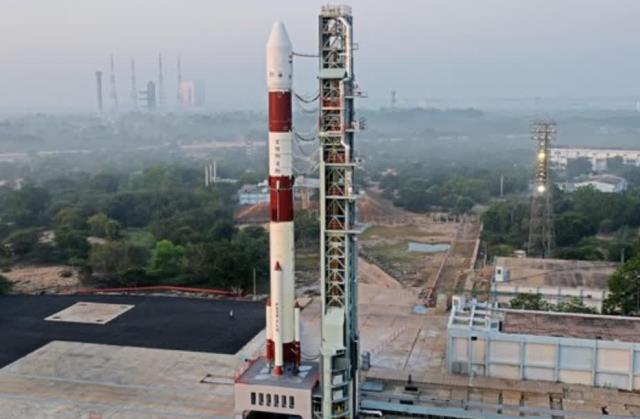
India on Monday launched its Polar Satellite Launch Vehicle (PSLV)-C62 mission carrying the ‘Anvesha’/EOS-N1 satellite and 15 other satellites into the sun-synchronous polar orbit (SSO) from the Satish Dhawan Space Centre in Sriharikota.

In its first launch of 2026, the Indian Space Research Organisation (ISRO) launched the mission to place the Earth observation satellite into orbit from the First Launch Pad (FLP) at Sriharikota. The mission is being carried out by NewSpace India Limited and represents the ninth dedicated commercial mission to build and launch an Earth Observation satellite.

Developed by the Defence Research and Development Organisation (DRDO), the Anvesha satellite is designed to provide cutting-edge imaging capabilities, enabling India to map enemy positions with pinpoint accuracy.

For the first time, a single Indian private company, Dhruva Space, based in Hyderabad, is contributing seven satellites to the mission.

Chaitanya Dora Surapureddy, CFO and Co-founder of Dhruva Space, said they also launched four satellites that they built.

“We launched four satellites that we have built, three for customers and one for us, and we also help other companies with part of the integration of the satellite onto the rocket. Essentially, a total of nine of our systems, which we have built, are going onto the rocket. So, quite exciting that that’s a good number,” he said.

Surapureddy said their satellites are for low-data-rate communication, which can be utilised by amateur radio operators.

“The satellites that we launched are all for low data rate communication. Amateur radio operators can utilise it towards that, and also a good demonstration for these satellites, and also for low data rate communication that can be done,” he added.

Jawaharlal Nehru Planetarium Director, BR Guruprasad, said earlier that PSLV has also launched spacecraft such as Chandrayaan-1, Mangalyaan, Aditya-L1, and others.

“It is the first launch of the year being conducted by India. This launch vehicle is among the most reliable in the world. The PSLV has also launched spacecraft such as Chandrayaan-1, Mangalyaan, Aditya-L1, and others,” he added.

Speaking to ANI, Guruprasad said that the launch marks the 64th launch of the Polar Satellite Launch Vehicle. It will take an Earth observation satellite named ‘Anvesha, EOS-N1’ to a polar sun-synchronised orbit, at least a hundred kilometres above the Earth’s surface.

“It is the 64th launch of the Polar Satellite Launch Vehicle. This vehicle is going to take a satellite called Anvesha, EOS-N1, an Earth observation satellite, into a polar sun-synchronous orbit, probably a couple of hundred kilometres above the Earth’s surface,” he added.

On December 24, ISRO successfully launched the BlueBird Block-2 communication satellite for the United States’ AST SpaceMobile. The satellite was successfully placed in orbit, and the mission was declared a success.

The launch took place from the Satish Dhawan Space Station in Sriharikota, Andhra Pradesh, at 8:55 AM IST.

The mission deployed the next-generation communication satellite designed to provide high-speed cellular broadband directly to smartphones worldwide. The BlueBird Block-2 spacecraft would be the heaviest payload to be launched into Low Earth Orbit in the history of the LVM3 rocket. (ANI)

Singer Tamang’s Mortal Remains Brought to Siliguri

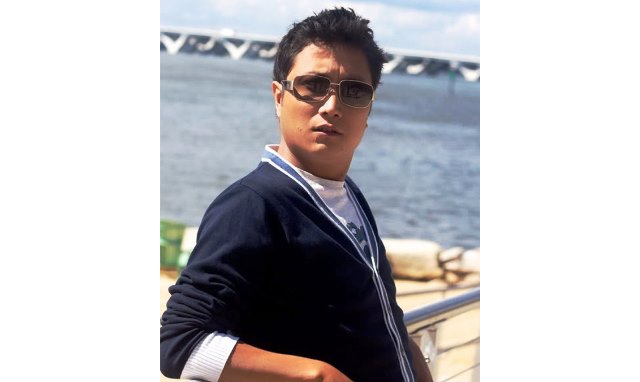
The mortal remains of singer-actor Prashant Tamang, who passed away in Delhi, were brought to the Bagdogra airport in Siliguri on Monday morning.

BJP MP Raju Bista from Darjeeling and many other prominent figures from the entertainment community were present to pay final respects to the late singer.

Tamang’s mortal remains are likely to be taken from the airport for further rituals, including a scheduled public viewing for fans to offer their last respects at Chowrasta, Darjeeling. His final rites are set to take place in the presence of his family members and the local villagers in Darjeeling, said Gorkha Shaheed Sewa Samiti (GSSS) National President, Andrew Gurung, on Sunday.

Speaking to ANI, BJP MP Raju Bista expressed grief over the sudden passing of Tamang.

“It is a great loss for us. Prashant Tamang did a great job with his singing and his talent as an artist. He did a great job of uniting all the Gorkha people. We will always be indebted to him for this. The whole country is with his family during this difficult time. He has a very young daughter, and his wife works at Air India. The family lived in Delhi. We will stand by his family,” the BJP MP said.

Hailing from West Bengal’s Darjeeling, Prashant Tamang passed away on Sunday at his Delhi residence.

ADCP South-West Delhi, Abhimanyu Poswal, shared official updates about his death and told ANI, “At 3.10 today, an MLC was received from Mata Chanan Devi Hospital. We received information that Prashant Tamang, a r/o of Raghunagar, was declared brought dead at the hospital. An Investigation Officer visited there and received the MLC.”

“Crime team and FSL team reached the residence of the deceased and collected evidence. At present, for postmortem examination, the body has been sent to DDU hospital, so that we can determine the cause of death. His wife and daughter lived with him, and it was his wife who had brought him to the hospital. Her statement and other things have been recorded. It will be tough to point out anything suspicious until the final postmortem report comes,” he added.

Tamang was the winner of Indian Idol Season 3. Besides cementing his position in music, he also entered acting, famously appearing in ‘Paatal Lok Season 2’. He is also expected to be a part of Salman Khan’s upcoming film, ‘Battle of Galwan’.

His wife, Martha Aley, expressed gratitude for the overwhelming support and condolences from fans and well-wishers around the world following Tamang’s death.

Addressing speculation over his sudden demise, Martha Aley clarified that there was no suspicious circumstance involved.”It was a natural death. He was in his sleep when he left us. I was right beside him at that time,” she said. (ANI)

$4.2 Bn Worth of Oil From Venezuela On Way To US: Trump

US President Donald Trump spoke to reporters aboard Air Force One on the situation in Venezuela on Sunday (local time). He said, “Venezuela is really working out well. We’re working along really well with their leadership, and we’ll see how it all works out.”

Trump also spoke with the interim President of Venezuela, Delcy Rodriguez. On the meeting Trump said, “She’s been very good. She asked us if we could take 50 million barrels of oil, and I said yes, we can, it is worth $4.2 billion, and it is on its way right now to the United States…”

This development comes after the President on Friday (local time) signed an Executive Order declaring a national emergency to protect Venezuelan oil revenue held in US Treasury accounts from legal attachment or judicial seizure, saying the move is aimed at advancing US foreign policy and national security objectives.

According to the White House, the Executive Order blocks any attachment, judgment, lien, execution, garnishment or other judicial process against Venezuelan oil revenues and diluent sales deposited in US Treasury accounts.

These funds, termed “Foreign Government Deposit Funds,” are to remain frozen unless specifically authorised under the new order. The order also prohibits any transfer or dealing in the funds and overrides earlier directives that may have regulated or restricted such transfers or dealings. It states that the oil revenues are the sovereign property of Venezuela, held in US custody for governmental and diplomatic purposes, and cannot be claimed by private parties.

Before this, US President Donald Trump on Friday (local time) met with top oil and gas executives at the White House to promote major investments in Venezuela’s energy sector, and said that “a lot of money is going to be made”.

Earlier, on Saturday, Venezueland Interim President Delcy Rodriguez stated that the US action that led to the capture of deposed dictator Nicolas Mauro and his wife “will go down in history as a major stain” on relations between Washington and Caracas.

In a speech broadcast on the state channel Venezolana de Television (VTV), Rodriguez reiterated that the Executive Branch “will not cease to condemn the criminal aggression” that culminated in the capture of Maduro, currently detained in New York. (ANI)

US, Israel Want To Sow Chaos & Disorder By Ordering Riots In Iran: Prez Pezeshkian

Iran’s President Masoud Pezeshkian has accused the United States and Israel of seeking to destabilise the country, saying they want to “sow chaos and disorder” in Iran by ordering “riots” and urging citizens to distance themselves from “rioters and terrorists,” Al Jazeera reported.

The remarks came as Iran’s state media reported mounting casualties among security forces amid protests driven by an economic crisis. State television said on Sunday that 30 members of the police and security forces were killed in Isfahan province and six others in Kermanshah in western Iran during the latest unrest. The semi-official Tasnim news agency put the nationwide toll among security personnel at 109.

The Iranian Red Crescent Society said one staff member died during an attack on one of its relief buildings in Gorgan, the capital of Golestan province. State media also reported that a mosque was set on fire in Mashhad in eastern Iran on Saturday night.

Iranian authorities have stepped up action to quell what has been described as the country’s largest protests in years, with thousands taking to the streets in anger over the soaring cost of living and inflation. The Ministry of Interior said the “riots” were gradually subsiding, while the attorney general warned that those involved in the unrest could face the death penalty, Al Jazeera reported.

On Saturday, Ali Larijani accused some demonstrators of “killing people or burning some people, which is very similar to what ISIS does”. Hassan Ahmadian, an academic at Tehran University, told Al Jazeera that the demonstrations that began two weeks ago turned violent on Thursday, calling it “one of the scariest days in Iran, including in Tehran”.

“In the past two days, we saw the shrinking of those events because, of course, there are clashes and confrontations with those who resort to violence,” he said. “People also started going away from those kinds of violent activities,” Ahmadian added. “The majority of Iranians are not happy with the economics in Iran, but a majority of them are not happy with violence as well,” he noted.

In parliament on Sunday, Speaker Mohammad Baqer Qalibaf warned the US against “a miscalculation” following threats of military strikes by US President Donald Trump if Iranian authorities kill protesters. “Let us be clear, in the case of an attack on Iran, the occupied territories [Israel] as well as all US bases and ships will be our legitimate target,” Qalibaf said, Al Jazeera reported.

Reporting from Tehran, Al Jazeera’s Tohid Asadi said Qalibaf’s words were “a new level of escalation, at least rhetorically.” Some lawmakers reportedly rushed the dais in parliament chanting: “Death to America!”

Asadi said the authorities were “trying to draw a line between protesters and what they call rioters,” and noted that Iranian Supreme Leader Ayatollah Ali Khamenei had referred to them as saboteurs. He said the authorities maintained they recognised public economic grievances and the right to protest, while distinguishing that from violence.

Trump said on Saturday the US is “ready to help” as protesters faced an intensifying crackdown. “Iran is looking at FREEDOM, perhaps like never before. The USA stands ready to help!!!” Trump said in a post on Truth Social. A day earlier, Trump warned Iran was in “big trouble” and said he could order strikes. “That doesn’t mean boots on the ground, but it means hitting them very, very hard – where it hurts,” he said.

A nationwide internet blackout in Iran has continued for more than 60 hours, according to NetBlocks. “The censorship measure presents a direct threat to the safety and wellbeing of Iranians at a key moment for the country’s future,” it said on Sunday, Al Jazeera reported.

Iran’s police chief Ahmad-Reza Rada was quoted by state media as saying that the level of confrontation with rioters had been stepped up. The Iranian army said it would defend the country’s “national interests” as it accused Israel and “hostile terrorist groups” of seeking to “undermine the country’s public security”. “The Army, under the command of the Supreme Commander-in-Chief, together with other armed forces, in addition to monitoring enemy movements in the region, will resolutely protect and safeguard national interests, the country’s strategic infrastructure, and public property,” it said.

The protests were triggered by an economic crisis worsened by Western sanctions. The demonstrations began in late December and are the largest in Iran since the 2022-23 protest movement linked to the death in custody of Mahsa Amini, who had been arrested for allegedly violating the country’s strict dress code for women.

Iran Human Rights, a Norway-based NGO, said at least 51 protesters, including nine children, had been killed by security forces and hundreds more had been injured, as rights groups urged restraint amid reports of mass arrests. (ANI)

‘No More Oil, Money Going To Cuba: Trump

US President Donald Trump on Sunday claimed that Cuba had lived for many years on Venezuelan oil and money but said that this would now stop after the United States launched a strike in Venezuela and captured its President, Nicolas Maduro and his wife, Cilia Flores.

In a post on Truth Social, Trump wrote, “Cuba lived, for many years, on large amounts of OIL and MONEY from Venezuela. In return, Cuba provided “Security Services” for the last two Venezuelan dictators, BUT NOT ANYMORE! Most of those Cubans are DEAD from last weeks U.S.A. attack, and Venezuela doesn’t need protection anymore from the thugs and extortionists who held them hostage for so many years. Venezuela now has the United States of America, the most powerful military in the World (by far!), to protect them, and protect them we will. THERE WILL BE NO MORE OIL OR MONEY GOING TO CUBA – ZERO! I strongly suggest they make a deal, BEFORE IT IS TOO LATE. Thank you for your attention to this matter. President DJT.”

Following Maduro’s capture, Venezuela’s Vice President Delcy Rodriguez officially assumed charge as the country’s acting president, according to CNN.

Trump earlier said that the United States would now “run Venezuela” and seek full access to the country’s oil resources from the newly appointed acting president.

Earlier on Friday (local time), Trump met top oil and gas executives at the White House and said major investments would be made in Venezuela’s energy sector.

Addressing reporters, Trump said, “We just had a great meeting with the oil executives, we sort of formed a deal.”

He added, “They’re going to be going in with hundreds of billions of dollars in drilling oil, and it’s good for Venezuela, and it’s great for the United States,” Fox News quoted Trump as saying.

Trump further said, “A lot of money is going to be made. Oil prices will come down, although they are getting down pretty good now without it, and it was a great meeting we had today with the biggest companies anywhere in the world.”

The US President also assured oil executives of safety and security in Venezuela. He said the United States had built Venezuela’s oil industry earlier and would now do “everything” regarding assets that were stolen.

Trump said he was pleased to welcome some of the biggest oil and gas companies to the White House and added that the departure of Nicolas Maduro made it possible for a strong future for both countries.

Earlier this week, Trump said Venezuela would turn over 30 million to 50 million barrels of oil to the United States, which would be sold at market value, with the proceeds controlled by the US.

Meanwhile, Cuba last week announced that 32 of its citizens were killed during the United States military operation in Venezuela.

The Cuban government also observed two days of national mourning on January 5 and January 6 to honour those killed in the operation. (ANI)

Will Venezuela Be A Patiala, Mewar Or A Punjab After The Invasion?

President Trump’s daring intervention in extricating President Nicolás Maduro from his palatial, well-guarded home has attracted much criticism and concern about the post War World order. In a previous article, I had suggested that it is on the way out and a new world is emerging. Whether this is the beginning of a new wave of colonialism or imperialism or genuine multipolar spheres of influence will probably be shaped by what US now does with Venezuela and Chinese-Russia reaction to it.

Generally, the US has attempted bottom up regime changes. It has encouraged insurrections, rebel movements etc with the aim of circling the leadership and forcing it out. Or in some cases, as in Iraq, a direct attack. They have generally been messy affairs, with collapse of the administration, counter rebellions and unrest. In many cases the US failed.

This time, Trump’s policy has gone for a top down regime change approach. The President of Venezuela has been physically removed and in his place, his deputy Delcy Rodriguez has taken over. The regime and administration remains intact. No grand plans for nation building, elections or complete replacement of the governing system appear to be on the horizon. However President Trump is going to meet the Nobel prize winner Maria Corina Nachado, who has often been called the real leader in waiting. It remains to be seen.

Politics is never an easy road especially when going through regime transitions. There is China, a parallel, perhaps untested power. China has nearly a trillion dollar invested in Venezuela with a major stake in its oil which it needs for its own development. If Venezuela slides away completely from it, respect for China will be considerable undermined around the world. China has interests almost everywhere now and heavily invested both politically and financially in South America.

Russia too has close relationship with Venezuela. Maduro has been Russia’s constant supporter in international platforms such as United Nations. Russia vetoed any attempts at UN by leading western countries to delegitimise Maduro’s election victories. There has been close military and intelligence cooperation between the two countries.

Clearly the intelligence failed Maduro. Neither China nor Russia was able to protect him from a surprise attack by Elite US forces. Maduro either didn’t have the same level of sophisticated support that Pakistan had during operation Sindoor or Chinese equipment didn’t work. In the post Maduro era both China and Russia seem inadequate.

Trump has played like a business man that he is. The attack and its aftermath are similar to hostile corporate takeovers that turn pragmatic. The target company remains intact with all its staff and management in place except at the very top; ownership changes. Reforms are brought in later, through voluntary and some times forced redundancies. The targeted company’s policies, marketing, relationships and priorities are changed. The only thing that changes is the ownership or rather the ultimate ‘Boss’. Although not all takeovers are as smooth; sometimes the entire management is changed.

Changes in political leadership sometimes follow this pattern. There are examples in British colonialism in India. After defeating or threatening the Maharajah with attack, detention or exile, many Maharajahs chose to make their Kingdom part of the Empire as a client or subsidiary state while the Maharajah still had pretensions of being ‘sovereign’.

The Maharajah enjoyed all the trappings of the throne, such as wealth, salutes, the head gear, the servants, the ministers etc. But sitting next to the Maharajah was the British political agent who was the real master and decision maker on behalf of the British crown. Essentially the Maharajah managed the Kingdom for the British and paid a tribute. In return the British provided protection. There were no palace coups or attacks by neighbours. The big Maharajahs also got to attend balls etc in London.

The Kingdom of Patiala and many of the Kingdoms of Rajasthan, such as Mewar, Banswara etc, entered into these arrangements with the British. In fact there were nearly 565 such princely states around India by 1947.

But some Kingdoms were too proud to become vassal states. They were finally annexed and their entire ruling regime deposed, exiled or imprisoned. Punjab was one such state. While initially the state became a protectorate under the British, there was general feeling among the British that the Sikhs will rise to take back the Kingdom. A small insurrection was treated as evidence of this. Maharajah Duleep Singh was removed from his subsidiary throne and his entire family exiled, imprisoned or controlled. Duleep himself was converted to Christianity, brought to Britain and given a pension. His mother, accused of the rebellion, had a less fortunate experience.

Similarly, the fate of Venezuela now hangs between being a client state (Kingdom) with real sovereignty resting with US. A regime in place will run the state. There may even be elections to please the people, but most decisions will be taken in Washington. Venezuela’s resources will be at the disposal of the Trump regime. He is already making way for American Oil companies to start investing in Venezuela and has told China to take its investments out. Maduro’s Vice President, Delcy Rodriguez, has become President and seems compliant to the ‘client state’ arrangement at the moment.

Will it succeed? It would appear that it will. Venezuela’s leadership has been known to be corrupt. It enjoyed power and wealth. If wealth is guaranteed and power within the domestic field is ensured, Venezuela will be another Patiala or Mewar. The Venezuelan leadership know how to suppress dissent. This well established regime can bring the army, the enforcers and the civil service to ensure compliance among the population. It will crush anti-US dissenters to ensure US lordship or paramountcy as they called in colonial period. Previously it used the apparatus to crush pro US dissenters against Maduro regime. They are strengthened by the fact that Trump is not into ideology. He simply wants a country aligned to US regional and international interests.

Trump is following the McKinley-Roosevelt doctrine of securing regional power through territorial acquisition, protectorates and creating sphere of influence that even went wider. Monroe also believed in interventionist foreign policy but stop other western countries competing with the US in western sphere. The attack on Venezuela and now threats to Greenland are not new policy but follow an old one. However it could get into trouble.

Venezuela could be gripped by nationalism of the type that started in Iraq and during colonialism in the Punjab. The US may then ‘annex’ Venezuela as a ‘colonised state’. Its excuse will be to ensure peace and stability. That will be a fate close to that of colonised Punjab. If the uprising is as powerful as in Afghanistan, it could spell disaster for USA as Venezuela is on its door step.

But the chances of such a resistance are not high. Both Iraq and Afghanistan are different civilisations whose people could not tolerate non-Islamic power over them.

There is a third scenario. Russia or China, or both, may well incite an insurgency and instate a regime friendly to them. This will be a dangerous moment. Moreover Russia is too preoccupied and China hasn’t really been involved in regime changes since the Mao period and therefore does not have the skills or experience.

So far it seems that Venezuela will become a client state of the US like the princely states of India during colonialism.