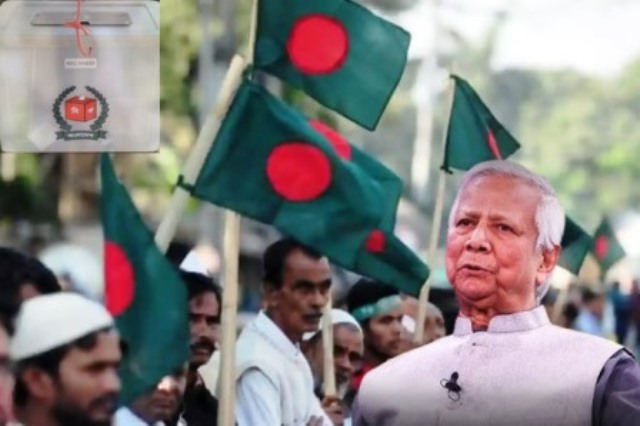
Electoral Rumble In The Neighbourhood

Elections have determined Bangladesh’s course even before its birth, which was triggered by the way they were held in 1970 in Pakistan. Compounding an intense internal turmoil, the ones due on February 12 are for the first time being held with a foreign military presence on its soil, along a troubled border with Myanmar, where a pro-Beijing military junta has lost control to rebel groups. A global power play of the United States-led efforts to confront China is underway.

In a repeat, history has judged Bangladesh’s founding leader, Sheikh Mujibur Rahman, and now, his daughter. India’s former envoy to Dhaka, Pinak Ranjan Chakravarty, reminds: “Sheikh Hasina had annoyed both the US and Pakistan. She refused to submit to American demands for facilitating a military base on St Martin’s Island and the so-called “Humanitarian Corridor”, to pump in arms into Myanmar to help rebels fighting the ruling Military Junta.”

A December 2025 news clip, gone viral, has US President Donald Trump declaring, “We have decided that elections in Bangladesh would be free and fair”, and that “no extremist elements” will win. However, America’s need to confront China in a country that straddles South and Southeast Asia cannot be overlooked.

Assiduously cultivated by the Mohammed Yunus-led regime, Pakistan has returned to its erstwhile eastern province, aiding the resurgence of the Islamist forces. That questions the raison d’etre of separation. The frequent visits by Pakistani military and ISI officials have strengthened military ties and joint defence outreach with China, the biggest beneficiary of the 2024 change. And since anything happening in Bangladesh spills over to its eastern region, India sees red.

In the ensuing elections, leading an 11-party alliance, the Jamaat-e-Islami Bangladesh has disciplined cadres and wide support among the conservative Muslims in the countryside. It is in a tight race for power with the largely city-based Bangladesh Nationalist Party (BNP) of the Zia family, which lacks such a base. According to a survey by the US-based International Republican Institute, Jamaat is the “most liked” party.

The Islamist alliance includes the National Citizens Party (NCP), of student leaders whose protests led to the toppling of the Hasina regime in August 2024. Some of its women leaders, fearing a clampdown from fundamentalist elements, chose to quit. Bangladesh has one of the largest women’s workforces in the Muslim world.

Struggling to retain identity among the entrenched Islamists, the NCP’s student leaders have forced a referendum along with the election. But the elections could minimise, if not eliminate, their future role.

The entire right-wing phalanx is anti-India. Among many things, the larger neighbour hosting Hasina has been a talking point, even with the BNP.

Hasina’s first audio conference on January 23, beyond lambasting Yunus, should have included a pre-poll, manifesto-like declaration to “stay in the race”, albeit notionally. An opportunity was missed.

Unable/unwilling to control crowds, a recalcitrant Yunus regime has sullied the diplomatic pitch. For the first time, India’s visa offices have been attacked, forcing Delhi to suspend these facilities and withdraw families of its staff for safety reasons.

The BNP is galvanised by the return from exile of Tarique Zia, just before Khaleda Zia, his mother and two-term prime minister, died. The family of slain former president General Ziaur Rahman enjoys respect and semi-official support. Tarique, the new ‘dynast’ (replacing Sheikh Mujib and Hasina), is the top favourite. After his Western ‘approval’, Yunus met him during the London exile and facilitated his return.

The stage is set for Tarique as the prime minister, it is speculated, with Yunus as the likely future president. Or, a graceful retirement for the Nobel laureate after having ‘delivered’ to his mentors.

One big hurdle is the Islamists. Yunus’ perceived proximity to the student leaders, now in his administration and in the NCP, could deny Tarique a parliamentary majority, forcing him to form a coalition government. But the BNP’s founder, Ziaur Rahman, was a soldier/freedom fighter. Despite its ‘nationalist’ ethos, during 2001-2006, Khaleda had shared power with the Jamaat. Post-polls exigencies and external pressures may dictate a repeat.

Nor can one ignore the general approval of the Yunus regime by the Western governments and the media, which has overlooked the exclusion of the Awami League, Bangladesh’s largest political party. Yunus told the BBC that the AL was “still there”, his government had no role in its exclusion, and the Election Commission had ordered it. He wasn’t asked who appointed that poll body, or, for that matter, the judges of the Crimes Tribunal who have delivered the death sentence against Hasina.

Besides having played a role in Bangladesh’s liberation, India supported Hasina, even her many autocratic ways at home, because she met Delhi’s security concerns by curbing militancy and closing down terror camps run by Pakistan’s ISI. Fostering revenge as the motive, the Yunus regime has allowed Awami League leaders and workers to be hunted down and killed, and their properties destroyed. But that is how the “winner-takes-all” politics, of the Awami League, as well, has worked in Bangladesh.

Sheltering Hasina, because Britain did not issue her a visa, hugely adds to India’s dilemma. It has exercised strategic restraint and kept up a difficult relationship, although attacks on minorities, Hindus and Buddhists have a direct bearing on India’s domestic scene.

While rights groups have documented numerous such attacks, Yunus claims that only 645 “incidents” occurred in 2025, and that just 71 of them were communal in nature. He has termed allegations of atrocities on the minorities as ‘propaganda’, pointing the finger at India. But the Dhaka Tribune newspaper (January 20, 2026) has, in an editorial, said that such attacks “are a deeply troubling reminder of a persistent and corrosive mentality that insists on retaliation over reason, and instant judgment over justice.”

Yunus had earlier argued that most attacks on minorities were “political.” He now insists they are primarily criminal rather than communal. This shifting terminology is not incidental; it reflects a deliberate effort to strip the violence of its definite religious character and obscure the identity of the victims. In reality, the choice of targets is driven by religious vulnerability.

Islamist groups have grown more visible and assertive, as evidenced by the destruction of shrines and statues and the torching of minority homes. The pattern is unmistakable. The Army Chief, Gen Waqer-uz-Zaman, citing huge quantities of arms in illegal hands, including the Islamist cadres, has cited it as one of the obstacles to a fair election.

India’s dilemma is that it feels the need to speak up for Bangladesh’s minorities because of the spill-over effect. At the same time, this hurts these minorities who are feeling persecuted and sour Delhi-Dhaka relations.

Consequently, India, while remaining diplomatic, has done little to stop the anti-Dhaka stance in its media and has allowed issues like a cricket tournament to become part of the acrimony. When Bangladesh projects a Hindu as its cricket team captain, how should India react? This symbolises the delicate Delhi-Dhaka relationship, different from other neighbours.

The international community is likely to put its stamp of approval on the election’s outcome. Its impact on Bangladesh’s constant search for national identity, however, is unclear.
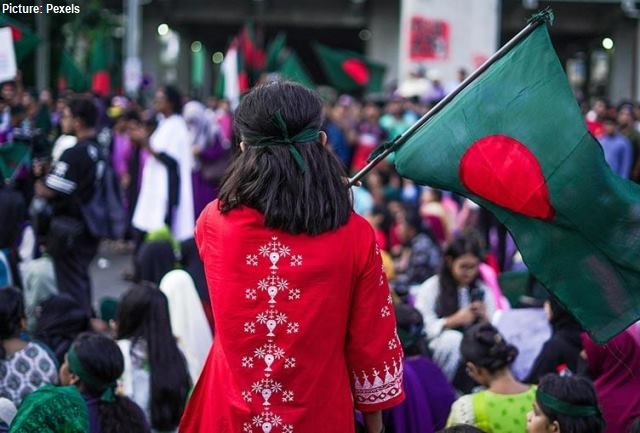
Dhaka Disorder: A Year Later

The current India-United States spat triggered by the “Trumpian tariff terror”, his repeated claims of brokering the end of the India-Pakistan conflict and his accusing India of ‘financing’ the Ukraine conflict, may or may not slide down to Cold War era rhetoric among “strategic allies.” But it has provoked the Indian Army, not without an official nod, to recall on social media what the Nixon administration did way back in 1971.

That year, India defied Nixon and the collective disapproval of the Western and the Islamic world to win decisively, its campaign to facilitate the birth of Bangladesh. Analysts say this has rankled with the US policy makers to repeatedly side with Pakistan and, whenever it found it convenient, target Bangladesh.

That was why Sheikh Mujibur Rahman was killed in a military-led coup, precisely 50 years ago. No evidence, but when some of the actors spoke out, it got written about, like many other regime changes in that era.

Now, there is talk that the Biden administration may have been behind the ouster of his daughter, the longest-serving Prime Minister, Sheikh Hasina, a year ago. Sophisticated, without the military involvement. No evidence, again, until someone speaks up one day. And allies don’t complain. Of course, the father-daughter had made a similar set of serious mistakes at home and outside of it.

The Biden/Trump boost to the new Dhaka regime, analysts say, has more to do with the US’s long-term need to ‘contain’ China. Reports say the US has quietly unleashed plans to use Bangladesh’s southeastern border to take on the China-supported military regime in Myanmar. Foreign military boots are stomping the ground, and Washington has reportedly invested USD 400 million to create a “humanitarian corridor” to facilitate the Rohingya refugees’ return to Myanmar. The new regime in Dhaka is facilitating it.

India is placed in a piquant situation where the US, its strategic ally, and China, the strategic adversary, otherwise confronting each other in the region and globally, find their clashing interests converging in Bangladesh.

Last year’s regime change has pushed Bangladesh closer to Pakistan, but even more to the latter’s “all-weather ally” China, which is perceived as trying to encircle India in the region. The era of India benefiting from having midwifed Bangladesh’s birth seems to have ended.

China is today Bangladesh’s largest arms-giver and trading partner. Dhaka looks to them, whatever its equations with India. This zero-sum game negatively impacts India, the largest entity in the region, in its internal security and external relations.

On the ground, improving Teesta’s flow with China’s help and a plan for an air force base for Bangladesh at Lalmonirhat, both close enough for a crow to fly from India’s vulnerable “Chicken’s Neck” corridor, worries New Delhi.

ALSO READ: Hindu Persecution In Bangladesh Vindicates Need For CAA

Further, neither the US, nor Pakistan, nor China appear concerned about the ill-treatment of religious minorities and the surge of the Islamists, but all three concern India in its east and northeast.

Given the history of how Pakistan lost its erstwhile eastern wing, now Bangladesh, it is a zero-sum game: India loses as Pakistan and China gain. The American factor has hugely added to these complexities. All of this makes the South Asian region the playground for geopolitical games as never before.

Amidst this situation, Bangladesh is headed for elections next February. The announcement came significantly on the day that marked one year of Hasina’s ouster and exile. The “July Charter” reads like the total of what the critics think of her, ignoring the economic and social leaps, as if she did nothing good for 15 years.

Chief Advisor Mohammed Yunus warned of “a certain group” ready to ‘obstruct’ the elections, “both from within the country and abroad.” These obvious hints leave little doubt that like all previous elections, India is destined to be an election issue, with a sharper edge provided by the Islamists who are ideologically opposed to anything Indian.

All this gives little hope to India – and not only because the Awami League it trusted for half a century, is banned and out of the election fray. As Dhaka demands Hasina’s repatriation for trial on multiple charges, India cannot forsake her. Things could get more volatile as her supporters, already on the run and facing violence and imprisonment, may seek to cross over.

There are a few silver linings, though. The July Charter has stopped short of including two crucial demands from the Islamists: removing the reservation in parliament for women guaranteed at present and establishing an Upper House based on proportional representation. This could have made a relatively woman-friendly Bangladesh another Afghanistan and accorded parliamentary legitimacy and clout for the Islamists.

The Islamists want the history of Bangladesh to be traced from 1947, when a divided Bengal became part of Pakistan. But the “July Charter” begins the historical trajectory from the struggle for liberation, democracy, and sovereignty, with the 1971 Independence Declaration.

The announcement of the elections may have the effect of putting on hold the reforms in the system governing Bangladesh, however good, bad or needed. The contesting parties will be busy pushing their respective political and ideological standpoints in the months to come. It is a test for a chaotic administration and for the intending voter alike to show appetite for this discourse amidst poll-related violence that is endemic to the Bangladeshi scene.

Arguably, though, Bangladesh’s trajectory begins with the 1970 election, the last in Pakistan and rated as the fairest. The one in February next year has the potential to show if the separation five decades back to safeguard Bengali culture and language was worth it.

Earth’s Year of Elections

2024 Will Be Earth’s Year of Elections. What Should You Expect?

This year could be the year of national elections on Earth. In 64 countries (plus the European Union), two billion humans or one in every four of the eight billion of us that populate the planet will be set to go to the polls. An estimated 1.16 billion of these voters will be from the South Asian countries of India, Pakistan, Bangladesh, and Sri Lanka, with India alone accounting for more than 900 million voters, which is 100 million more than the number that was eligible to vote in the previous national election held in 2019.

After you have wrapped your head around those staggering numbers, consider also how the outcomes of some of those elections could impact the state of the world here on our planet. Take the big ones first. The US will hold its presidential elections in November. As of now, indications are that former Republican President Donald Trump, who served as the 45th president from 2017 to 2021, could be his party’s nominee for the 2024 election. Trump is facing a slew of legal problems but this does not seem to deter his supporters: with 52% of Republican voters or Republican-leaning independent voters, Trump is way ahead of his nearest rivals in the race for nomination.

If Trump, 77, is nominated, the face-off will likely be between him and the Democratic incumbent Joe Biden, 81. If Trump wins, as many analysts think he will if he is nominated, his policies and actions as President of the US will affect not only his country but also the state of the world. More on that soon. For now, turn to another election that will take place this year.

Two months from now, in March, Russia will go to the polls to elect a President. In all likelihood it will be Vladimir Putin who will be re-elected. Putin has been in charge of Russia since late 1999 or more than 21 years and is eligible for re-election this year, as a result of constitutional amendments that he orchestrated in 2020. The amendments reset his previous terms and allowed him to seek two more six-year terms, potentially extending his rule until 2036. Putin is 71 so, in theory, he can rule till he is 84.

Russia is a democracy only in theory. In reality it is an authoritarian state where elections are not free or fair. The Kremlin, Russia’s seat of power, controls the media, the security forces, and the election commission, and Putin has effectively suppressed all opposition, barred many of rivals from contesting the elections and either imprisoned dissenters or exiled them. 

A Trump-Putin Combo? If Putin is reelected, Russia will likely continue its aggressive foreign policy, especially in Ukraine and Eastern Europe, and face more international sanctions and isolation. Putin will also tighten his grip on domestic politics and suppress any dissent or opposition. If Trump is elected in 2024, the US will face more political and social turmoil, as Trump will try to overturn his 2020 election loss and pursue his populist agenda. Trump will also undermine democratic institutions and norms, and alienate many US allies and partners.

A Trump-Putin combo would mean that the world could face a more unstable and unpredictable geopolitical situation. Trump and Putin have a long history of mutual admiration and personal rapport, but their interests and agendas are often at odds. Trump could weaken NATO and other US alliances, while Putin could exploit the chaos and expand his influence in regions like Ukraine, Syria, and the Middle East. The risk of conflict and escalation between the two nuclear powers would increase, as well as the challenges for global cooperation on issues like climate change, human rights, and cybersecurity.

A third term for Modi? The biggest national elections this year will be in India, which has the largest electorate in the world, with over 900 million voters eligible to vote for the lower house of Parliament, Lok Sabha, which has 543 seats. India has a multi-party system, with two major alliances competing for power this year: the incumbent National Democratic Alliance (NDA), led by the Bharatiya Janata Party (BJP) and Prime Minister Narendra Modi, and the opposition Indian National Developmental Inclusive Alliance (I.N.D.I.A.), led by the Indian National Congress (INC) and its president, Mallikarjun Kharge.

India’s elections are held in multiple phases, spanning over several weeks, to ensure security and logistical arrangements. In 2019, the elections were held in seven phases, from 11 April to 19 May. The schedule for 2024 is yet to be announced by the Election Commission of India (ECI).

India’s elections also involve millions of polling staff, security personnel, electronic voting machines, and observers. In 2019, there were over 10 lakh polling stations, 17.4 lakh voting machines, and 23 lakh security personnel deployed across the country.

India’s Prime Minister Narendra Modi is widely expected to win a third term in 2024, as he enjoys a strong popularity and because the Opposition is weak. In recent months, his party has scored significant victories in state elections, which could be an indication that voters’ support for it is strong.

A third term may see India becoming one of the top three economies in the world. India’s economy is one of the largest and fastest-growing in the world. According to the latest data from the World Bank, India’s nominal GDP was $3.73 trillion in 2023, making it the fifth-largest economy in the world after the USA, China, Japan, and Germany. India’s GDP growth rate was 7.6% in the second quarter of 2023-24, higher than most of the major economies.

India’s per capita income was $2,389 in 2022, which ranked 112th in the world. India’s per capita GDP on PPP basis was $8,379 in 2022, according to the World Bank. In comparison, China’s per capita GDP on PPP basis was $21,476 in 2022. This means that China’s per capita GDP on PPP basis was more than twice as high as India’s.

Prime Minister Modi faces some challenges such as poverty, inequality, infrastructure gaps, environmental issues, and fiscal deficits. However, during his tenure, which began in 2014, India has also undertaken several reforms and initiatives to boost its economic potential, such as the Goods and Services Tax (GST), the Make in India campaign, the Digital India program, and the Atmanirbhar Bharat Abhiyan. India aims to become a $5 trillion economy by 2027 and a $10 trillion economy by 2032.

Led by Modi, India recently had a successful G20 presidency and a lunar mission. For a country of its size, it has also managed a satisfactory a post-COVID-19 recovery and achieved robust growth. India has also been part of a new Indo-Pacific alliance against China, along with the US, Australia, and Japan, to counter China’s expansionist ambitions and assert India’s role as a key player in the region.

In crisis areas such as the Russian aggression in Ukraine and the Israel-Hamas war, India has protected its own economic and political interests instead of taking sides. That sort of strategy could be expected to continue on the international front. Relations with China remain tense, though, especially on border disputes between the two countries although under Modi, the foreign policy targeted at China and Pakistan (with which there are continuing disputes on the western borders of the country) has been assertive.

Modi may, however, face some challenges in balancing the interests of different Indian states and regions, as well as in addressing the issues of social justice, environmental protection, and democratic rights.

Elections in the rest of South Asia. India’s neighbours, Pakistan, Bangladesh, and Sri Lanka, will also go to the polls this year. In Pakistan, elections are scheduled to be held in February but the Pakistan Senate has passed a resolution seeking to delay the elections due to security and weather concerns. The resolution is not binding and the final decision rests with the Election Commission of Pakistan. With the former Prime Minister Imran Khan in jail on corruption charges, the main contenders are the Pakistan Muslim League (N), led by former Prime Minister Nawaz Sharif, and the Pakistan Peoples Party, led by former Foreign Minister Bilawal Bhutto Zardari. In Pakistan, the army plays a key role in politics and the government and outcome of the election there will be keenly watched.

Elections will also take place this year in Bangladesh, where Sheikh Hasina of the Awami League has been in power since 2009 and where she is accused of silencing dissent and ruling with an authoritarian iron hand. She is expected to win another term.

India’s other neighbour, Sri Lanka, also goes to the polls this year. Two years ago, the then president of the island nation Gotabaya Rajapaksa was forced to flee his country after protests accused  him for the country’s worst economic crisis in 73 years. Inflation had soared and the nation had turned bankrupt leaving millions in the tiny country unable to get food, fuel or healthcare. That was when the current President Ranil Wickremesinghe took over. But elections haven’t been held in Sri Lanka since 2018 and if a date is finally announced for this year, all eyes will be on who gets the people’s mandate. Wickremesinghe, who helped get a loan from the International Monetary Fund and has led several reforms to get the economy back on track, will likely contest and hope for a second term.

Other notable elections in the world include Indonesia, where the current incumbent Joko Widodo (aka Jokowi) is ineligible due to term limits.

Besides this, there will be elections in Iran, South Korea, Panama, and several African Nations, including Rwanda, Libya, Mali, and Ghana. As I said, this year is the year of elections on Earth.