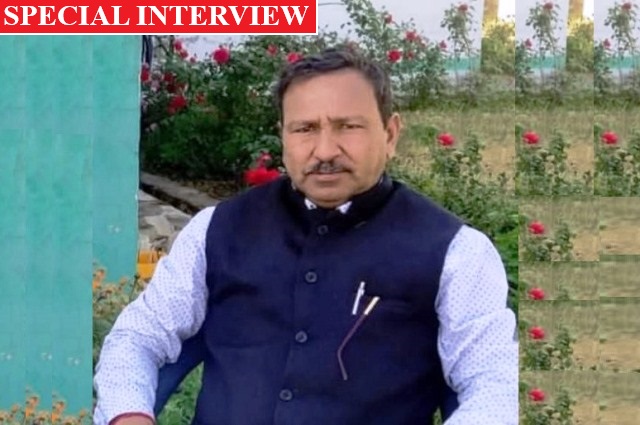
Dev Chand Uttarakhandi is the kendriya mahamantri and spokesperson of Uttarakhand Kranti Dal, the oldest regional political party in Uttarakhand, established to fight for a separate hill state. In a no-holds barred interview with LokMarg’s Rajat Rai, he lambasts the current BJP-led Centre for using investigation agencies like ED, CBI and even Election Commission to usurp power in every state by hook or crook. Excerpts:
Q. The original motive behind the formation of Uttarakhand Kranti Dal was rooted in regional development and, hence, also federal structure. However, it was Central parties which have ruled the state since its formation. How do you see this alleged ‘injustice’?
Ans. Ever since the UKD came into existence in 1979, our sole motto was a separate hill state with autonomy in everything – from resources, employment to locals and everything related to us. We had a 30-point demand for the formation of a separate state and it was Deve Gowda who gave a positive consideration to our demand. However, the state came into existence only in the year 2000 with much of our demands yet to be fulfilled.
We are the only regional political entity in the state and with our three to four legislators in the beginning we supported both the Congress and the BJP in the formation of the government in the years 2002 and 2007. However, both the governments ditched us, forcing us to part ways but we have continued with our battle for the rights of the indigenous people of the state. We are still fighting for the original cause of our region and our people. We hope someday the people will give us an opportunity to serve them.
Q. Do you believe federalism, where power is decentralised, is steadily getting weakened after Narendra Modi took over the Centre in 2014? Please give examples to support your view.
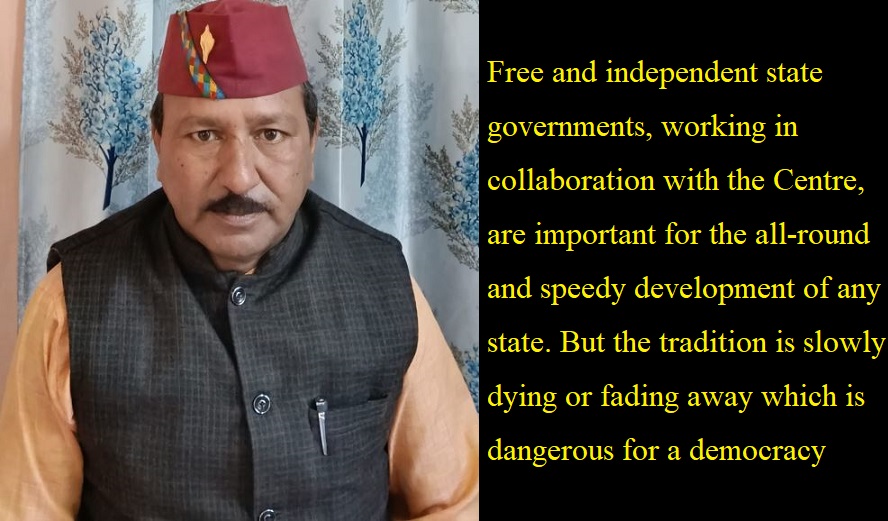
A. It was due to the untiring efforts of Sardar Valabh Bhai Patel that the Rajwadas and the princely states of India were united after Independence and since the very first day, all the central governments have tried to run states from the Centre. However, federalism has been hit harder since the BJP came to power in 2014 and it is not a good practice to seize the powers of state governments and try running the states from the Centre. Free and independent state governments, working in collaboration with the Centre, are important for the all-round and speedy development of any state. But the tradition is slowly dying or fading away and it is very dangerous for a healthy democracy.
Q. There have been allegations that increasingly there is lesser space for regional parties to prosper because and the BJP wants a strong Centre which can influence areas and powers that fall under States list. How far do you find such allegations true?
A. It is a known fact that the governance model and the work culture of the BJP is, in a way, inspired or nourished by the RSS. It has also become a tradition of the BJP to form state governments by hook or by crook if they do not win an absolute majority. The biggest losers are the regional parties like us whose existence depends on their state related local issues which hardly matters for national parties when they come to power in states. And above that, there are central agencies like ED and CBI who work hand in glove with them to ensure dominance over regional parties that lack in all kind of resources. This certainly is a reason why regional parties are losing significance gradually.
Q. Are minorities in Uttarakhand feeling increasingly targeted amid a rise in Hindutva forces? We saw several such instances in the past be it Uttarakashi or Haldwani. Please substantiate your views with examples.
A. Both the BJP and the Congress are provoking such issues in the manner which suits them. Since the years soon after Independence i.e. early 1950s, the population of minorities (including Christians, Jains, Buddhs, etc) was around 10 to 15 per cent and there was a cordial atmosphere in the region as everyone (including minorities) fought shoulder to shoulder for the cause of a separate hill state.
However, after the formation of the state, the Muslim population increased rapidly and in some regions, it now stands at 25 to 30 per cent with people flooding in from states like West Bengal. Who is to blame: The Congress for its vote bank or the BJP milking the issue for its convenience? They also impact election results now in four to five constituencies and a burning example is regional parties of UP like Samajwadi Party and BSP winning seats in Uttarakhand! It is also surprising that an MP from BJP (Ajay Bhatt) is also advocating including minorities in SC, ST reservation. Is it not a bid to eat on the basic rights of the SCs and STs of the state? We are hopeful the issue is addressed by the SIR which is a good initiative and will add to the cause of the locals.
Q. What are the limitations and challenges before a regional party like UKD while countering a powerful political network like the BJP? Do they lack moneybags or muscle power even when they have popular support?
A. I still admire the late Atal Bihari Vajpaee and a person of principles like him will never be born. No doubt that the BJP is the most powerful (in terms of money and muscle power) party in the country but it also has an added advantage of the Election Commission and the ED. Their principle seems to be clear: if you cannot overpower a person or party with the legal means, let loose the government institutions and they will do it for you. Let me give you a recent example. The serving CM of Uttarakhand was seeking votes for his mayoral candidate in the Srinagar district where, during a public speech, he openly threatened people by saying that if you do not vote for him the developmental works and schemes will not reach here. This is how they threaten or manipulate voters.
Q. The BJP is seen as cannibalizing on its own regional allies, gradually weakening them and then pushing them to margins. This was seen in Maharashtra recently. Why do think BJP feels threatened by regional political groups, including its own allies?
A. You cannot blame BJP or Congress for this – it is the greed of the regional parties that is costing them their existence. If you, just with two or three or 1 seat, bow down to the stronger party just for the sake of getting a ministerial berth of red and blue beacon, it is not the fault of the ruling party. It is you who is compromising with your principals and the faith that the people have entrusted in you. A stronger competitor is bound to end smaller ones just to secure its future and it depends on the morality of the regional parties either to surrender for instant gains or to stand with its principles for the cause of its people and its region.
Q. Do you believe that Uttarakhand Kranti Dal has a future like Trinamool in Bengal, BJD in Orissa or DMK in Tamil Nadu? Elaborate why?
A. We definitely are a very small force but people in the UK are getting aware gradually and are getting associated with us. We put all our efforts in every election, from local body to Panchayat to Vidhan Sabha and the Lok Sabha and it is never the end of roads after any elections. We will contest with full force and commitment in the upcoming 2027 Vidhan Sabha election and then the 2029 general elections and all other small and big elections to come.
We ignited a large movement – for an autonomous hill state long ago and slowly, our motive is being perceived well by the natives (Uttarakhandis). We will make it big someday as we are connecting with the people with an honest motive. We admit that we do not have any money or muscle power but our honesty and commitment will yield results some day and we may be in a position to ask what we wanted from day one for our state.