The Dhaka Seesaw

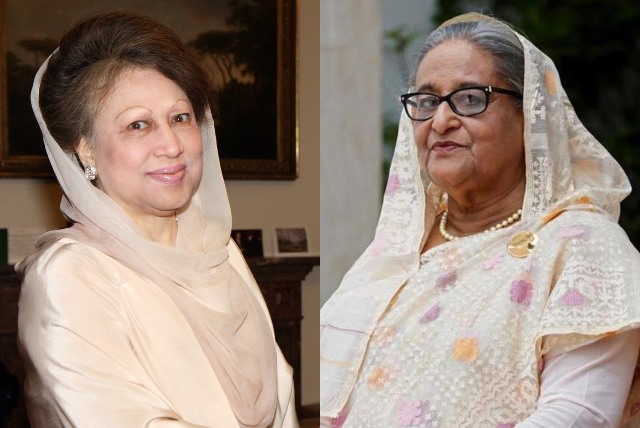
Providence has willed contrasting twists for the “Battling Begums of Bangladesh.” Former Prime Minister Sheikh Hasina is exiled in India, facing a death sentence back home. Her arch-rival, Begum Khaleda Zia, the ailing two-term premier, battling for life, has the nation’s sympathy.

Bangladesh is election-bound, and Zia’s Bangladesh Nationalist Party (BNP) is the front-runner. This explains why the ‘establishment’ led by Chief Advisor Muhammad Yunus is working feverishly for her recovery, declaring her a ‘VIP’, after doctors’ advice that she is too weak to travel to London for advanced treatment.

India’s Prime Minister Narendra Modi has joined in with ‘concerns’ about her health and has offered any help Dhaka may require, ignoring bad vibes, on the day a probe panel alleged that 16 years ago, India was ‘involved’ in the mass killing of the neighbour’s border police in a mutiny. The charge is preposterous because Hasina had just assumed power, defeating both Zia and military machinations in an all-in election. Besides Hasina’s exile, this impacts the current election campaign. The perennial India factor is also Providence’s will.

London is where Zia’s elder son, Tarique, is exiled. Although he has no Bangladeshi passport, his homecoming poses no problem since the courts have cleared both mother and son of corruption charges.

Will Khaleda, 80, having multiple ailments, become the third-time premier if her party wins the elections next February? It will be tragic if she cannot, after many years of imprisonment and sufferings inflicted by the Hasina government. In that case, Tariq, 60, may lead Bangladesh. Like Yunus, targeted by Hasina, returned from the United States after student protests felled Hasina in August 2014. Providence, Providence, Providence!

The way for either Zia to come to power is paved by the ousting of the Hasina-led Awami League from the electoral arena. In Bangladesh, politics is a zero-sum game. If you win, you rule. If you lose, you boycott and protest, face court battles and imprisonment.

The Awami League ban reminds one of Hasina’s ban on the Jamaat-e-Islami. It was accused of ‘collaborating’ with the erstwhile East Pakistan regime in 1971. It is now a footnote in contemporary history as the Jamaat is back in the political mainstream and may again align with the BNP in the February elections. And so is Pakistan back in what was once its eastern province.

To return to the two women and the family legacies they inherit. Hasina’s father, Sheikh Mujibur Rahman, was assassinated in 1975. Zia leads that of her husband, General Ziaur Rahman, also the President who was gunned down in 1981. The rival legacies have clashed for political primacy and power, of which bad personal vibes are a natural outcome.   

The only time the two Begums – Hasina never uses this prefix while Zia does – collaborated as part of a larger political alliance was in the late 1980s, to oust General H M Ershad. In the election that followed in 1991, Zia won, and Hasina lost. The tables turned in 1996, but Zia was back in power in 2001.

Rivalries sharpened all these years. One pushed the other to jail with graft charges. Dhaka’s Zia International Airport was renamed after Shah Jalal, a revered saint. Three attempts were made on Hasina’s life. She paid Zia back in the same political coin during 2009-2024.

They rarely met or shared a public platform. Among the more prominent was Hasina’s visit to the Zia home to console the death of younger son, Arafat. The prime minister waited, to be told by Zia’s staff that, under sedation, she was resting and unable to receive her.

Both women were out of power in 2006-08 when the military-backed caretaker government did not hold the elections as prescribed under the Constitution. That government failed to exile them. Hasina, in America to meet her family, was denied re-entry. She fought her way back home from London. Public opinion in Britain helped. Khaleda, too, offered freedom from jail and immunity for her sons, but refused to be exiled. The bizarre “minus-2” attempt failed, and Bangladesh was back to “Battling Begums”.

In fairness to Zia, she did not express joy at Hasina’s ouster. Her party, advocating “inclusive politics”, opposed the Awami League’s ban. Its swift switch-over has come only after it became clear that the Yunus regime is bent on a vengeful course against Hasina.

The prayers and public sympathy for Khaleda, with Yunus also joining in, are coupled with a special prayer organised at the Dhakeshwari temple in Dhaka, Bangladesh’s most prominent shrine of the largest minority community. It reflects, besides respect for a woman leader, which is typical of Bangladesh but rare in the Islamic world, how the political wind is blowing.

Perhaps, it is appropriate for this writer to record some memory flashbacks, having worked as a journalist in Dhaka. Both women are light-eyed and beautiful in a conventional Bengali/Asian sense.

In the years following independence, a bespectacled Hasina alternated between a housewife and a low-profile daughter of the prime minister who took an interest in students’ politics. Deeply political, she would watch her father at work. Comparisons were drawn, in whispers, though, with Jawaharlal Nehru and Indira Gandhi.

Khaleda was a vivacious army wife, then in her late twenties, the cynosure of many eyes at diplomatic events as she walked with her soldier/freedom fighter husband. As the army’s Number 2 man, he was rising in influence. Mujib was known to have been fond of the couple.  

If Hasina returned to active politics on her return to Dhaka from her earlier exile in New Delhi (1975-81), Khaleda was compelled after her husband’s assassination in May 1981, to lead the BNP that he had founded.

Like any Bangladeshi over the years, they figure out India. The rival legacies have meant that Hasina was, and remains, friendly to India, paying a political cost, being maligned by her critics at home and in the West. That has also shaped the Awami League’s relatively secular politics. Khaleda carries no such baggage. Like her husband, she distrusts India.  

Muchkund Dubey, one-time Indian High Commissioner to Bangladesh and later Foreign Secretary, records that he had wanted then Prime Minister P V Narasimha Rao to visit Dhaka and mend fences with the Khaleda government. That visit did not work out. Zia’s visit during the Vajpayee era was also a low-key affair as India was concerned about the rise of Islamist terrorism under her charge.

As Delhi tackles Dhaka’s pressures to return Hasina, who is viewed negatively by the Western world, it must also prepare for the near future, assuming elections are held and will mark the rise of the Zia family. These are radically changed times, when regional and global trends in and around southern Asia pose complex challenges.
Bangladesh

Bangladesh – Reeling Under Multiple Crises

Russia’s unrelenting military assault on Ukraine that began on February 24, 2022 has already done a significant collateral economic damage to Bangladesh and other East Asian countries. The setback is to an extent that Bangladesh, a least developed country which aspires to acquire middle income status by 2031 had to scamper to International Monetary Fund (IMF) for a bailout package of $4.5 billion. Earlier to the damage being wreaked by the Ukrainian war that shows no signs of ending anytime soon, the Bangladesh economy took a beating from the Covid-19 pandemic. But as the IMF acknowledges, Bangladesh made a “robust economic recovery from the pandemic” by clocking a 3.4 per cent GDP (gross domestic product) growth in 2020 followed by a lot more impressive 6.9 per cent in the following year. The problem of inequitable distribution of incremental wealth generation among different sections of society remains.

In a recent country report, the World Bank has, however, cut the Bangladesh GDP forecast for 2022-23 by 0.6 percentage points to 6.1 per cent as the country battles “high inflation and rolling electricity blackouts.” Led by economic distress, Bangladesh is the third of India’s neighbour country to have secured accommodation from the IMF with all the stiff accompanied conditions. Nevertheless as IMF emergency funds help avert a potential debt servicing/payment default, they create the ground for more aid from other multilateral institutions and friendly nations.

Incidentally, Pakistan’s extended loan facility from IMF stands at about $7 billion. The highly politically disturbed Pakistan, according to expert estimates, will need at least $41 billion for debt repayments and to fund imports. Most worryingly, the country’s foreign exchange reserves are down to a level that could pay for about one month’s imports. Political unrest that recently took the form of an attempted assassination of dethroned prime minister Imran Khan, mostly covert army interferences in government work, the law unto itself ISI, state harbouring Islamist forces within the country and outside have all combined to exacerbate Pakistan’s economic problems. Till such time, the army stays put in the barracks and a democratically elected government gets a free hand to rule, there will be no redemption for Pakistan.

Sri Lanka will remain an example of how runaway inflation of food, medicine and fuel prices making them unaffordable for the masses could bring hundreds of thousands of protesters out on the road and lead them to lay siege on the President’s official residence forcing Gotabaya Rajapaksa to resign and flee to Singapore. The island country, which defaulted on its $51 billion external debts, ran out of foreign exchange to fund essential imports. That left Sri Lanka with no alternative but to agree to conditional $2.9 billion bailout from IMF.

India too a victim of inflation well beyond the Reserve Bank of India’s tolerable band and a high rate of unemployment is expectedly concerned about developments in its immediate neighbourhood. Concern remains about China spreading its influence in south Asia. Currency depreciation vis a vis US dollar and high energy prices have dealt a major blow to all these countries.

ALSO READ: Delhi-Dhaka – Shared Interests, Mutual Progress

Historically, India has an affinity towards Awami League and its leader Sheikh Hasina. This is based as much on thrice incumbent Hasina government pursuing a secular policy in the face of opposition from Jamaat-i-Islami and not so covert attempts at Islamisation/radicalisation of Bangladeshis by Pakistani agents as the ties forged since the liberation war leading to creation of a new country out of east Pakistan. Even then, New Delhi has kept communication channels with the principal Opposition party Bangladesh Nationalist Party (BNP) of which the founder was former President Ziaur Rahman (1977-81) live, if not for anything than to loosen its dalliance with Islamist forces. In any case, BNP has seen that its pursuit of a highly Islamist policy and communal rant are not yielding dividends at the hustings.

For example, in the 2018 general elections to Jatiya Sangsad (House of the Nation), BNP got only seven seats and 13 per cent of the votes. Besides the voters not warming up to what it promised in the election manifesto, the party had to contend with two handicaps during 2014 elections. First, the late Ziaur son Tarique, the acting chairman of BNP is cooling his heels in exile in London following the life sentence award given to him on charges of attempt to kill Sheikh Hasina in 2004.

Second, chairperson Khaleda Zia (the late President’s wife) spent nearly four years in jail between 2017 and 2020 on several corruption charges, including siphoning of foreign donation money for an orphanage. She got released from jail well before serving the full sentence, but with the condition that she would stay put in Dhaka. Moreover, she has serious health problem creating a leadership vacuum in BNP. Whatever that is, BNP has principally latched on to growing popular discontent about rising prices of all essential items to launch a campaign against Hasina government, which is becoming increasingly strident.

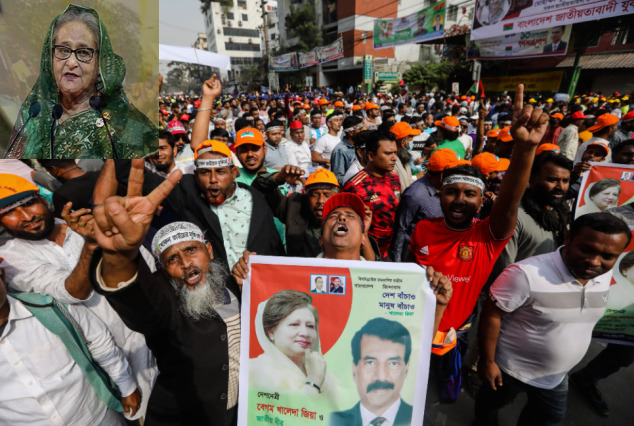
Despite official highhandedness in dealing with protests, BNP, to the surprise of the government has been able to hold massive rallies in districts and the capital city Dhaka. In the meantime, revelation of a big ticket corruption involving S Alam group, popularly believed to be Awami League’s key financier, has helped in fanning people’s anger against the government. Name almost any sector, including banking, S Alam has its finger in the pie. Such is the public resentment against the group taking multi-billion dollar loans from a number of banks, in some of which it has substantial equity ownership. Worse is the group has used the borrowed funds to fund purchase of hotels and real estate in Singapore. The irregularities in borrowings and subsequent investments offshore reek of a kind of corruption that Hasina is left with no alternative but to order an inquiry.

A question mark remains on the fairness of the inquiry since the involvement of some Awami League politicians close to the prime minister is not ruled out. But the bank loan scandal already an embarrassment for the administration will compromise the Awami League and its leader ahead of 2023-end elections in case the inquiry reveals some murkiness in loan sanctioning. Some BNP politicians claim that in the days ahead more cases of corruption involving businessman-politician nexus will come to light to provide them with the handle to berate the government of the day. Besides piling pressure on Hasina administration for its attempts to silence the Opposition using every means, including arrests and attempts to sabotage lawful protests, BSP for political optics made its seven MPs to resign their parliamentary seats. Naturally, Awami League is wondering aloud why did it take BNP four long years to realise that democracy is now at risk? As it happens in such awkward situations, the ruling party sees a foreign hand working.

Bangladesh foreign minister Dr AK Abdul Momen has complained, not to anyone’s surprise that “some powerful countries have the historical habit to suppress third world countries like ours. Have they not in the past destroyed stable countries such as Iraq and Libya in the past? Let me warn my countrymen if we are not able to resist foreign engineered unrest then all of us will suffer.”

In the meantime, in its attempt to build pressure on Hasina government, BNP has announced a 27-point programme for structural reform of the state and governance. This, among other reforms, includes reintroduction of holding elections under a neutral government, limiting a prime minister to hold office for two consecutive terms (this in order to debar Hasina to become prime minister once again), election commission to be manned by “independent and impartial persons,” and formation of an election reforms commission. The elections are to be held by December 2023 and it is too early to make any forecast about poll outcome at this stage.