Bharatiya Janata Party government in Delhi led by Chief Minister Rekha Gupta has completed 10 months in office. LokMarg in association with the Centre for Reforms, Development and Justice (CRDJ) carried out a survey on the performance of the government on the whole and those of the ministers individually. A “filled” preliminary assessment methodology has been used for this survey. It’s a fast, early-stage evaluation, not a final decision, aiming to flag critical issues, determine feasibility of initiatives, and guide next steps.
The preliminary assessment of the current Delhi cabinet shows a government that has moved quickly on agenda-setting, monitoring systems, and headline reforms but is still struggling to translate intent into consistent, measurable outcomes across core public services.
Chief Minister Rekha Gupta scores highest on direction and oversight. She has centralized key portfolios, expanded budgets, and pushed dashboards and reviews, yet persistent problems of pollution, waterlogging, and uneven service delivery continue to dilute results. Parvesh Verma’s stewardship of PWD and flood control remains mixed: there is visible planning and inspections, but recurring monsoon failures highlight deep execution gaps.
Ashish Sood’s portfolio is heavy and complex. Education modernization has momentum, but learning outcomes, policing coordination, and power reliability need clearer data and demonstrable progress. Manjinder Singh Sirsa shows policy seriousness on environment and industry, though Delhi’s air quality remains largely unchanged underscoring the difficulty of translating policy into enforcement.
On the welfare front, Ravinder Indraj Singh’s initiatives are promising, yet lack transparency and measurable coverage. Kapil Mishra’s culture and tourism push builds narrative value, but job creation and tourism-linked revenue gains are still modest and evolving. Pankaj Kumar Singh has done well in expanding primary healthcare and addressing bus safety, though staffing shortages, hospital crowding, and transport uptime remain structural challenges.
Overall, the cabinet appears strong on intent and structure, moderate on execution, and uneven on outcomes. Future evaluations should rely increasingly on published metrics like budget utilisation, AQI reductions, ridership, learning outcomes, and welfare coverage to move beyond announcements toward evidence-driven accountability. The preliminary assessment of the current Delhi cabinet shows a government that has moved quickly on agenda-setting, monitoring systems, and headline reforms but is still struggling to translate intent into consistent, measurable outcomes across core public services.
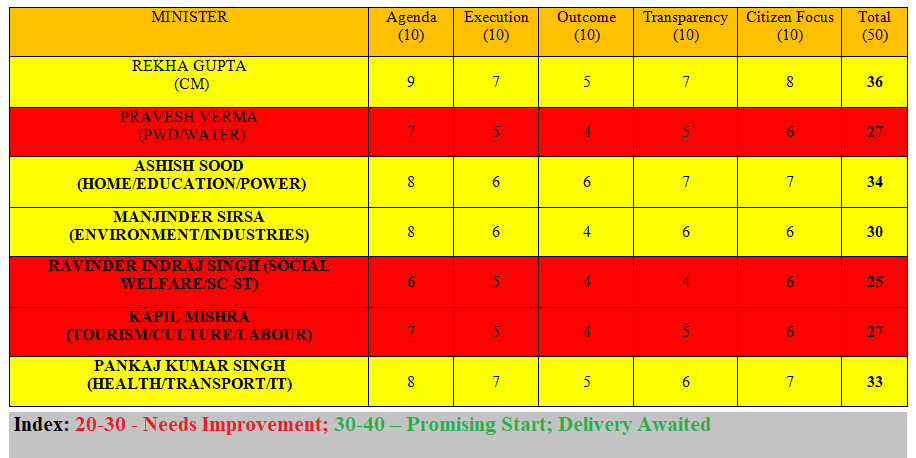
⭐ Rekha Gupta — 36/50
Strong agenda + monitoring systems. Early delivery visible (housing repairs, project dashboards).
Weak spot: pollution, urban flooding, and uneven service outcomes.
⭐ Parvesh Verma — 27/50
Active on inspections and planning.
Gap: persistent waterlogging + weak measurable progress.
⭐ Ashish Sood — 34/50
Clear education modernization push.
Gap: learning outcomes, crime perception, power metrics still unclear.
⭐ Manjinder Sirsa — 30/50
Serious policy intent on pollution and industries.
Gap: air quality practically unchanged; enforcement is key.
⭐ Ravinder Indraj Singh — 25/50
Meaningful welfare intent.
Gap: poor data visibility and slow roll-outs.
⭐ Kapil Mishra — 27/50
Tourism narrative strong.
Gap: jobs, tourism footfall, labour welfare outcomes not yet visible.
⭐ Pankaj Kumar Singh — 33/50
Visible push on primary healthcare + safety in buses.
Gap: staffing shortages, hospital crowding, transport uptime.
(Sidharth Mishra is an author, academician and president of the Centre for Reforms, Development & Justice)