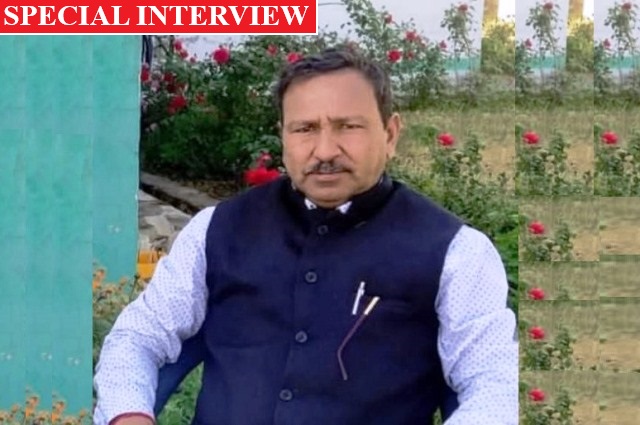
‘BJP Stands Against the Federal Spirit of Constitution; It Misuses Governors & Central Agencies to Muzzle Regional Parties & Oppn’

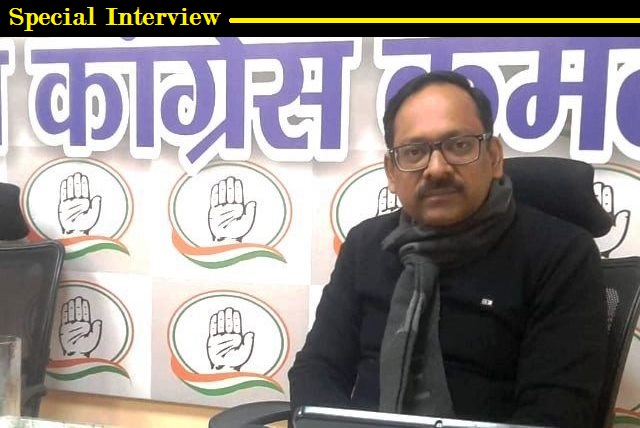
Manish Srivastava Hindvi, the Congress spokesperson, says federalism does not finds any mention in the dictionary of the Bharatiya Janata Party. The Centre under BJP has not only put a noose on the working of its own state governments, but has also placed puppet governors in the states ruled by other parties, in order to carry forward their nefarious agenda. In a candid Q&A session with Rajat Rai of Lokmarg.com, Hindvi also discusses his party’s plans to counter the saffron agenda.

Q. As the principal Opposition party in Parliament, how do you see the importance of federalism in a country as diverse as India?

Ans. Federalism is the root of a model of governance that is pro people and pro-democracy but the idea is completely missing from the work culture of the Bharatiya Janata Party (BJP). It is quite obvious that the Centre does have some interference in the working of the state governments but making a state government (be it of the BJP or any other party) literally helpless and keep looking towards the Centre for even a smallest work or decision is not acceptable in a healthy and transparent democracy. This `dangerous’ model is quite visible in the state runs by the BJP and to keep its agenda going, and in state run by other parties, it has appointed Governors who work on the directions of the Centre and keep hindering the smooth working of state governments.

Q. Do you believe federalism, where power is decentralised, is steadily getting weakened in India after Narendra Modi took over the reins in 2014? If yes, please give examples to support your view. Also, there have been allegations from several regional parties that the BJP wants a strong Centre which can influence areas and power that come under States list as per the Seventh Schedule. Do you find any merit in such allegations?

Ans. Federalism is indeed steadily getting weakened ever since the BJP came to power at the Centre in 2014 and eventually, the BJP wants to keep all kinds of power in its hand and run the states from the Centre. Leave aside the states having a BJP government, there are burning examples like Kerala, West Bengal, Jharkhand and Rajasthan and Madhya Pradesh in the past where, for example, the governors used to sit silently on bills passed by the Vidhan Sabha and the shamelessness fell to such an extent where at times, the Supreme Court has to interfere. Another fresh example of how federalism is choked to death – the MNREGA, which was started by the UPA government and the beneficiaries were those at the end of the social chain, used to work on a model that started from the poor (labours) who were, in a way, the decision makers. Now, it has literally been quashed and replaced by a model where everything – be it work days, kind of work, mode of work, etc. – will be decided by the Centre. Is it not murdering federalism in broad daylight? A strong Centre is a basic need for strong and flawless governance (at both Centre and states) but this is missing in the NDA government. It only wants to eventually concentrate all kinds of decision making power in its hand and keep the states choking for fresh breath.  

Q. Are minorities in Uttar Pradesh feeling increasingly marginalised amid a rise in Hindustan forces both at the state as well as Central levels? Please substantiate your views with examples.

Ans. Minorities are definitely not feeling safe not only in UP or any other state but across India due to the narrative that the BJP is setting since day one of its coming to power. I will not go into specific incidents but its agenda is quite evident from its team of `aggressive’ leaders who are only into giving provocative statements that eventually passes down the line to its last level of workers. Let’s begin with UP CM Yogi Adityanath who recently said in the UP Vidhan Sabha that he will deliver such a treatment to offenders that they will not be in a position to read `Fatiha’. What is this? Is this permissible in a healthy and secular democracy? Then there are other state and national level leaders like Hemanta Bisva Sarma, Ramesh Bidhuri, Anurag Thakur, etc., who it appears, have been given the job to start and end their days with such provocative and offensive statements to hurt the minorities. This has not only given free hands to their workers down the line but has also helped fringe groups like X Sena, Y Dal, Z Rakshaks, etc., to operate and disturb social harmony without the fear of the law of the land.

Q. Does the Congress have a political strategy to push back divisive communal forces? Do you think the Congress can effectively strengthen federal forces in the country?

Ans. We are the only party that stands with the oppressed irrespective of his/her social, ethical or religious beliefs and it was visible from the 4000 km of Bharat Jodo Yatra that was taken up by our leader Rahul Gandhi from Kashmir to KanyaKumari. The only message that was conveyed throughout the Yatra and that still resonates in our working at all levels is the `Mohabbat Ki Dukan’ which is strongly gaining popularity amongst the masses. We also make it a point to reach out to each and every oppressed person and the incidents of Kushinagar and Behraich are examples where we were the first to reach out and make sure that the incident does not go unnoticed and the government was forced to take action.

As far as strengthening the federal forces is concerned, I would like to start from the scratch when, in 1947, we were handed over only a piece of land and it was with great effort and pain that we devised a federal structure – from the Centre to the state to the Panchayat level – to run the country peacefully and effortlessly. Though some loopholes are left in any type of governance, it is the moral duty of every government (BJP, Congress or any other) to fix it rather than pin pointing it and making an issue out of it.

Q. What are the limitations and challenges before a regional party while countering a powerful political network like the BJP?

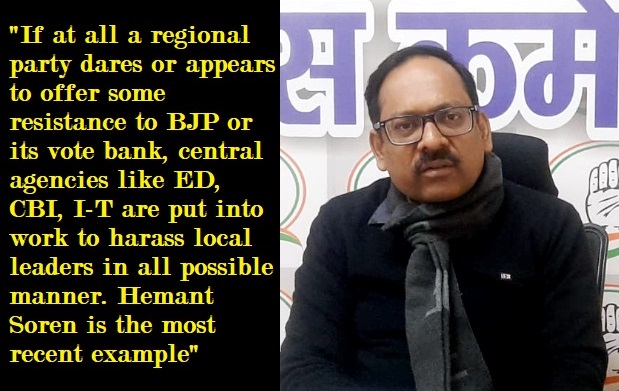
Ans. This is true that a regional party has less or limited resources and power as compared to a national level party especially when it is in power in the Centre. If at all a regional party dares or appears to offer some resistance to BJP or its vote bank, central agencies like ED, CBI, I-T are put into work to harass local leaders in all possible manner. The fresh example was of Jharkhand CM Hemant Soren who was `tortured’ in all possible manners to break down and eventually shun politics. However, hats off to his wife Kalpana Soren who stood strong and helped his husband ward off all kinds of pressures. The sentiments of the people of Jharkhand were also with Soren which also helped as a cushion and enabled him to come out more strongly. Similar was the case with the BJD in Odisha where not only its CM Naveen Patnaik bid adieu to politics but the party is also in shambles.

Q. The BJP is seen as cannibalizing its own regional allies, gradually weakening them and then pushing them to margins. This was seen in Maharashtra recently. Why do you think BJP feels threatened by regional political groups, including its own allies?

Ans. There are many live examples of this phenomenon – that eat up your allies and finish your opponents – Shiv Sena and Akali Dal are now in the history books and JDU is slowly and steadily following the same fate. If you observe TV debates in connection with Bihar politics, you clearly see one thing – while two of BJP leaders are advocating the leadership of Nitish Kumar, another set of leaders is justifying a change of guard in Bihar. This is a burning example of the state of mind of BJP – to ally and eventually finish its allies. This is done only for the sake of the regional vote bank of such parties as BJP’s strong vote bank comprises mainly of the middle class and upper class voters and to penetrate the OBC, SC, ST, etc., vote bank, they need regional allies who are lured inside NDA and eventually sacrificed for the sake of the vote bank they enjoy.

Q. There are voices of change of guard in the UPA by some of its partners as Rahul Gandhi is also the LoP. What are your views on this?

Ans. One thing is for sure that only a national party can run a government at the Centre and it is also a fact that it is also not quite possible without the assistance of regional parties. Regional parties do have an urge to move to central politics and they have limitations of being limited to only a state or a region. There are voices in some regional partners but there is nothing going as such inside the UPA for a change of guard. Additionally, the BJP keeps running narratives of differences between allies of the UPA regarding the leader of UPA but we, as a team, remain intact with the sole motive of returning to the Centre in 2029.

Q. There are also allegations on some regional parties like AIMIM and the BSP of participating in Vidhan Sabha elections to help BJP. Your views?

Ans. In a democracy, everyone has the right to contest elections and it will not be fair to term any party as a B team of BJP or any other party. In a democracy, if any entity contests elections, it may be beneficial to some and on the other hand, someone else may incur some kind of loss. However, the fight at present is even bigger – to fight against dictatorship and to fight for survival – as the BJP is making all efforts to finish all its opponents by hook or by crook.

Q. Does Congress has any plans to go solo in any of the upcoming Vidhan Sabha elections as concerns are being raised in the inner circle of the party. Your views?

Ans. At present, our `Sangathan Srijan Abhiyan’ is going on at all the 403 Lok Sabha seats at grass root level and the UPA is united for a single cause – forming a government at the centre in 2029. As far as going solo in any election is concerned, there is no such discussion at present and a decision, if any, will be taken by our central command.

Statism In Time Of Pandemic

Politics, it seems, is one part of national life that does not go into lockdown. Beneath the appearance of the whole country united in dealing with the Covid-19 pandemic, the undercurrents of State-Centre relations continue.

These are testing times for Prime Minister Narendra Modi who hopes to come out of this with national as well as international compliments on his handling of the crises.

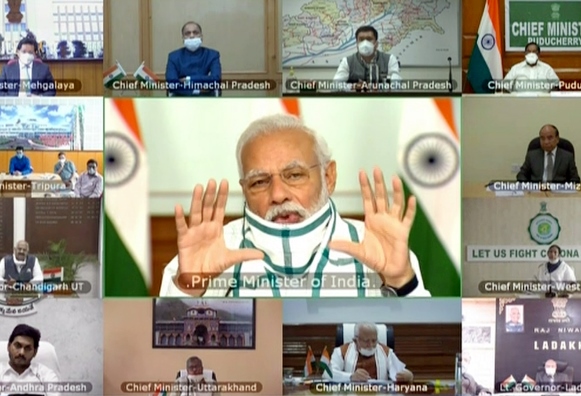
But it is the chief ministers who are actually doing all the heavy lifting in tackling the Covid-19 pandemic in their respective states. And they are not all getting the equal recognitions or complete support they deserve.

Faced with a serious public health emergency and a looming economic crisis, the chief ministers have a lot at stake and are, therefore, putting their best foot forward in managing the deadly coronavirus outbreak. They know they will be judged by their handling of the crises.

Kerala chief minister Pinarayi Vijayan and Rajasthan’s Ashok Gehlot have come in for praise for their quick and deft management of the pandemic. Kerala was a step ahead of other states as a proactive chief minister lost no time in announcing a slew of social welfare measures and initiated steps for setting up quarantine centres and testing facilities. Kerala has an advantage over other states as successive governments have invested heavily in health infrastructure. Gehlot also displayed similar alacrity in ordering an immediate shutdown, door-to-door surveys, testing and monitoring in Bhilwara when it was hit by a rush of infections. The Bhilwara model has since been replicated in other states.

ALSO READ: What Rest Of India May Learn From Kerala

Among the other chief ministers – Bihar’s Nitish Kumar and West Bengal’s Mamata Banerjee – face a big challenge as Assembly elections are due in both the states. Bihar goes to polls later this year while elections in West Bengal are due next year.

Of the two, Nitish Kumar has to be on top of his game because the Bihar Assembly elections are to be held this November which gives him a small window of opportunity to contain the pandemic. The chief minister’s handling of the corona crisis will predictably be a major issue in these polls and have a huge bearing on Nitish Kumar’s electoral prospects. Though his government is making all-out efforts to procure testing kits and protective equipment for the medical staff, the chief minister has a tough task on hand as Bihar does not boast of a strong health infrastructure.

Then there is the troubling issue of migrant workers from Bihar who have been working in other states but now wish to return home as they have no jobs or money. Nitish Kumar was initially reluctant to facilitate their return as there was a fear that the infection could spread to the rural areas with the influx of such a large population. He first transferred a sum of Rs. 1,000 each to the one lakh-plus stranded migrant workers but later agreed to ferry them back after the Centre made necessary arrangements for their journey home by train. Nitish Kumar was forced to give in because migrant workers are an important vote bank as most of them invariably come home to cast their vote.

As BJP’s alliance partner, Nitish Kumar has been fortunate to get special treatment from the Centre which is more than willing to bail him out. The saffron party also has a big stake in the coming assembly election in Bihar. Nitish Kumar is further lucky as the opposition in Bihar is leaderless and hopelessly divided.

WATCH: Covid-19, Lockdown And Farmers

Mamata Banerjee, on the other hand, has a match on her hand as she has to contend with a strong and powerful rival in the BJP.  There is simmering tension between the Modi government and Mamata Banerjee with the Centre accusing her of withholding accurate figures of the corona cases and for not providing adequate quarantine centres and further lagging behind in testing. She has also received a lot of flak for indulging in minority appeasement by not enforcing the lockdown too strictly in the minority-dominated areas during Ramzan. To make matters worse, West Bengal governor Jagdeep Dhankar has shot off a series of letters to Banerjee charging that she had committed “monumental blunders” in handling the pandemic.   

Desperate and working hard to expand its footprint in West Bengal, the Centre has been particularly critical of the Trinamool Congress chief as the BJP believes this is an opportunity to show Mamata Banerjee in poor light.

Although West Bengal had ordered a lockdown before the Centre’s announcement and took necessary measures to manage Covid-19 cases, the Modi government chose to send an inter-ministerial team to the state for an on-the-ground assessment of the situation. This led to a war of words between the BJP and the Trinamool Congress with Mamata Banerjee accusing New Delhi of playing politics by singling out West Bengal for this treatment. Banerjee further alleged that the Centre had deprived West Bengal of its share of taxes and ignored her requests for additional funds required by the state to manage the pandemic.

While the Centre has not missed this opportunity to discredit Mamata Banerjee, it has been more generous towards BJP chief ministers. Madhya Pradesh’s Shivraj Singh Chouhan, Gujarat’s Vijay Rupani and Uttar Pradesh’s Yogi Adityanath are struggling to contain the rising number of infections in their state but not too many questions are being asked of them by New Delhi. 

ALSO READ: The Invisible Indians In Pandemic

Chouhan has a convenient explanation that he did not have sufficient time to make the necessary arrangements to deal with a crisis of this magnitude since he had taken over as chief minister when the pandemic had already gained a foothold in the state. However, Chouhan has no explanation for the fact that he had failed to appoint a health minister for nearly a month after he was appointed CM.

Unlike Chouhan, Vijay Rupani ought to have done far better as he inherited the famed Gujarat model of development, put in place by Narendra Modi when he was chief minister. This was expected to serve him well in the current situation. As it happens, the rate of infections in Gujarat is high and is continuing to climb.

Rupani’s lacklustre performance in managing the pandemic is matched by his poor handling of the large number of the restless migrant workers who were housed in makeshift camps in Surat and Vadodara. There have been several instances of violent clashes between the police and the migrants who wanted to go back home, giving the distinct impression that no one was in charge. 

Similarly, Yogi Adityanath’s efforts in dealing with the pandemic have also been found wanting. He is not helped by the fact that Uttar Pradesh’s health care infrastructure is shoddy to say the least. But, in his trademark style, Yogi Adityanath has conveniently added a communal tinge to Covid-19 pandemic and blamed the minorities for spreading the virus after a number of infections were traced to the Tablighi Jamaat assembly in Delhi. This has been exploited as a timely distraction from his government’s incompetence. 

Though Modi is being heaped with praise for his decisive leadership in this hour of crisis, the fact is that it is the chief ministers who have led from the front in this battle. There have been some signs of tension between the Centre and the states over the lack of funds and centralisation of powers by New Delhi but, for a change, the Modi government has chosen to listen to the chief ministers. It agreed to lift the ban on the sale of alcohol, as demanded by the chief ministers, as it had deprived the state governments of a  huge source of revenue which, it was pointed out, could have been used to ramp up their health infrastructure.

It is now to be seen if the Centre will put aside politics, be a uniting force, go a step further and release the pending share of taxes to the states and provide them with the monetary assistance they have demanded to help them deal with the corona crisis, whether they are pro or anti BJP.

State-Centre politics has not gone into lockdown, but it will be wise for Modi’s BJP to suspend it at least until the nation gets through the crises.