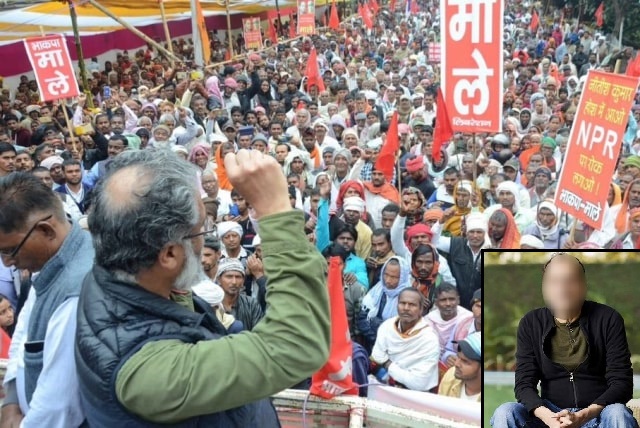
Communist Party of India Marxist Leninist Rally

Why Inner-Party Democracy Is Good For Communist Parties!

Last week, CPI-ML (Liberation) leader Kavita Krishnan resigned from all party posts, kicking up a debate on democracy in communist parties. LokMarg spoke to a sympathiser and close supporter of the CPI-ML (L) on the issue. This senior writer, who does not want to be named, says the communist parties should realize that those who raise the question of democracy in socialism should be embraced and not vilified. His views:

No, I never discussed Stalin with them or with anyone else for that matter because I have no means to prove or disprove anything about what he did or did not do. This is for two reasons. Basically, when I work with anyone I don’t normally get into discussions about their family history. If one goes up anyone’s family tree, one might or might not find evidence of ‘criminality’ at some point. That should not come in the way of constructively working together with that person in the present.

Secondly, I believe Stalin is simply too controversial for anyone to have an unbiased opinion on him. In my opinion, everyone is free to have whatever view of him they want, but I will retain my freedom to work with people with all kinds of viewpoints on this issue. This is simply because work in the present is more important than endlessly fighting over history.

I am a supporter and sympathizer of the CPI-ML (Liberation). With all their limitations, they are the most sensible and honest communist party in India today, with some very fine leaders and wonderful cadre. We have disagreements, but our agreements are far greater. Besides all this, I have too many friends in the party – so it is not a matter of ideology alone, they are like family to me. I am critical of them only because I am concerned about their decline and want them to grow for the sake of India’s future.

The debate over democracy and even its definition is an old one within the global communist movement. The fact that it continues in our times only means that there has been no satisfactory resolution of this question. However, it is an extremely important discussion that should not be brushed aside or suppressed in any way.

The reason why a lot of comrades raise the issue of both inner-party democracy and the need for a democratic polity under socialism is simply because they feel it is wrong to give complete monopoly of power to any political formation, including to the one they are themselves working with. This is a very ethical position. It is unfortunate that many communists think that this is ‘anti-party’ – because, in truth, it is a position with the best interests of protecting the rights of the people.

ALSO READ: Can Socialism Find its Feet?

Socialist systems claim to be more democratic than capitalist ones because they focus on delivering the basic necessities of the population – such as food, shelter, education and health. They do not recognise freedom of protest, organisation and speech as fundamental rights and see them as a ‘luxury’.

This is actually like the mindset of a poultry or pig farmer who claims to be feeding his caged livestock regularly before sending them to the slaughterhouse. Communist parties should stop doing mathematics with human populations because they are flesh and blood creatures, and thinking, feeling creatures, and not abstract numbers.

They should also realize that democratic processes and institutions are not a luxury but essential in ensuring both justice and resilience within the communist systems. Marxism – as Marx himself thought of it — is unique because on the one hand it is about being passionately against injustice, and on the other it is highly intellectual and sensitive, and insists on action based on serious study, research, presentation of evidence and debate.

Deciding the fate of the party or of the population cannot be a whimsical exercise of a few leaders – democratic participation and flow of information are critical. The various institutions of so called ‘bourgeois democracy’ that protect freedom of association, speech or fair treatment, while imperfect and also inadequate in many ways, are still superior to the archaic justice mechanisms we see in ‘communist countries’.

Those comrades who still have a heart, and have not become cold, calculating machine-like bureaucrats, will keep raising the question of democracy within and outside the party-fold. They are an asset to the communist movement and should be embraced and not vilified and expelled.

The communist parties should realize that the people – including the working classes everywhere — are rejecting them all around the world because of their contempt for democracy. They are on the wrong side of history on this issue and it is up to them to change, or, become completely irrelevant.

As told to Amit Sengupta

SC Stays Demolition Of Curlies Restaurant In Goa Linked To Phogat’s Death

The Supreme Court has stayed the demolition of Curlies restaurant in Goa soon after its demolition began on Friday on the subject to the condition that no commercial activities will take place there.

This is the same restaurant in Goa where actor and BJP leader Sonali Phogat was allegedly drugged and was later declared dead.

The demolition action against the restaurant began after its owner failed to get any respite from the National Green Tribunal (NGT). On Thursday, NGT upheld the Goa Coastal Zone Management Authority’s previous order to demolish the shack.

Owner Edwin Nunes of the ‘Curlies’ restaurant, located on Goa’s famous Anjuna beach, was among five persons arrested in the Phogat death case and on Thursday was later granted conditional bail against a personal bail bond of Rs 30,000 and two sureties of Rs 15,000 each.

The actor was pronounced dead on August 23 at the St Anthony Hospital in Anjuna, North Goa.

A heavy police force has been deployed outside the Curlies restaurant.

“We are providing police protection for the demolition. As per the order, it is being demolished,” said DYSP Jivba Dalvi.

Meanwhile, Goa Coastal Zone Management Authority (GCZMA) has ordered the closure of all commercial activity in the form of nightclubs, bars and restaurants being run by Edwin Nunes and Linet Nunes, both Curlies Restaurant and Night Club and guest house, St Michael Wado, Dando, Anjuna, Bardez-Goa.

Earlier on Sunday, the Goa Police also visited various locations in the alleged murder case of BJP politician Sonali Phogat in Haryana’s Hisar district.

“Teams went to various places, as per allegations levelled by the late actor’s brother Rinku including property and other issues. Our team is going to all those places, speaking with local witnesses and trying to get information which may help us reach a conclusion,” informed Goa Director General of Police Jaspal Singh.

Sonali Phogat was declared dead at the St Anthony Hospital at Anjuna in North Goa on August 23. A post-mortem report revealed blunt force injury on her body, following which the Goa Police registered a murder case.

On Friday, Goa Police visited Phogat’s Sant Nagar residence in Haryana’s Hisar district and seized three diaries. Sonali’s bedroom, wardrobe, and password-protected locker were inspected by the police search team. The police also sealed the locker at Sonali Phogat’s residence. Phogat’s PA and his associate were arrested after police accessed the CCTV footage in which the trio were seen partying at a club.

Expressing dissatisfaction over the probe by the Goa Police into the death case of Sonali Phogat, her family will approach the Goa High Court demanding a Central Bureau of Investigation probe into the matter.

Sonali Phogat’s family had met Haryana Chief Minister Manohar Lal Khattar in connection with the case and had demanded a CBI probe. The Chief Minister had assured of the CBI investigation. However, being dissatisfied with the ongoing investigation, the family has decided to go to Goa High Court with their demand.

Speaking to ANI, Vikas Singh, Sonali Phogat’s nephew, who is also an advocate in his family said that they have written to Chief Justice of India UU Lalit for a CBI inquiry, and will approach the Goa High Court with a writ petition by Friday if they are not satisfied with the answer of the top court.

Earlier, Goa Police had said that Sonali Phogat was forcibly drugged by her two associates who were arrested after being named as accused in the case.

Haryana Police detained a man after the family accused him of taking a laptop and mobile from the farmhouse of the deceased BJP leader. Haryana Police has recovered the items following which the questioning is underway.

Sonali Phogat who rose to fame with her TikTok videos, contested the 2019 Haryana election as a BJP candidate but lost to then Congress leader Kuldeep Bishnoi (he has since joined the BJP). She also appeared in the reality show Bigg Boss in 2020. (ANI)

India To Benefit From G7 Price Cap On Russian Oil: US Officials

The Group of Seven (G7) nations will soon convene and carve a price cap on Russian oil purchases, according to top US officials who said that India is going to benefit from the move even if it does not join the price cap mechanism directly.

US Treasury Department’s assistant secretary for terrorist financing and financial crimes, Elizabeth Rosenberg said, “India will have access to lower price of affordable energy (Russian Oil). It can leverage the price cap to negotiate a lower price with Russia. It is consistent with a price cap.”
“We will not allow Russia to profit and get a war premium for invading Ukraine,” the US official added.

US officials informed reporters that while determining the price cap the G7 will factor in the cost of production and will give an economic incentive to Russia so that its oil keeps flowing into the markets.

This assurance comes as several countries are facing high inflation due to spiralling fuel prices.

The price cap policy applies to Russian oil, any service provider from G7 involved in transporting, banking, insurance or any other service will have to attest that Russian oil is purchased below the price cap and has to be compliant.

US assistant secretary for economic policy and a counsellor to the secretary of the treasury, Ben Harris told reporters that “It is not a global cap, it is G7 cap, we are using G7 reach and influence, in this everyone wins except Russia.”

According to an estimate, G7 wealthy nations, which are made up of Britain, Canada, France, Germany, Italy, Japan and the United States, control nearly 90 per cent of insurers and vessels that transport oil and Russia is heavily dependent on it.

Officials also said that Russia is already doing long-term contracts with several buyers giving huge discounts, which means that the price cap mechanism will be working.

India is maintaining silence on the price cap initiative led by the United States even though it is one of the largest importers of oil and it depends on imported oil for its need which is more than 80 per cent.

Furthermore, India has maintained that restrictions on oil imports cannot work and it is importing Russian oil considering the low cost and easing of the burden on its economy.

Crude oil prices soared to near record high earlier this year due to the Russia-Ukraine conflict. Western countries led by the United States imposed several sanctions on Russia to limit its revenues from its energy exports.

However, Prime Minister Narendra Modi’s government decided to ramp up oil imports from Russia giving primacy to national interests.

On Thursday, Union Finance Minister Nirmala Sitharaman said the share of Russian oil in India’s overall oil import basket increased from 2 per cent to 13 per cent in a couple of months after the beginning of the Russia-Ukraine conflict.

Addressing an event organised by the Indian Council for Research on International Economic Relations (ICRIER), Sitharaman said credit must be given to PM Modi’s statesmanship to take the decision of boosting imports of Russian oil at discounts that helped in reducing the import bills.

Sitharaman said the increase in oil imports at discounted prices from Russia is a part of the “inflation management”.

Amid the unreasonably high oil and gas prices, External Affairs Minister S Jaishankar too has echoed a similar sentiment and said Russian oil imports are the “best deal” for the country. (ANI)

World's Third Richest Man

The Adani Ascendency Phenomenon

Jawaharlal Nehru consciously avoided being seen close to any of the large business houses of his times. In their ingeniousness, those houses successfully found their way through the labyrinth of the much feared and despised Indian bureaucracy and political establishment. The bureaucracy’s vice-like grip over economic administration remained unchanged for a good number of decades since Independence. At the same time, a few brave hearts, determined to make it big despite the infamous licence Raj and the concomitant bureaucratic cobwebs, managed to get into the inner court of the country’s third Prime Minister Indira Gandhi (1966 till October 31 1984, except for 1977-1980).

In Mrs Gandhi’s personal secretary and confidante extraordinaire RK Dhawan, wielding enormous power, three business men in particular – one from Bombay (Mumbai renaming hadn’t happened then) and two from Calcutta (since renamed Kolkata), found a friend who wouldn’t stop doing anything for them.

What was not ordinarily possible till Dr Manmohan Singh, under the prime ministership of Narasimha Rao rolled out a series of economic reforms, necessitated by a grave economic crisis, Dhawan would ensure that nothing would come in the way of securing for his three loyal friends what they wanted. Many would expectedly take exception to the favours thus extended selectively. At the same time, if the three were not enabled to overcome the hold that the then industry leading groups had on private sector economic activities, the country would not be experiencing some extraordinary entrepreneurship marvels of present times.

The worst thing that the industry leaders did in the licence Raj was to deny the possibility of aspiring businessmen to enter some industries by pre-empting licences all of which they would never implement. Business men cosying up to politicians and bureaucrats is not, however, unique to India. It happens everywhere with powerful lobbies working in developed countries on behalf of businesses. Civic society will frown on the practice and media will take note from time to time when limits are crossed and distribution of favours become disturbingly so.

Corporate governance in India was an unknown phenomenon almost till the end of last century. And till the non-resident Indian industrialist Swraj Paul (earned peerage in the UK since) made infructuous attempts to buy into two Delhi based groups – Escorts and the diversified DCM – in the early 1980s, people in general were not aware that in majority of cases families with equity holding of less than 10 per cent stayed in full control of companies. Abuses naturally followed with impunity. Today provoked or on occasions without provocation, the seemingly uninterested politician Rahul Gandhi will invoke two groups Reliance and Adani for amassing great wealth helped by their proximity to Prime Minister Narendra Modi. It will not be anybody’s case that proximity to the powers that be doesn’t help in running businesses. Great risk taking capacity, foresight, execution of very large projects without time and cost escalation, ability to get into sunrise sectors ahead of others and capacity to hire the best talents and empower them count a lot more than connection with people in power.

It will not be out of place to recall here that once when Pranab Mukherjee was told by a party colleague in a somewhat disapproving tone that the Ambanis always got favoured treatment from him, his retort was “get me any number like them, I can assure you I shall extend them the same kind of courtesy.” Once again the message that came out from that unofficial conversation is that knowing people in right places is no guarantee for success in business.

Let’s take the case of the Birla family, which once had free access to Mahatma Gandhi then all through with the ruling political establishment and also the principal opposition parties. In spite of that proximity, it is only one branch of the family headed by Kumar Mangalam Birla that counts today. Businesses of a number of leading groups of the past have either shrank in size beyond recognition or just withered away, thereby underlining the point political patronage is no guarantee of success. Consider several information technology companies, including TCS, Infosys, Wipro and HCL Technologies acquiring global status without any government help or the over a century old Tata Group with presence in automobile to steel to retail reinventing itself to greater glories.

ALSO READ: Family Business And Succession Plan

The country will never be short of people who will always see the presence of an invisible hand (in the present case distribution of patronage by the government) in the meteoric rise of Adani Group. Such vigilance, if it is informed is good for the economy and general public who responding to sustained campaign by official agencies make investment in the equity market either directly or through mutual funds. Investors find reassurance when promoters themselves have substantial holdings in companies. As said earlier, Indian promoters per se managed to exercise total control over companies by pegging their ownership of equity capital as little as possible till the late 1980s. In that kind of environment, promoters enjoyed running companies putting all risk on banks, financial institutions and general investors. But shaken by Swraj Paul episode and in order stave off takeover attempts, all Indian business men started raising holdings in their promoted companies.

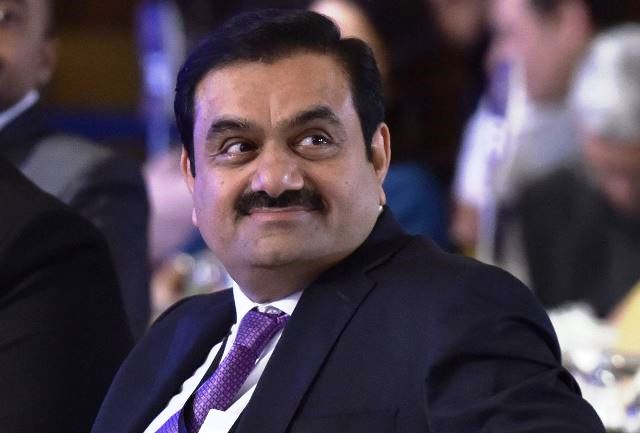
What about Gautam Adani, who starting with trading in commodities in the late 1980s made big strides in infrastructure (roads, airports, seaports), energy (both coal fired and renewable) and electricity transmission, gas distribution, mining, FMCG and real estate? Bombay Stock Exchange says promoter holdings in Adani group companies are like this: the flagship Adani Enterprises 72.28 per cent; Adani Ports & SEZ 66.02 per cent, Adani Power 74.97 per cent, Adani Transmission 73.87 per cent; Adani Green Energy 60.5 per cent, Adani Total Gas 74.8 per cent and in the recently listed Adani Wilmar 89.74 per cent.

Remarkably all Adani group company shares are doing very well with their prices continuing to appreciate a lot more than progress of BSE and NSE indexes. A report published the other day by CreditSights, a Fitch arm saying Adani group is “deeply overleveraged” as it is predominantly using debts to invest aggressively across its existing as well as new businesses. Giving a warning, the report says: “In the worst case scenario, overly ambitious debt-funded growth plans could eventually spiral into a massive debt trap, and possibly culminate into a distressed situation or default of one or more group companies.” No doubt many horizontally fast expanding groups here and elsewhere have run into debt traps from where they could never come out. At the same time, there are quite a few examples in India, more importantly the Tata Group and Reliance Industries, both not very long ago carrying the burden of debt mountains, have been able to achieve comfortable debt equity ratio through sustained improvements in cash flow and EBITDA (earnings before interest, tax, depreciation and amortisation.) After having recorded profitable growth of its mobile telephony and data delivery and retail businesses and also announced massive plans for development of green energy and hydrogen, the outlook for Reliance improved so much that Mukesh Ambani could sell small parcels of equity at substantial premium to global giants such as GIC of Singapore, TPG of the US and Aramco of Saudi Arabia. The funds thus mobilised are used both to pare debts and further grow business.

The Economic Times, which saw Adani reply to CreditSights on its describing the group as “deeply overleveraged”, says in a report: “The group’s net debt was ₹1.6 lakh crore by the end of the June quarter this fiscal year, compared with ₹50,200 crore of run-rate EBITDA. Leverage as measured by gross debt to EBITDA ratio was at 3.92x, reflecting a drop in the debt level, Adani group said. The group’s gross debt was ₹1.8 lakh crore.” Whatever Adani may say, funding this scorching rate of growth through greenfield ventures and acquisition of the kind Swiss giant Holcim’s cement business in India for $10.5 billion – in one giant stroke Adani becomes the country’s second largest cement maker after Birla’s Ultratech – will remain a subject of concern.

The other day Gautam Adani made a startling announcement that his group will be building the country’s largest single location alumina refinery of annual capacity of 4 million tonnes in Odisha. (Alumina is an intermediate chemical derived from bauxite mineral used in smelters to make aluminium) The selection of Odisha is natural, for the eastern state owns over half the country’s bauxite deposits of 3.9 billion tonnes. No doubt before he commissions the refinery, he will use bauxite mines in the upstream and build a large smelter in the downstream. There is a point here. Odisha is a non-BJP state and is long under the rule of Biju Janata Dal (BJD). Chief Minister Naveen Patnaik is educated, cultured and suave.

So if anyone’s thesis is that ascendency of Gautam Adani to the extent of becoming Asia’s richest and the world’s third wealthiest is because of his proximity to Modi, then she/he is short on understanding the economics of how business is run. Adani exercising the option provided in the loan agreement that at any point that loan can be converted into equity at face value of share making the way for his acquisition of marquee television channel NDTV no doubt raises the prospect of the channel undergoing change in character of content. But the acquisition cannot be challenged. The watchdog SEBI has not found anything wrong in Adani move.

Rajpath Gets A Makeover

Modi Inaugurates Kartavya Path, Unveils Netaji Statue At India Gate

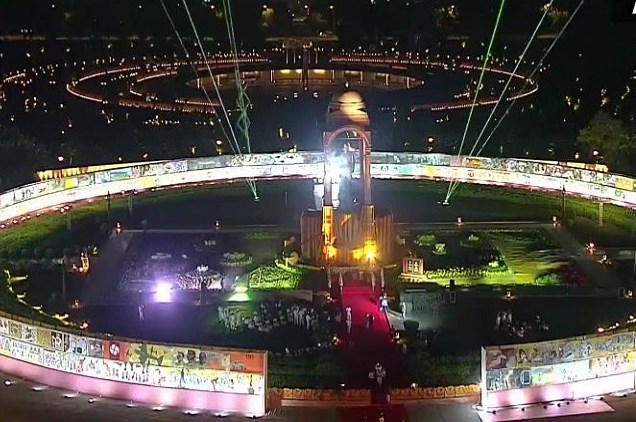
Inaugurating the ‘Kartavya Path’ at India Gate in the national capital, Prime Minister Narendra Modi on Thursday said a new era has begun in the form of Kartavya Path that will consign the symbol of colonialism ‘Kingsway’ to history.

Speaking at the inauguration of the ‘Kartavya Path’, PM Modi said, “A new era has begun in the form of Kartvya Path. Symbol of colonialism ‘Kingsway’ will be history and has been erased forever. I congratulate all the people of the country as we come out from another symbol of colonialism.”

He said in the Amrit Mahotsav of Independence, the country has got new inspiration and new energy. “Today we are filling the picture of tomorrow, leaving behind the past, adding new colours to the picture of tomorrow. Today this new aura is visible everywhere, it is the aura of confidence of New India,” he said.

Prime Minister said the Rajpath was for the British Raj, to whom the people of India were slaves. He said Rajpath was also a symbol of slavery and its structure was also a symbol of slavery. “Today its architecture has also changed and its spirit has also changed,” PM stated.

PM Modi said a huge statue of Netaji Subhas Chandra Bose has also been installed near India Gate. At the time of slavery, he said there was a statue of the representative of the British Raj.

He said, “Kartavya Path is not just a road of bricks and stones. It is a living example of India’s democratic past and all-time ideals. When the people of the country come here, the statue of Netaji, the National War Memorial, all these will give them such a great inspiration, they will inculcate their sense of duty.”

“Today the country has also established the life of a modern, strong India by installing the statue of Netaji at the same place,” he said.

Prime Minister said the country has changed hundreds of laws that have been going on since the British era. The time and date of the Indian budget, which was following the time of the British Parliament for so many decades, has also been changed. Through the National Education Policy, he said now the youth of the country are being liberated from the compulsion of foreign language.

As a part of the Central Vista redevelopment project, PM Modi inaugurated the ‘Kartavya Path’ at India Gate on Thursday.

Before the inauguration, PM Modi interacted with the workers who were involved in the redevelopment project and told them that he will invite all of them who worked on the Central Vista redevelopment project for the January 26 Republic Day parade.

He also witnessed an exhibition on revamped Central Vista Avenue. Prime Minister Modi also unveiled a grand statue of Netaji Subhas Chandra Bose near India Gate today. The jet black granite statue, with a height of 28 feet will be placed under the Canopy near India Gate. According to Prime Minister’s Office (PMO), the move symbolises a shift from the erstwhile Rajpath being an icon of power to the ‘Kartavya Path’ being an example of public ownership and empowerment.

“These steps are in line with Prime Minister’s second Panch Pran for New India in Amrit Kaal: remove any trace of the colonial mindset,” said a PMO statement.

Over the years, Rajpath and adjoining areas of Central Vista Avenue had been witnessing pressure of increasing traffic of visitors, putting stress on its infrastructure. The PMO said that it lacked basic amenities like public toilets, drinking water, street furniture and adequate parking space. Further, there was inadequate signage, poor maintenance of water features and haphazard parking.

“Also, a need was felt to organise the Republic Day parade and other National events in a less disruptive manner with minimal restrictions on public movement. The redevelopment has been done bearing these concerns in mind while also ensuring the integrity and continuity of architectural character,” it said.

Kartavya Path will exhibit beautified landscapes, lawns with walkways, added green spaces, refurbished canals, new amenity blocks, improved signages and vending kiosks. Further, new pedestrian underpasses, improved parking spaces, new exhibition panels and upgraded night lighting are some other features that will enhance the public experience.

It also includes a number of sustainability features like solid waste management, stormwater management, recycling of used water, rainwater harvesting, water conservation and energy-efficient lighting systems, among others. (ANI)

British Monarch

Queen Elizabeth II, Longest Serving Monarch of UK, Dies At 96

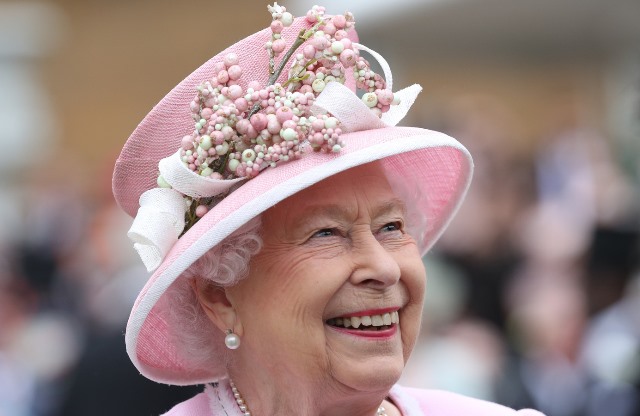
Queen Elizabeth II, the longest-serving monarch of the UK, died on Thursday, aged 96.

“The Queen died peacefully at Balmoral this afternoon. The King and The Queen Consort will remain at Balmoral this evening and will return to London tomorrow,” the Royal Family said in a statement.

Earlier today, the palace said that the Queen was under medical supervision at Balmoral after the doctors expressed their concern over her health.

“Following further evaluation this morning, the Queen’s doctors are concerned for Her Majesty’s health and have recommended she remain under medical supervision,” the official statement from Palace said.

The Queen was born on 21 April 1926 at 17 Bruton Street in Mayfair, London. She was the first child of The Duke and Duchess of York – who later became King George VI – and Queen Elizabeth.

Buckingham Palace earlier reported that doctors were concerned about the health of Elizabeth II, and recommended that she remain under medical supervision .

If reports are to be believed the British government have a plan Codenamed Operation LONDON BRIDGE, in the event of her death. (ANI)

Hijab Ban In Karnataka

Don’t Compare Hijab With Sikh Turban Or Kirpan: SC Bench

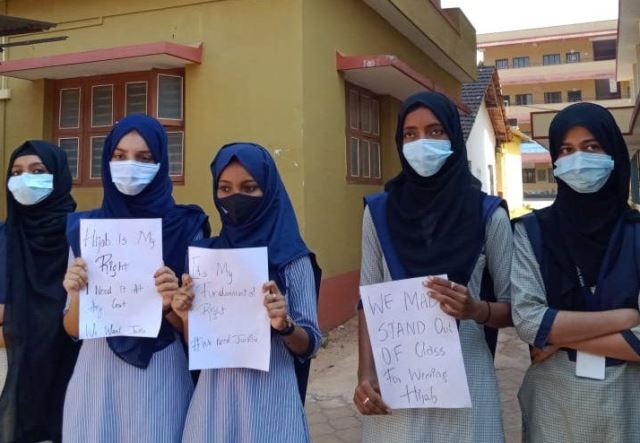
The Supreme Court on Thursday said that there is no comparison between Kirpan and turban of Sikhs with the hijab as a five-judge bench of the apex court held that wearing turban and kirpan is allowed for Sikhs.

The remarks came when a bench of Justices Hemant Gupta and Sudhanshu Dhulia heard various petitions challenging the Karnataka High Court judgement upholding the ban on hijab in educational institutes.

Advocate Nizamuddin Pasha, appearing for one of the petitioners, who is a student of Islam and Arabic, tried to draw similarities between the Kirpan and turban with the hijab.

Pasha said that the hijab is a part of the religious practice of Muslim girls and also asked if girls can be stopped from coming to school wearing hijab. He further argued that even Sikh students wear turbans.

Pasha stressed that cultural practices should be protected.

Justice Gupta said that comparison with Sikhs may not be proper as carrying of the kirpan is recognized by the Constitution. “So don’t compare practices,” the court remarked.

Justice Gupta said there are statutory requirements on turbans and these are all practices well established in the culture of the country.

Pasha tries to cite examples of foreign countries like France.

Justice Gupta said that we do not want to be according to France or Austria. “We are Indians and want to be in India,” the court said.

Pasha while countering the Karnataka HC judgement said that the hijab protects Muslim women.

Pasha said that the findings of Karnataka HC that the Hijab is a cultural practice are based on the assumption. He cited various religious books to support his arguments.

He also argued that it was a misreading of the footnote that the HC held that the Hijab is a “recommendation” and not “essential”.

Senior advocate Devadatt Kamat said that every religious practice is not essential but it is not that the state goes on restricting it.

During the hearing, Kamat, appearing for another petitioner apprised the court that divergent views were taken by Karnataka, Kerala and Madras High Court judgments on whether the hijab is an essential religious practice. Madras and Kerala courts have held Hijab as an essential religious practice but Karnataka HC differed, Kamat said.

“Karnataka Government Order on the prescription of uniform in educational institutes suffers from non-application of mind,” he further added. (ANI)

Democratic Azad Party

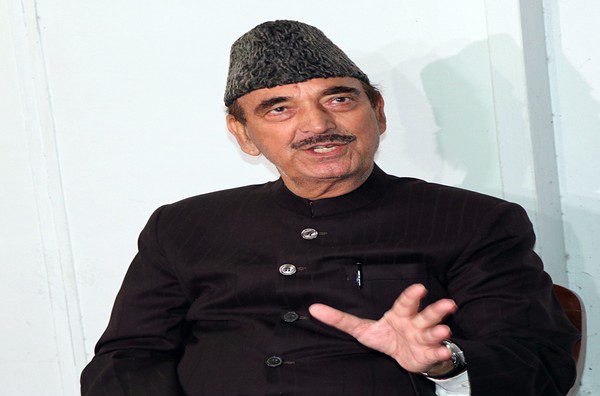
Cong Fired Missiles At Me, I Only Used 303: Ghulam Nabi

Former Union Minister Ghulam Nabi Azad, who ended his five-decade-long association with the Congress said he only retaliated with a 303 rifle when leaders from his former party fired missiles at him.

Addressing a public rally in Jammu and Kashmir’s Bhaderwah on Thursday, Azad said, “They (Congress) fired missiles on me, I only retaliated with a 303 rifle and they were destroyed. What would have happened had I used a ballistic missile? they must disappear.”

Meanwhile, he avoided commenting on the late Indira Gandhi and Rajeev Gandhi.

“Since I have been a member of the party for 52 years and consider Rajeev Gandhi to be my brother and Indira Gandhi to be my mother, I have no desire to even use words against them.”

Earlier in his first public meeting in Jammu after quitting Congress, Azad announced to launch of his own political outfit that would focus on the restoration of full statehood.

“I’ve not decided upon a name for my party yet. The people of J-K will decide the name and the flag for the party. I’ll give a Hindustani name to my party that everyone can understand,” he said.

Azad has been Chief Minister of Jammu and Kashmir from 2005 to 2008.

On August 26, Azad in a letter to Congress President Sonia Gandhi resigned from all positions of the Congress party including the primary membership of the party.

In his resignation letter to Sonia Gandhi, Azad had targeted party leadership, particularly Rahul Gandhi, over the way the party has been run in the past nearly nine years.

In the hard-hitting five-page letter, Azad had claimed that a coterie runs the party while Sonia Gandhi was just “a nominal head” and all the major decisions were taken by “Rahul Gandhi or rather worse his security guards and PAs”.

Azad had said he was submitting his resignation with “great regret and an extremely leaden heart” and severing his 50-year association with the Congress. He was earlier Leader of Opposition in Rajya Sabha. (ANI)

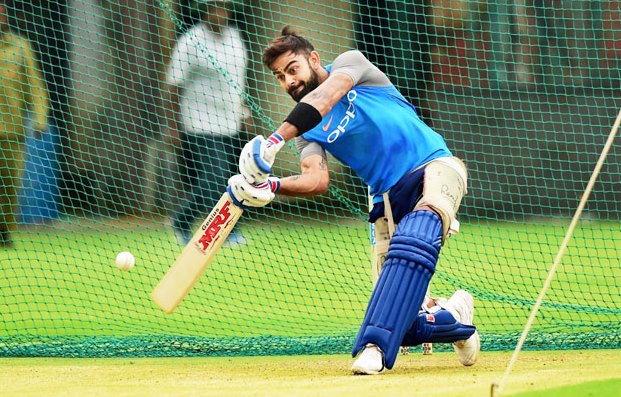
Asia Cup: Kohli Hits Highest Score By An Indian In T20I

Virat Kohli on Thursday scored the highest individual score by an Indian player in T20 international cricket.

The star Indian batter accomplished this landmark during the Super Four clash against Afghanistan at the ongoing Asia Cup 2022.

Virat finally completed his much-anticipated 71st century. He smashed an unbeaten 122 in just 61 balls with 12 balls and six sixes.

He has overtaken the score of 118 posted by Rohit Sharma against Sri Lanka in 2017. It is followed by 117 by Suryakumar Yadav against England in 2022, Rohit Sharma’s 111 not out against West Indies in 2018 and an unbeaten 110 by KL Rahul against West Indies in 2016.

Coming to the match, Star Indian batter Virat Kohli completed his much-anticipated 71st international century and powered India to a massive 212/2 in their 20 overs during their last Super Four clash against Afghanistan at the ongoing Asia Cup 2022 on Thursday.

Put to bat first by Afghanistan, openers KL Rahul and Virat Kohli got Team India off to a great start. The running between the wickets by the duo was good as usual. Openers really started to open their arms in the third over, with Virat smashing pacers Fazalhaq Farooqi for two fours.

From that point on, KL and Virat feasted on Afghan bowlers. Virat Kohli looked in really good touch and hit spinner Mujeeb ur Rahman for two fours and a six in the sixth over. At the end of six overs and the powerplay, India stood at 52/0, with Virat (25) and Rahul (26) unbeaten.

Virat and KL continued their domination over Afghanistan, even after the powerplay. The duo kept the scoreboard running at a good speed. At the end of 10 overs, India stood at 87/0, with Rahul (42) and Virat (44).

Virat brought up his 33rd half-century in the format with a single. KL Rahul helped the team cross 100-run mark with a four in 11.2 overs and scored another four on the next ball to bring up his fifty.

Medium-pacer Fareed Malik ended the 119-run stand between the duo in the 13th over, dismissing Rahul for 62 off 41 balls after the batter was caught by Najibullah Zadran at long-on.

Suryakumar Yadav was next and he started his innings with a six on the very first ball, but Fareed got his wicket on the very next ball.

Rishabh Pant was up on the crease. He continued to tick the scoreboard with Virat and took India into the final five without further damage. At the end of 15 overs, India was at 134/2, with Pant (6) and Virat (59).

Pant and Virat continued their assault on Afghanistan bowlers. Virat was the aggressor and mercilessly hit boundaries.

With two overs to go, Pant-Virat brought up their 50-run stand. Virat also entered into the 90s. Finally, he completed his much-anticipated 71st international century and his first in T20Is.

India finished its innings at 212/2, with Virat Kohli (122) and Rishabh Pant (20). Fareed Malik took 2/57 for Afghanistan. Virat finally completed his much-anticipated 71st century. He smashed an unbeaten 122 in just 61 balls with 12 balls and six sixes. (ANI)

Transgender who Sued Air India

Trans Woman Sues Air India; SC Tells Govt To Draft Job Policy

The Supreme Court on Thursday asked the Centre to formulate a policy within three months so that reasonable accommodation can be provided to transgender persons in all establishments covered by the provisions of the Transgender Persons (Protection of Rights) Act, 2019.

A bench of Justices DY Chandrachud and Hima Kohli in an interim order asked the government to consult all stakeholders on creating an enabling framework that would help the third sex with employment opportunities.

The top court said that every establishment was required to adhere to the provisions of the Act.

The order of the apex court came on a plea filed by transgender woman, Shanavi Ponnuswamy, who alleged that she was refused a cabin crew position by Air India owing to her gender identity.

However, the counsel appearing of the airline contended that Ponnuswamy was rejected not because she is a transgender woman, but because she was unable to score the minimum qualifying marks in the Scheduled Caste category.

Chennai-based engineering graduate Shanavi Ponnusamy had approached the apex court in 2017.

Ponnusamy, who was born male at birth and underwent gender reassignment surgery in 2014 had responded to an advertisement in 2017 and applied for a job as a cabin crew with Air India. Since the carrier did not have the option for the third sex, she applied as a female. Ponnusamy said she didn’t get the job because she was transgender.

Ponnusamy, who alleged she was not hired by Air India because she is a transgender and the vacancies in the cabin crew were earmarked only for men or women, moved the top court to scrap the airline’s hiring criteria which included a group discussion and a personality screening test for those willing to apply for cabin crew jobs.

The petition had also cited the Supreme Court verdict of 2014 that gave certain directions for protection of the rights of transgenders by including a third category in documents. (ANI)